Nigeria AfCFTA Export Competitiveness Report 2026
Nigeria has built more of the AfCFTA’s machinery than most African countries, but under 8% of its US$6.1bn formal non-oil exports reached African buyers in 2025. The report tests the debate against the data and sets out where Nigerian exporters can win.
Executive summary
<8%: Share of Nigeria's US$6.1 billion formal non-oil exports that reached African markets in 2025 [1, 8]
This report examines how Nigerian exporters can become competitive across Africa and how the African Continental Free Trade Area (AfCFTA) can help diversify the economy beyond oil. It tests common ambitions in the policy debate against the data and sets out where Nigerian exporters can realistically win in Africa.
1.1 The export base is narrow, and Africa is a marginal buyer
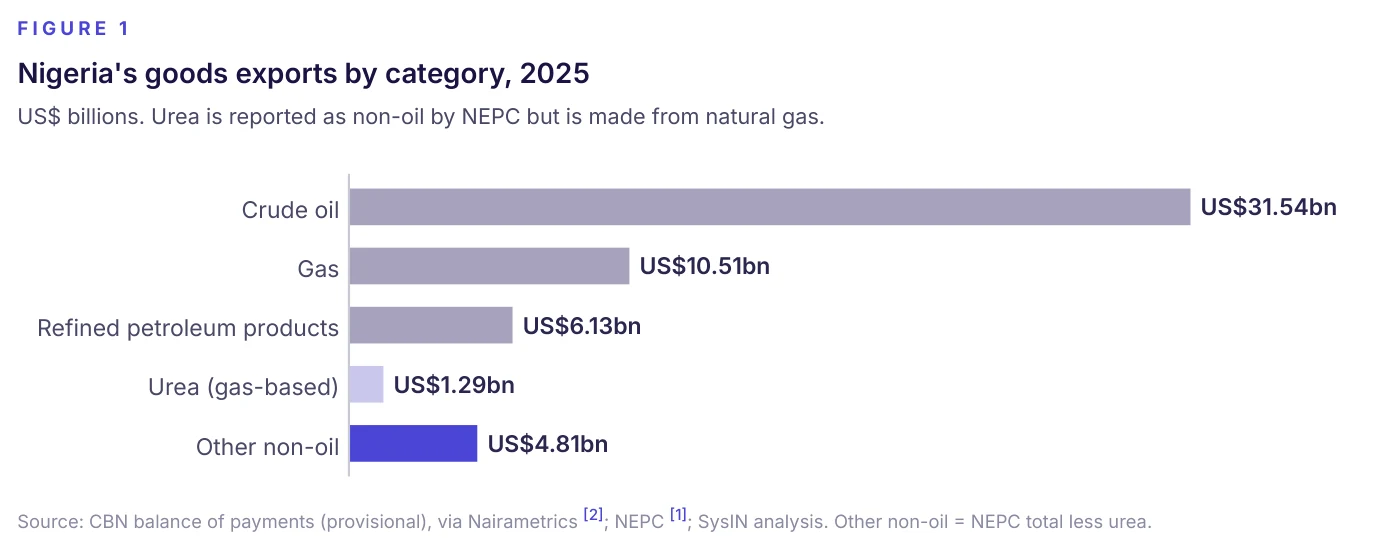
Oil still dominates. Crude, gas and refined products earned US$48.17 billion in 2025 against US$6.1 billion of formal non-oil exports [1, 2]. Urea, the second-largest "non-oil" export, is made from gas; without it, genuinely non-hydrocarbon exports were about US$4.8 billion.
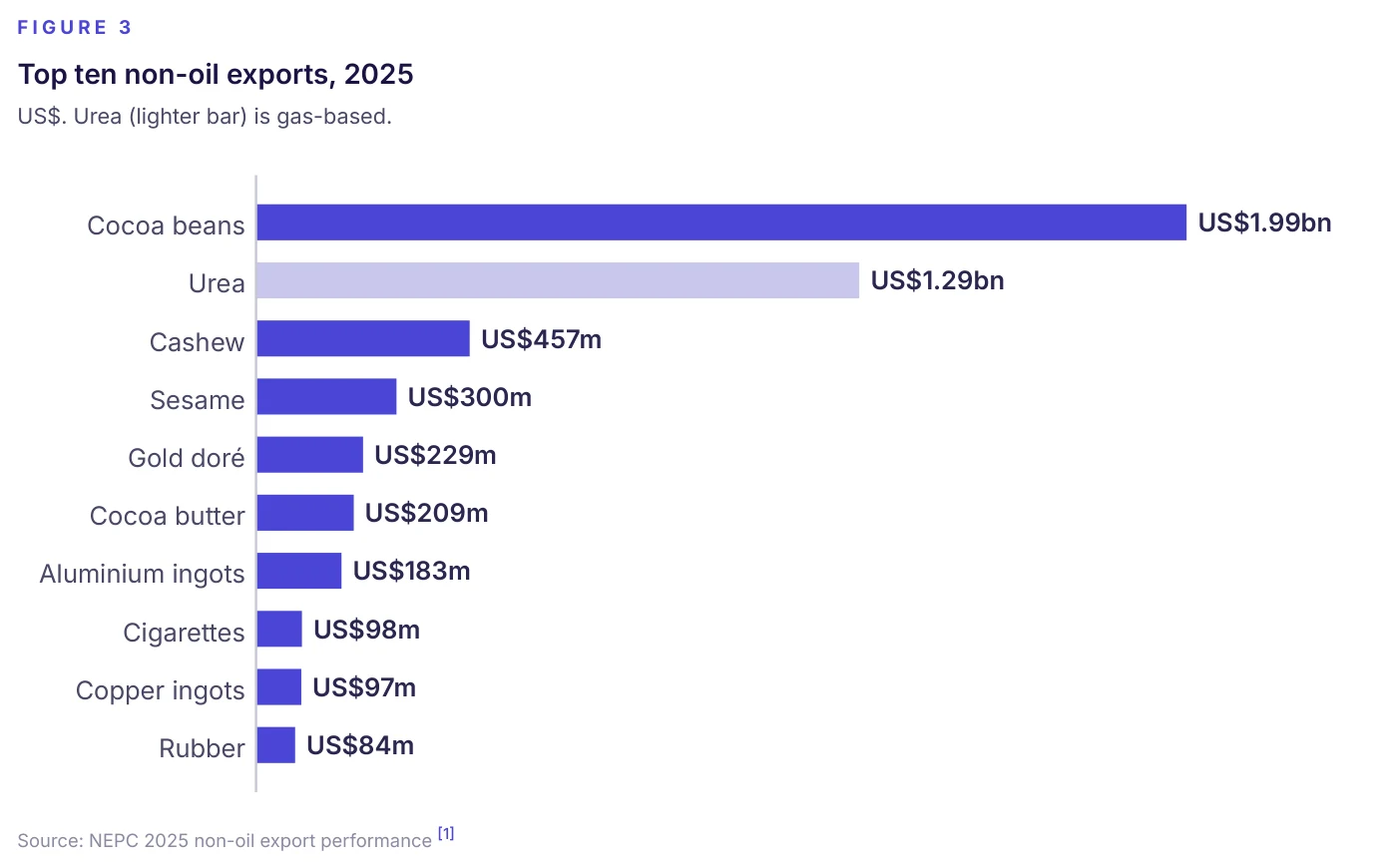
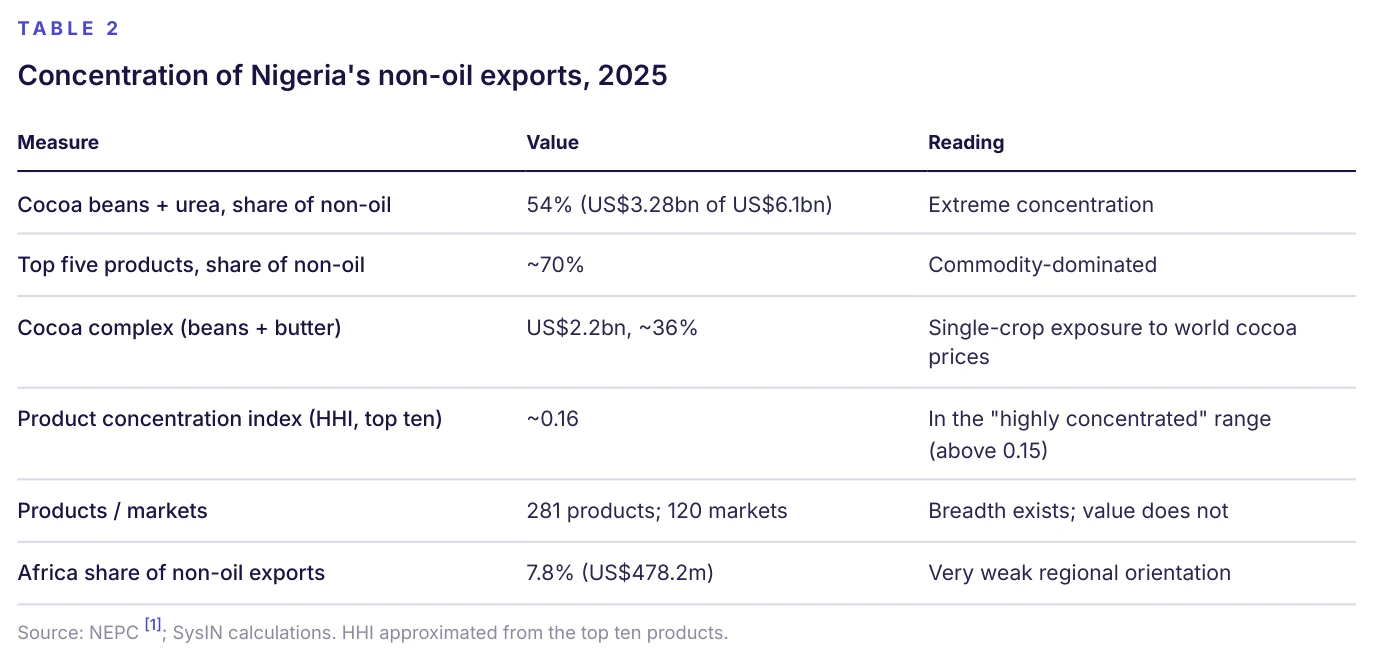
Two products carry the basket. Cocoa beans (US$1.99 billion) and urea (US$1.29 billion) made up 54% of non-oil earnings. The top buyers were the Netherlands, Brazil and India; no African country made the top ten [1].
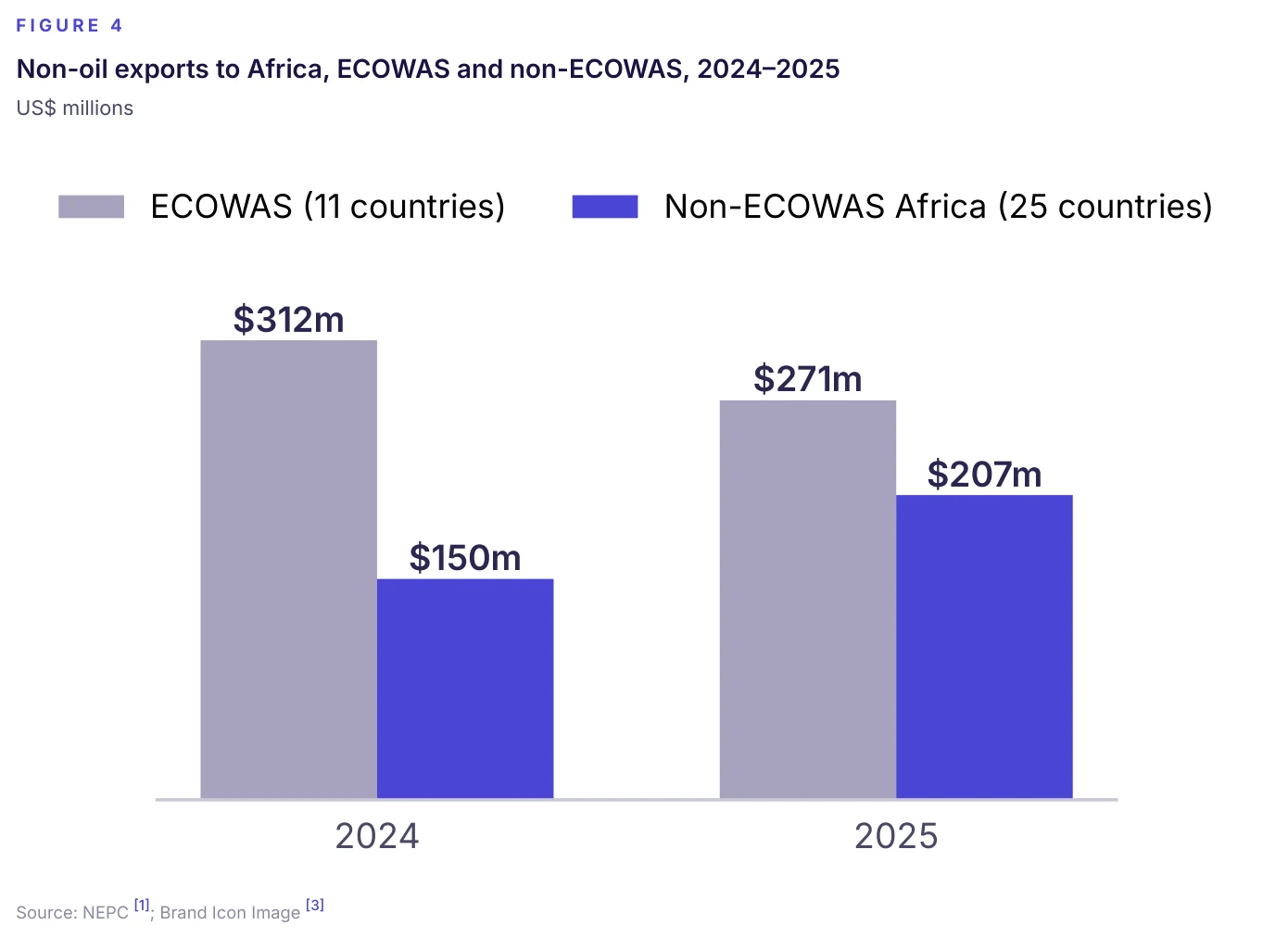
Africa takes very little. Only US$478 million of non-oil goods went to 36 African countries. Sales to ECOWAS fell 13% after Burkina Faso, Mali and Niger left the bloc, while sales to 25 non-ECOWAS markets rose about 38% [1, 3].
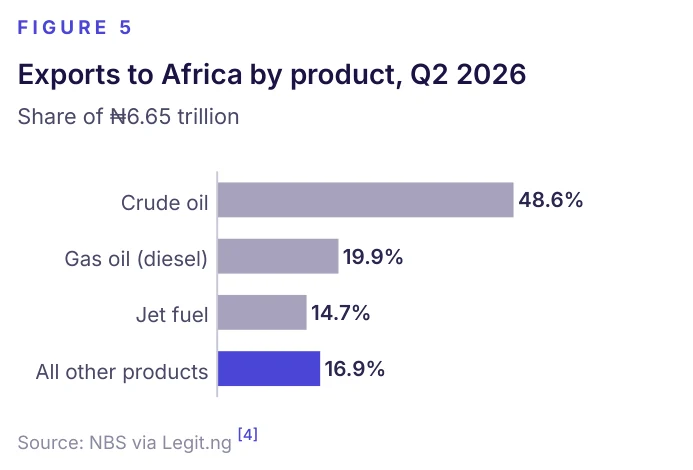
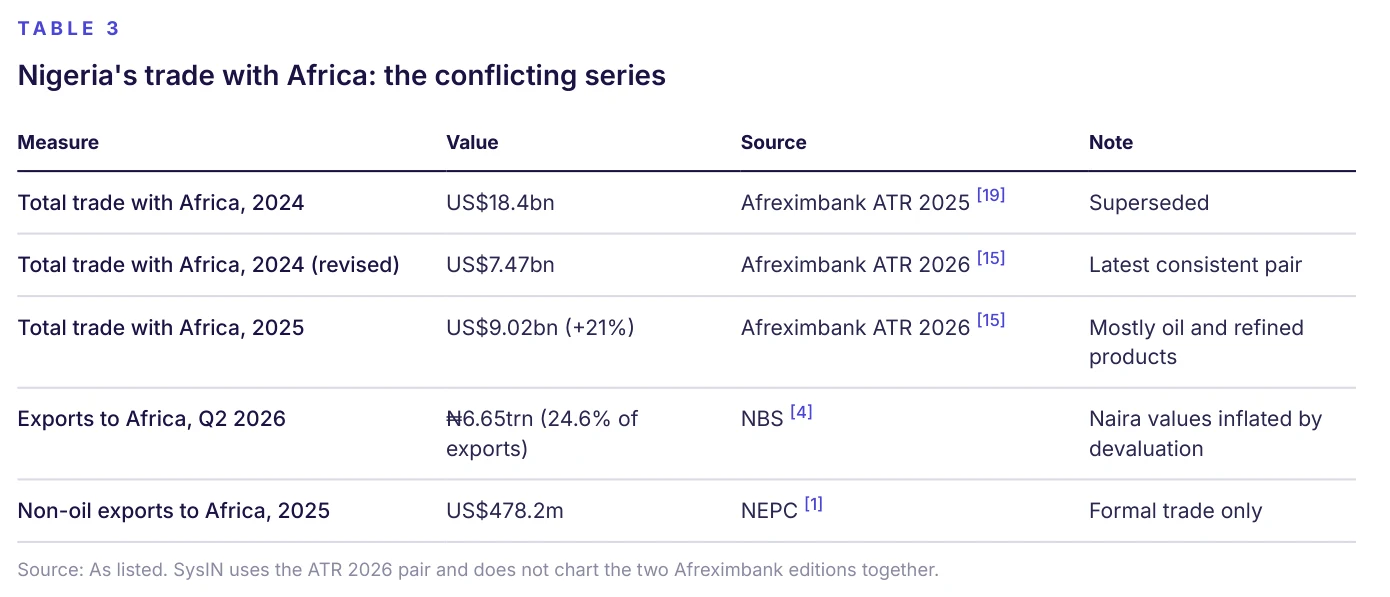
Headline Africa trade is a petroleum story. Exports to Africa reached ₦6.65 trillion in Q2 2026, but crude oil, gas oil and jet fuel made up 83% of the total [4].
1.2 The problem is competitiveness, not market access
Low complexity. Nigeria ranks 141st–142nd of 145 economies on the Harvard Economic Complexity Index and has slipped over the past decade [9, 10]. Few products sit close to what Nigeria already makes, so diversification has to be built step by step.
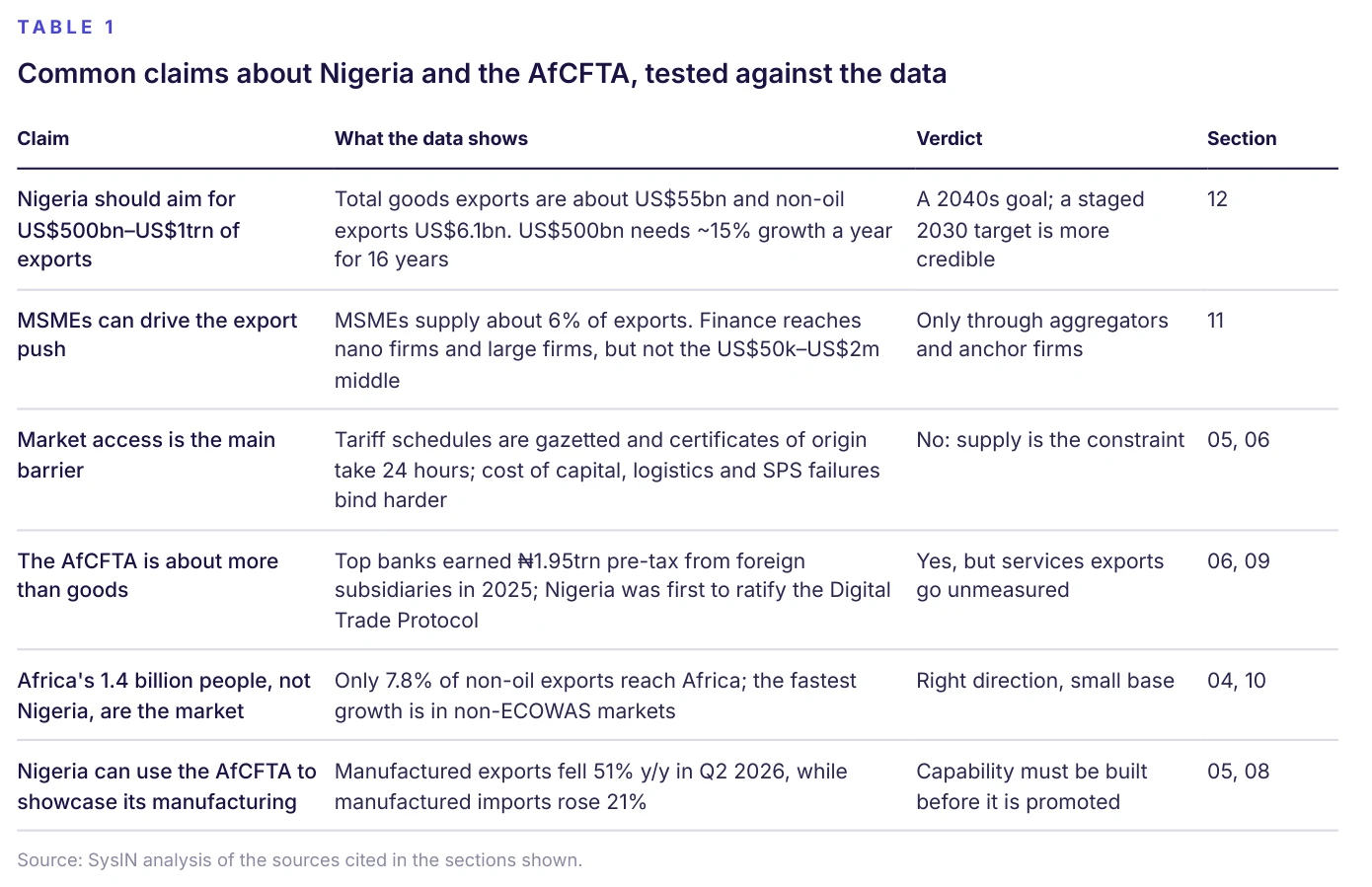
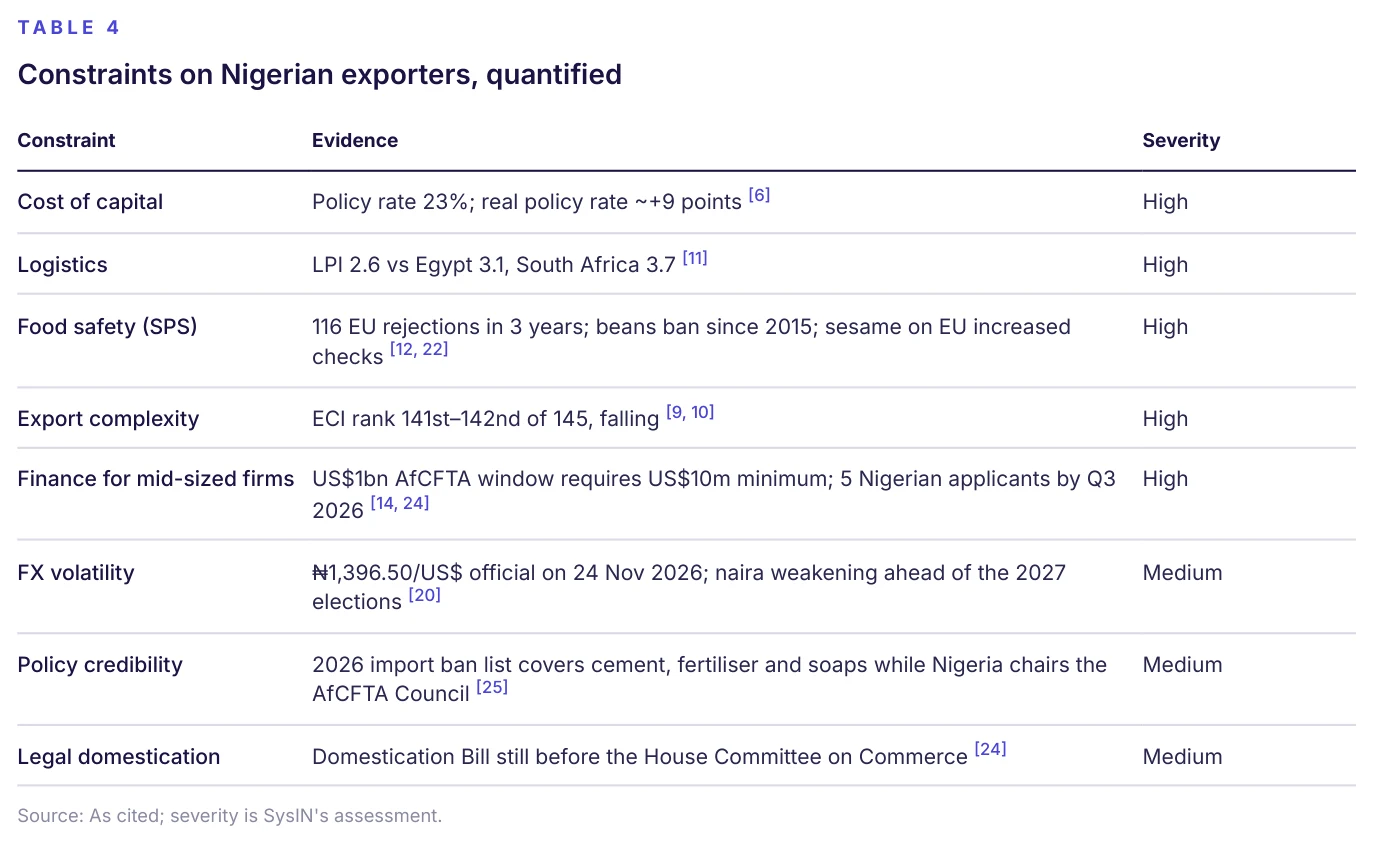
Capital is too expensive. The policy rate is 23% against inflation of 14.06% [6]. AfCFTA tariff margins of 5– 35 points, phased in over years, are smaller than the financing-cost gap Nigerian exporters face against Egyptian, Moroccan or Asian rivals.
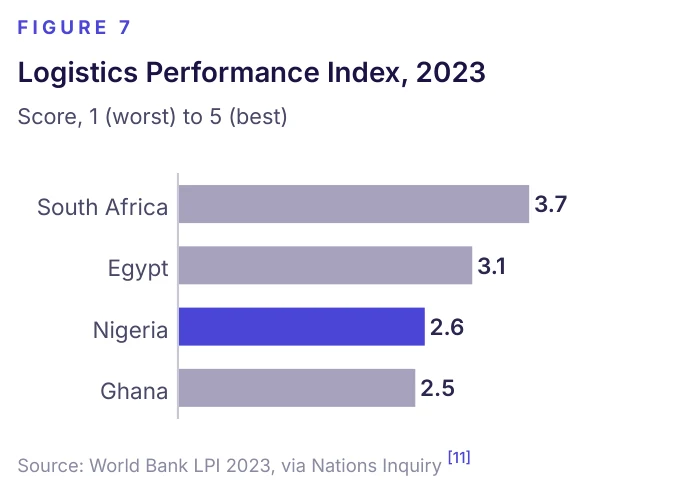
Quality and logistics fail at the border. Nigeria scores 2.6 on the World Bank's Logistics Performance Index, against 3.1 for Egypt and 3.7 for South Africa [11], and recorded 116 EU border rejections in three years [12].
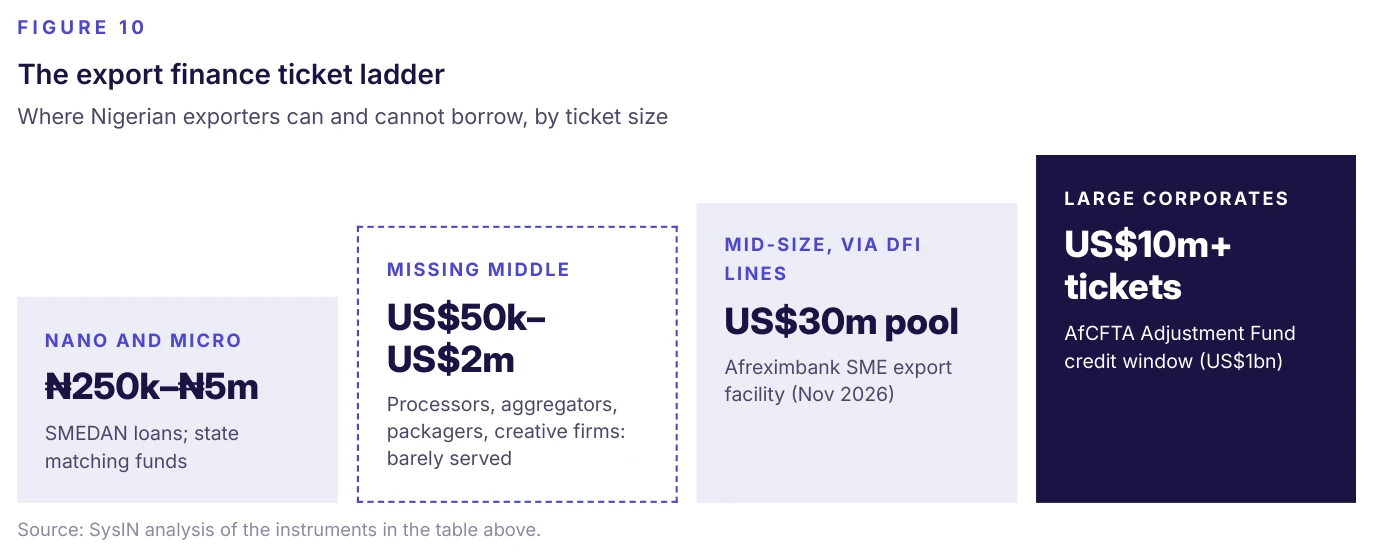
Finance misses the middle. Nano firms can borrow ₦250,000–₦5 million and large firms can reach the US$1 billion AfCFTA credit window (minimum US$10 million), but firms needing US$50,000–US$2 million are barely served [13, 14].
1.3 Where the opportunity lies
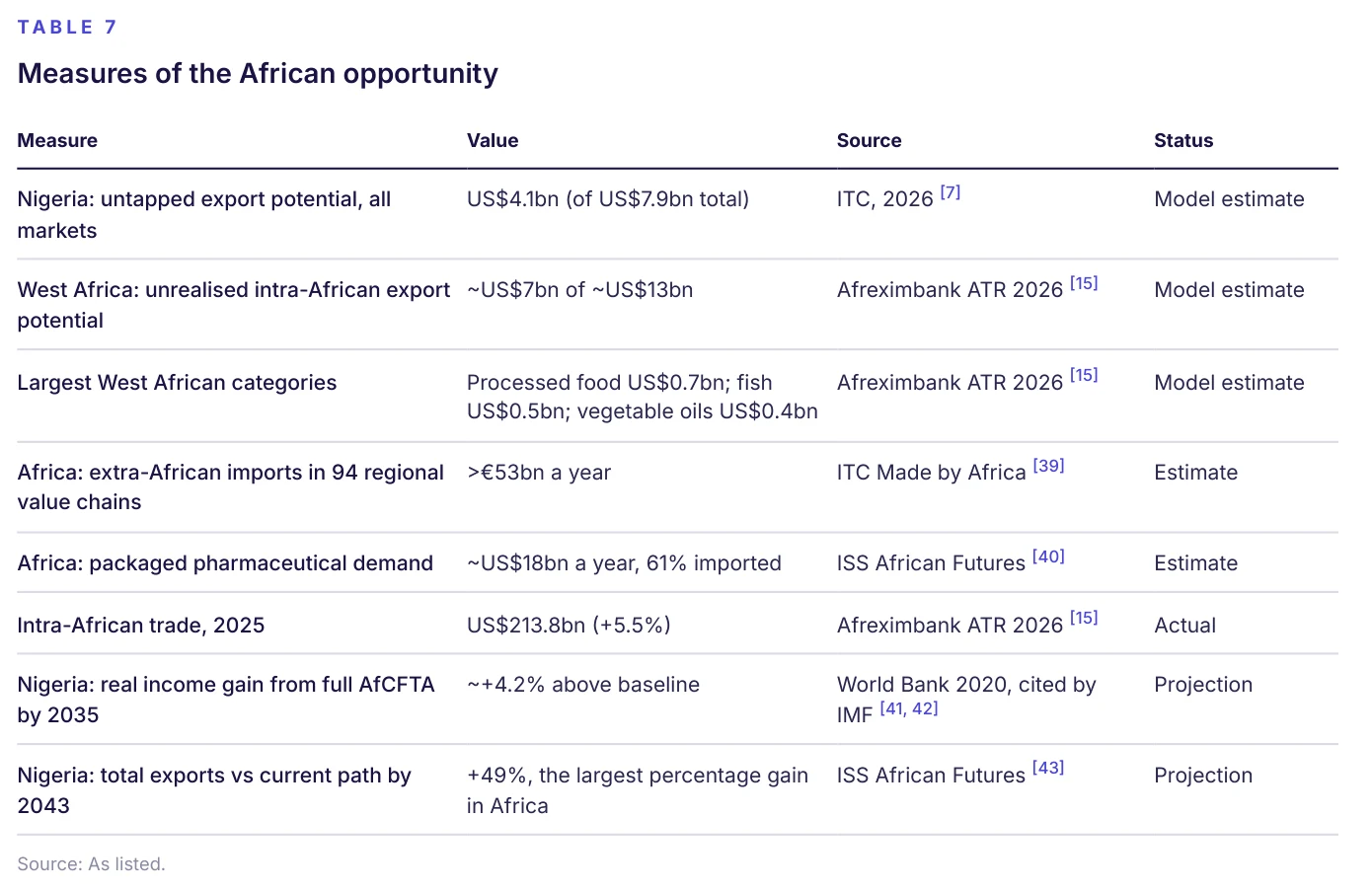
ITC estimates US$4.1 billion of untapped export potential for Nigeria across all markets [7], and Afreximbank puts West Africa's unrealised intra-African export potential at about US$7 billion [15]. The strongest near-term plays are processed agro-commodities (cocoa derivatives, cashew kernels, hulled sesame, packaged foods), fertiliser, cement and clinker, generic medicines and packaging into West Africa, and services: banking, payments, creative content and digital services, where Nigeria already has a pan-African footprint.
1.4 What SysIN recommends
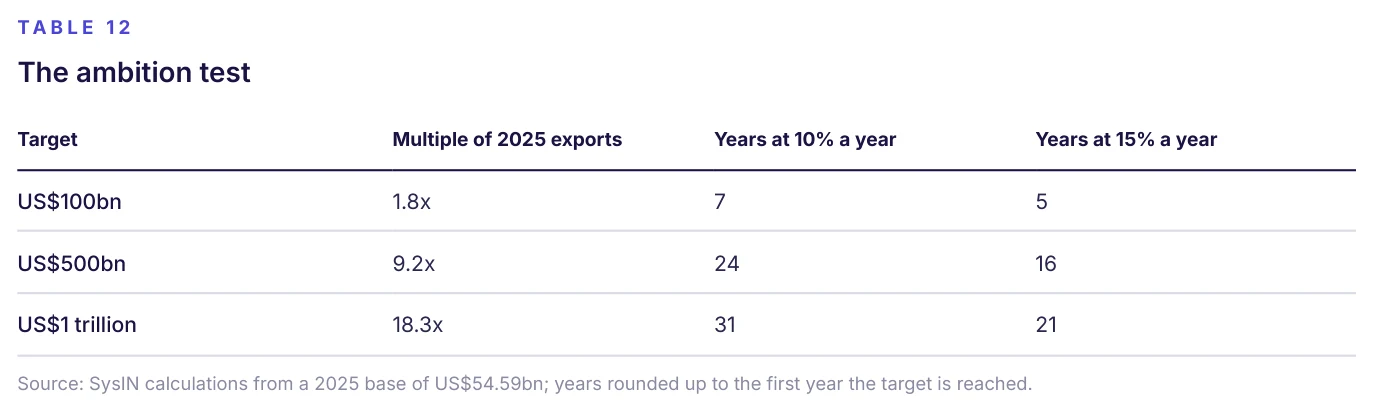
Calls for US$500 billion to US$1 trillion of exports describe a 2040s goal: even at Vietnam's 15% annual growth it would take 16 to 21 years from today's base of about US$55 billion. SysIN proposes an AfCFTA 2030 compact with four measurable targets: non-oil exports of US$12 billion (double 2025), Africa-bound non-oil exports of US$1.5 billion (three times 2025), 1,000 new MSME exporters linked to anchor firms and aggregators, and quarterly publication of exports by product and African destination, including services. Section 13 assigns specific actions to export finance institutions, NEPC, NACO, FMITI, SMEDAN, the CBN, state governments, banks and exporters.
Key findings
US$6.1bn
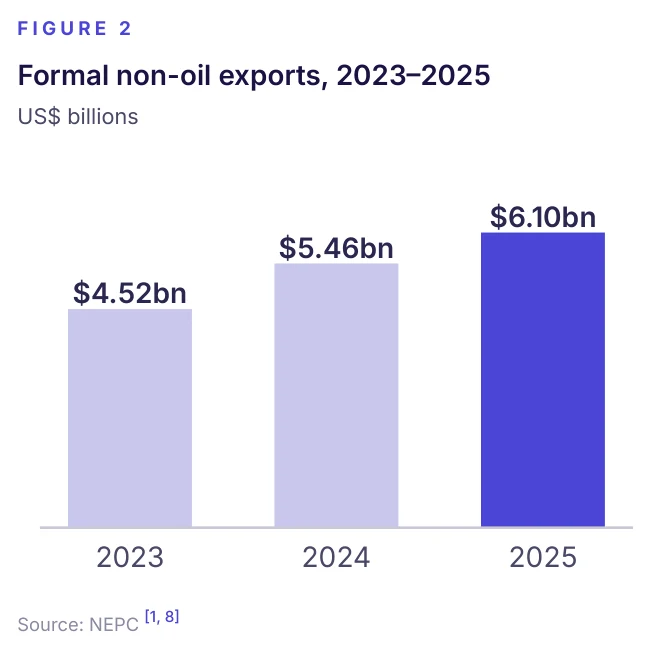
Record formal non-oil exports in 2025, up 11.5% on 2024 [1]
US$48.2bn
Earnings from crude oil, gas and refined products in 2025, eight times non-oil [2]
54%
Share of non-oil export earnings from just two products, cocoa beans and urea [1]
US$478m
Non-oil exports to Africa in 2025: US$271m to ECOWAS and US$207m to 25 other countries [1, 3]
83%
Share of Nigeria's Q2 2026 exports to Africa made up of crude oil, gas oil and jet fuel [4]
−51%
Year-on-year fall in manufactured goods exports in Q2 2026, to ₦393bn [5]
23%
Monetary policy rate, against 14.06% headline inflation: a real policy rate of about 9 points [6]
US$4.1bn
ITC estimate of Nigeria's untapped export potential across all markets [7]
The report in one paragraph
Nigeria has built more of the AfCFTA's legal and institutional machinery than most African countries, but its exporters are not yet in a position to use it. Formal non-oil exports reached a record US$6.1 billion in 2025, yet two commodities supply more than half of that, under 8% went to African buyers, and what Nigeria does sell to Africa is overwhelmingly petroleum. The constraint is supply rather than market access: a 23% policy rate, high logistics costs, repeated food-safety rejections and a finance system with nothing for the mid-sized firms most likely to export. The prize is real, in processed food, fertiliser, building materials, medicines and, above all, services, but it is measured in single-digit billions to 2030, not hundreds of billions. This report sets out where demand lies, which twenty product–market pairs to prioritise, and a measurable AfCFTA 2030 compact for government agencies, finance institutions, state governments and exporters.
Six claims tested against the data
6 Widely held views in Nigeria's export and AfCFTA debate, set against the evidence in this report
Nigeria's conversation about the AfCFTA is full of ambition: bigger export targets, an MSME-led export push, a pivot to services and a continental rather than national mindset. The table sets six widely held claims against the evidence assembled for this report and points to the section where each is examined.
The export base: oil, gas and non-oil
~9%: Share of Nigeria's goods exports that were genuinely non-hydrocarbon in 2025, once gas-based urea is set aside [1, 2]
Nigeria's export earnings rest on hydrocarbons. In 2025 crude oil earned US$31.54 billion, gas US$10.51 billion and refined products US$6.13 billion, a combined US$48.17 billion [2]. Formal non-oil exports reached a record US$6.1 billion, up from US$5.46 billion in 2024 and US$4.52 billion in 2023, across 281 products and 120 markets [1, 8]. Strong as that growth is, non-oil exports remain about 11% of goods exports, and closer to 9% once urea is counted as a gas product.
Growth has come from price and a few products
Much of the 2024–25 gain came from cocoa, whose world price peaked in 2024–25, and from urea plants operated by Indorama and Dangote. Indorama, Dangote Fertilizer and Starlink Global alone accounted for nearly 30% of non-oil export value [1]. Breadth is wider than depth: most of the 281 products are tiny.
Measurement gap
NEPC counts formally documented exports registered on the NXP form; 19,975 forms were processed by 30 banks in 2025 [8]. NBS customs data uses broader categories, and the two series should not be mixed. Informal exports to neighbouring countries are not captured at all: a 2020 estimate put them at US$12–18 billion a year, against about US$3 billion recorded at the time [16]. Africa-bound trade is therefore undercounted, but by an unknown amount.
Africa in Nigeria's export basket
+38%: Growth in non-oil exports to non-ECOWAS African markets in 2025, while sales to ECOWAS fell 13% [1, 3]
Africa is a marginal market for Nigerian non-oil goods. In 2025, eleven ECOWAS countries bought US$271.26 million and 25 other African countries US$206.94 million, together 7.8% of non-oil exports [1, 3]. Only Ghana (13th) and Côte d'Ivoire (20th) appear among Nigeria's top twenty non-oil destinations.
4.1 The map is shifting away from ECOWAS
Two forces moved in opposite directions in 2025. Sales to ECOWAS fell after Burkina Faso, Mali and Niger left the bloc in January 2025 and imposed a 0.5% levy on ECOWAS imports. Sales outside ECOWAS rose as the AfCFTA's practical tools took effect: the Guided Trade Initiative, 24-hour certificates of origin and the air-cargo corridor to East and Southern Africa [17, 18]. This is the clearest evidence so far that the AfCFTA is opening markets ECOWAS never reached. The volumes are small, however: the 967,398 tonnes shipped outside ECOWAS earned about US$214 a tonne, the value of bulk building materials and raw produce rather than branded goods [1].
4.2 Headline trade with Africa is mostly petroleum
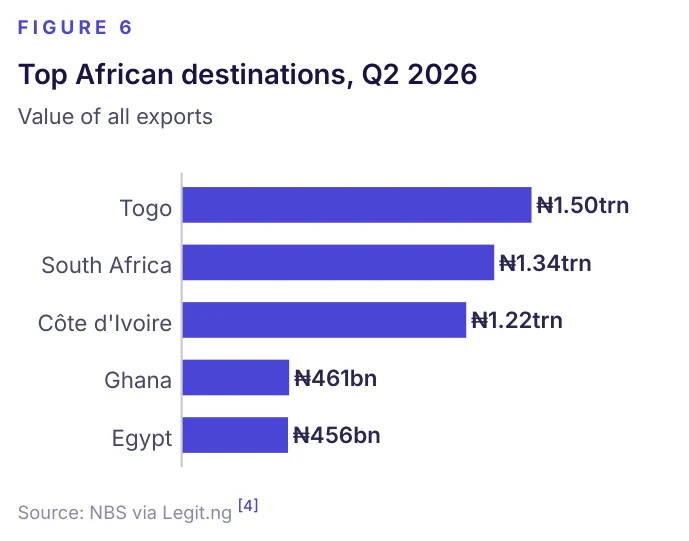
NBS data tell a different story from NEPC's. In Q2 2026 Nigeria exported ₦6.65 trillion of goods to Africa, 24.6% of all exports, but crude oil made up 48.6% of that, gas oil 19.9% and jet fuel 14.7% [4]. Five countries took three-quarters of the total. Dangote Refinery product sales to Cameroon, Ghana and Togo are reshaping regional fuel trade, which is valuable but is not diversification.
Why Nigerian exports struggle to compete
142nd Nigeria's rank of 145 economies on the Harvard Economic Complexity Index, 2026 rankings (ECI −2.26) [10]
Market access is no longer Nigeria's main problem in Africa. Its tariff schedule is gazetted and documentation is faster than ever. What holds exporters back is the cost and difficulty of producing goods that meet foreign buyers' standards at competitive prices. Five constraints stand out.
5.1 A low-complexity economy with few nearby products
The Harvard Growth Lab finds Nigeria's economy is less complex than a decade ago, ranking 141st of 145 on its country profile and 142nd under its new 2026 methodology [9, 10]. It projects growth of only 2.4% a year to 2034 and notes that Nigeria has few opportunities to diversify using the know-how it already has. The practical implication is that Nigeria cannot leap into complex manufactures; it has to move into products adjacent to what it already makes: cocoa, cashew, sesame, shea and cassava derivatives; gas chemicals beyond urea; building materials; fabricated aluminium and copper; and the consumer goods Nigerian firms already sell to 230 million people at home.
5.2 The cost of capital outweighs the tariff advantage
The CBN held the policy rate at 23% on 24 November 2026, against headline inflation of 14.06% [6, 20]. Commercial borrowing costs run well above that. An AfCFTA tariff margin of 5–35 points, phased in over 5 to 13 years, does not offset a financing gap of this size for goods that tie up working capital. Lowering exporters' cost of finance is therefore trade policy, not only monetary policy.
5.4 Food safety and standards failures
Agricultural exports fell 31% in the period to mid-2026 amid port delays and pesticide-related rejections, according to NBS-based reporting [21]. A tracker of the EU's RASFF database records 116 border rejections of Nigerian-origin products over three years [12]. The EU ban on Nigerian dried beans, in place since 2015, still stands, and sesame is on the EU's increased-checks list for salmonella [22, 23]. Because many African importers follow EU-style standards, these failures follow Nigerian products into African markets too.
5.5 A finance system with a hole in the middle
Section 11 sets out the detail. In short, nano firms can access small loans and large corporates can access large DFI tickets, but the mid-sized processors and manufacturers most likely to become regional exporters cannot.
The AfCFTA toolkit Nigeria has built
24 hrs Processing time for an AfCFTA certificate of origin in 2026, down from more than five days [18, 24]
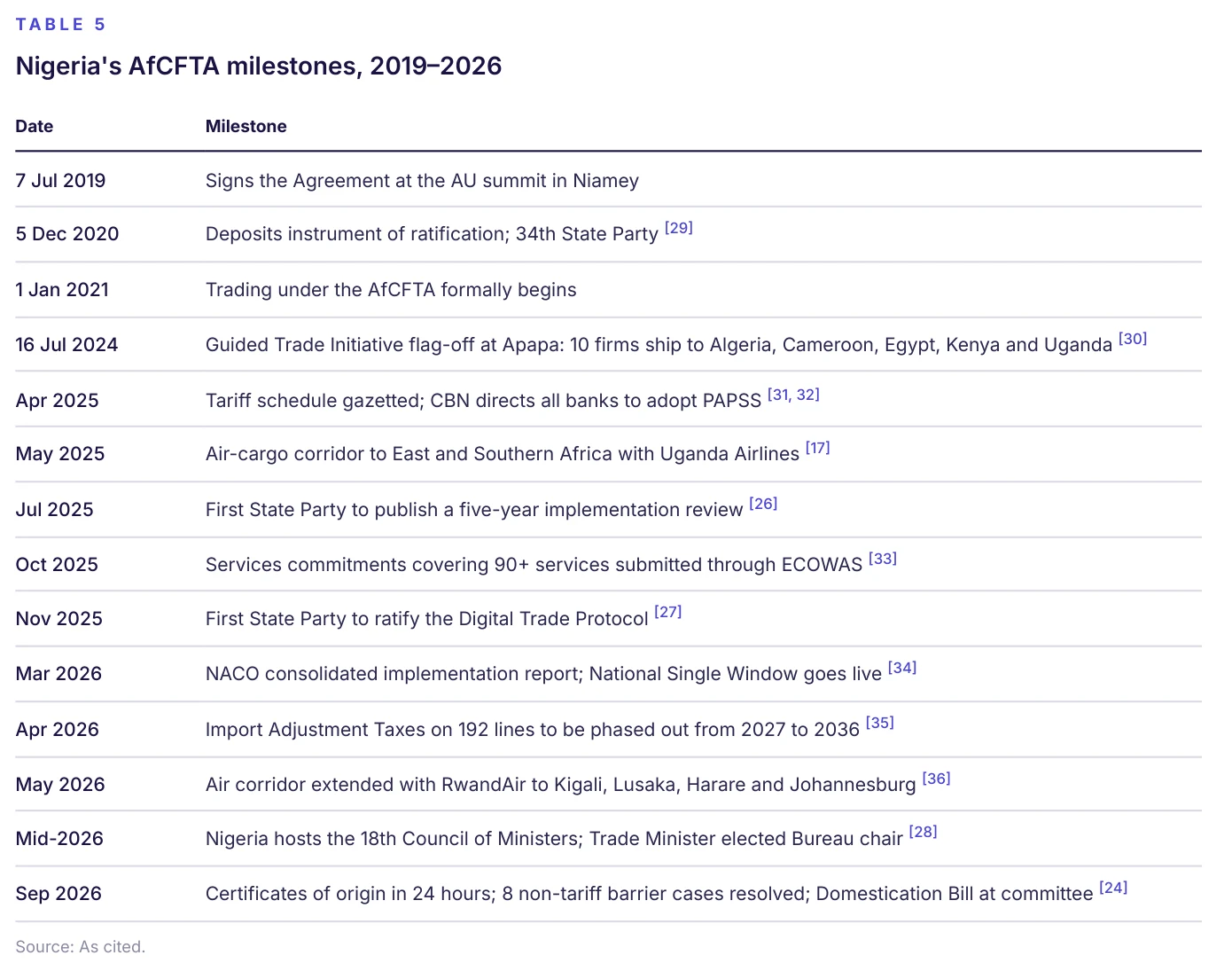
Nigeria refused to sign the AfCFTA in Kigali in March 2018. By 2026 it had become one of the most procedurally advanced State Parties: first to complete a five-year implementation review, first to ratify the Digital Trade Protocol, and chair of the Bureau of the AfCFTA Council of Ministers [26, 27, 28]. Institutions have moved faster than firms.
6.1 The protocols beyond goods
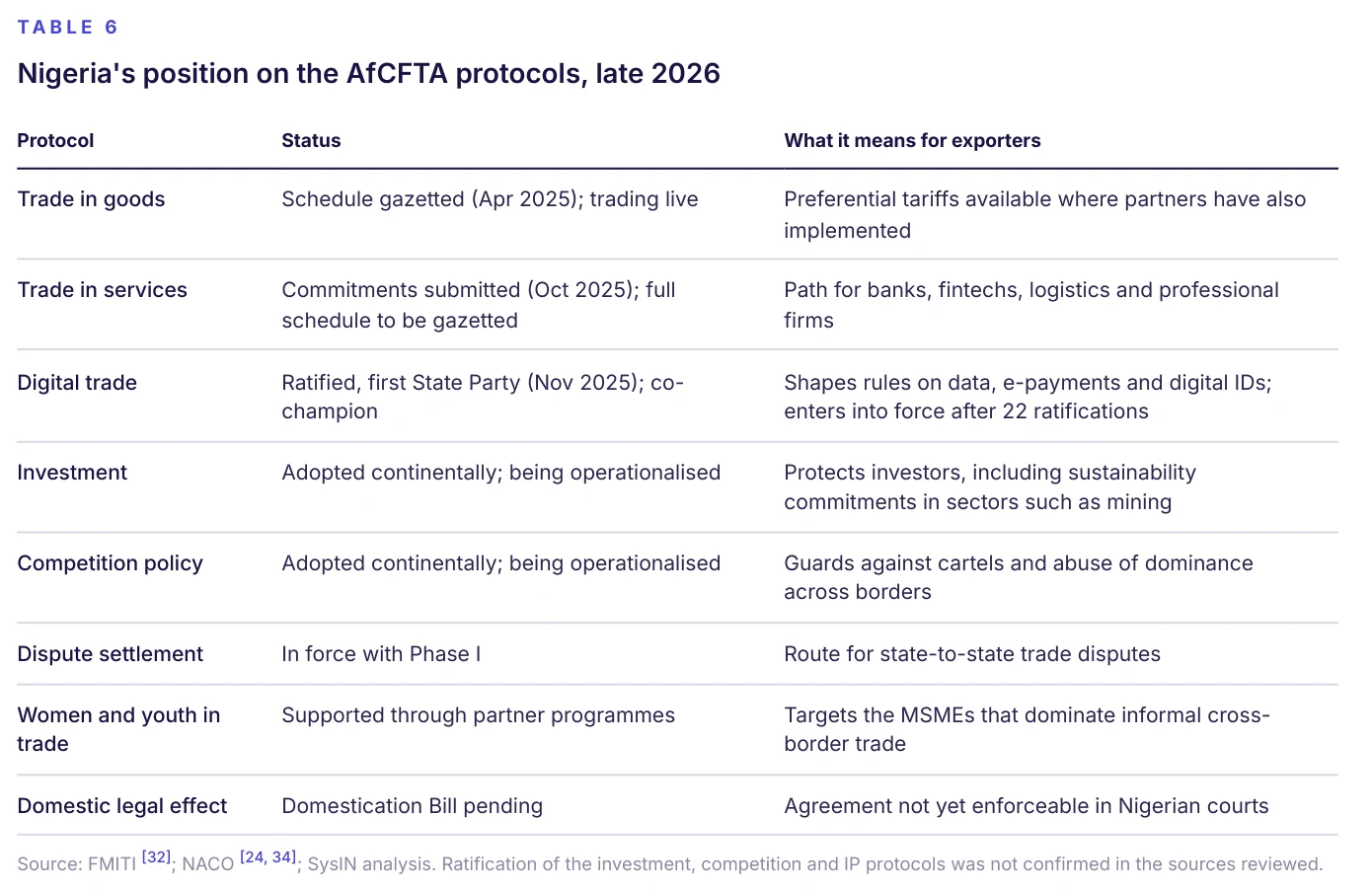
The AfCFTA is not only about goods. Its later protocols cover services, investment, competition, intellectual property, digital trade and women and youth in trade. The table shows where Nigeria stands on each.
The credibility question
Nigeria is liberalising and protecting at the same time. The 2026 Fiscal Policy Measures phase out Import Adjustment Taxes in line with AfCFTA commitments, but the same package extends a prohibition list that includes cement, fertiliser and soaps [25, 35], three of Nigeria's own best export prospects. As Council chair, Nigeria will be asked to justify these lines by partners whose markets it wants to enter.
Sizing the prize
US$4.1bn: ITC estimate of Nigeria's untapped export potential across all markets, on top of US$3.8bn already realised [7]
Several independent estimates give a sense of scale. None of them supports the idea of a sudden multi- hundred-billion-dollar opportunity; together they point to a prize worth a few billion dollars a year by 2030, concentrated in a small number of products.
7.1 Where the AfCFTA actually changes the maths
ECOWAS (Ghana, Côte d'Ivoire, Senegal, Togo, Benin). Nigerian goods already enter duty-free under the ECOWAS Trade Liberalisation Scheme, so the AfCFTA adds little tariff margin. Gains come from cutting checkpoints, paperwork and payment friction, which is where 24-hour certificates and PAPSS matter most.
Non-ECOWAS markets (Cameroon, Kenya, Egypt, South Africa, Morocco). This is where tariff preferences are real, but they phase in over years and exclude sensitive lines. ECCAS, for example, excludes soap, leaving a 30% tariff in Cameroon [44]. Exporters should check exclusion lists before targeting a market.
Reciprocity. As Nigeria's own schedule phases in, Egyptian, Moroccan and South African manufacturers gain cheaper access to Nigeria [45]. Domestic producers need to be export-ready before the import side bites.
Data gap
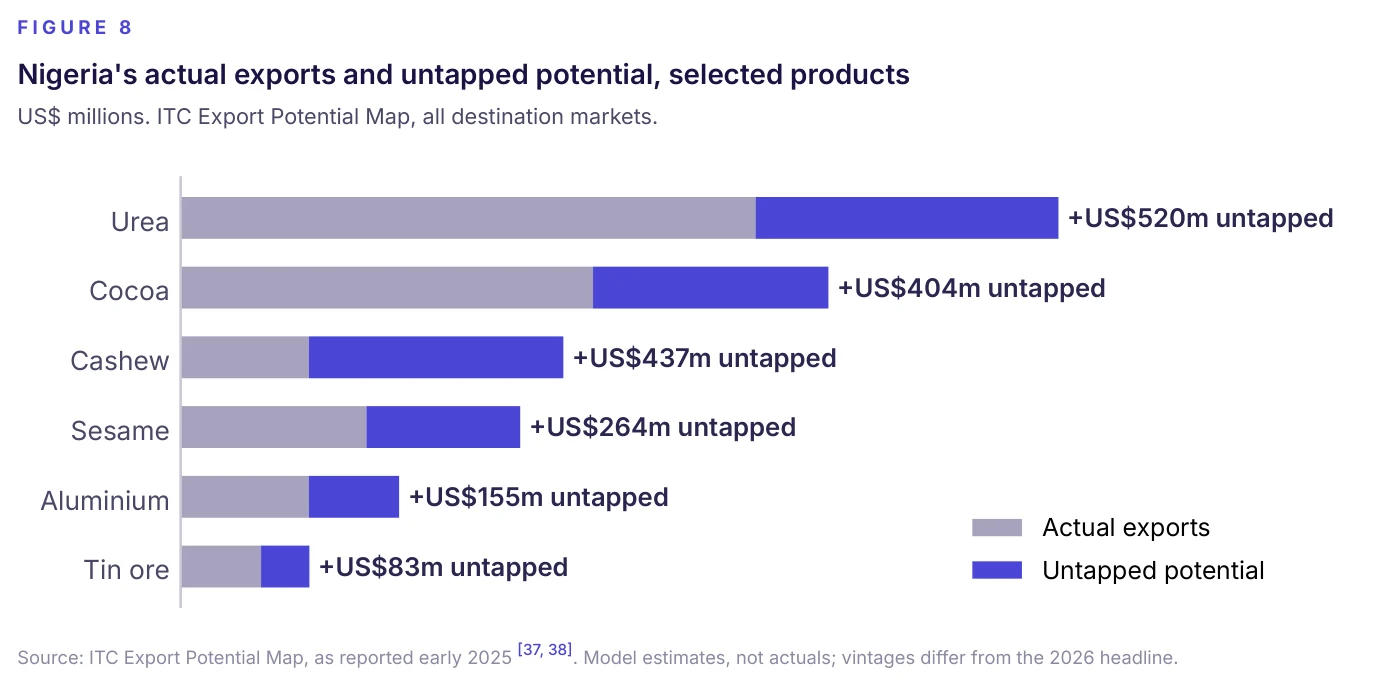
Product-by-market potential for Nigeria (for example urea to Kenya or cocoa butter to Egypt) and AfCFTA- versus-MFN tariff margins are available only through direct queries of ITC's Export Potential Map and Market Access Map. The priorities in Section 10 combine verified Nigerian supply data with verified African demand signals, and each should be quantified with ITC queries before resources are committed.
Goods: sector opportunities
US$3.0bn: Combined 2025 exports of cocoa beans, cocoa butter, cashew, sesame and rubber: Nigeria's base for agro-processing into Africa [1]
8.1 Agro-processing: the core diversification engine
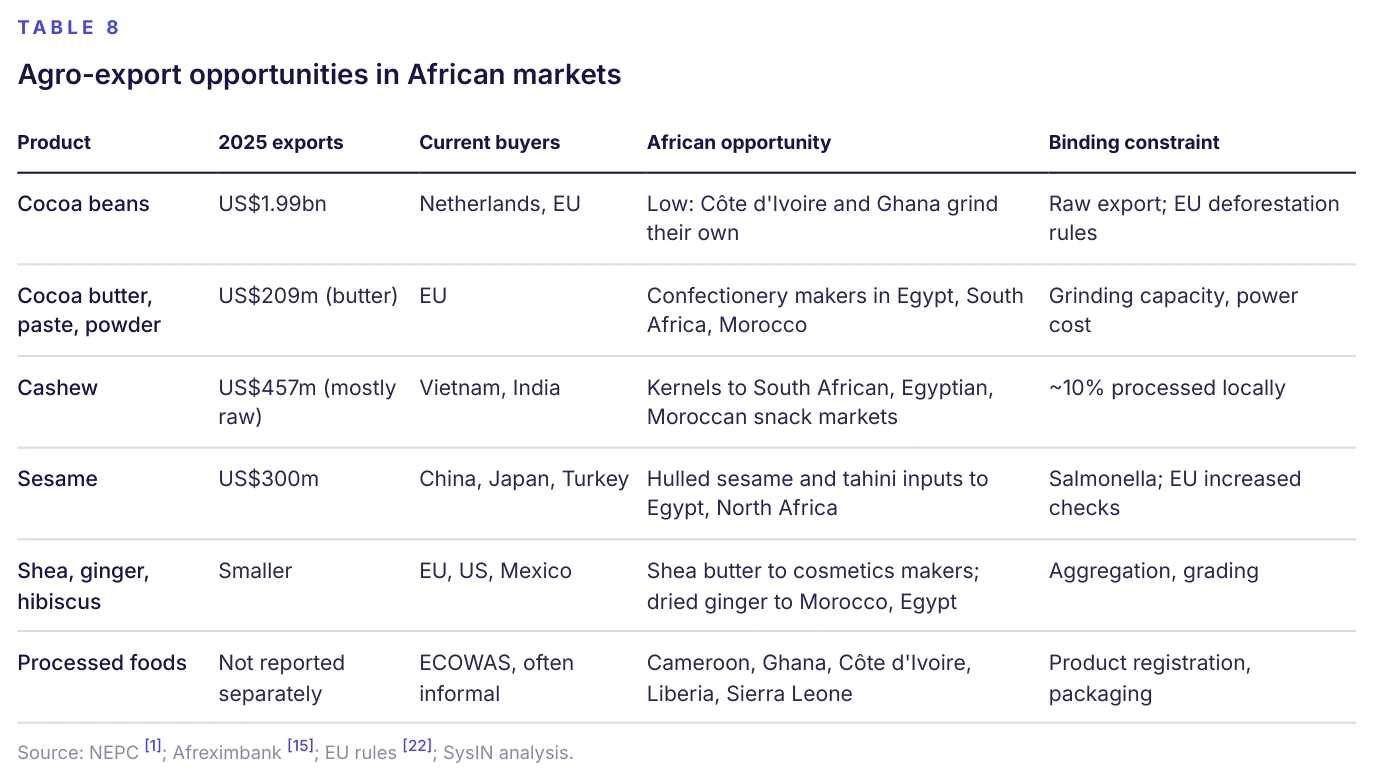
Nigeria's agricultural exports are large but mostly raw, and mostly sold outside Africa. The African opportunity lies in processed goods sold into food-importing, urbanising markets, the categories Afreximbank identifies as West Africa's largest unrealised intra-African trade [15].
The Special Agro-Industrial Processing Zones programme is the main vehicle for scale. Phase I covers seven states and the FCT, and the AfDB has approved US$200 million for a first tranche of Phase II [46]. Nigeria remains a net food importer, so rice and palm oil are import-substitution plays rather than near-term export plays.
8.2 Fertiliser and gas-based chemicals
Urea earned US$1.29 billion in 2025 and has ITC-estimated untapped potential of about US$520 million [1, 37]. Egypt and Nigeria drove a surge in African urea trade, with exports growing an average 50% a year in 2019– 2021 [47]. The opportunity is coastal West Africa and East African markets reachable by sea, where Russian and Gulf suppliers dominate. SysIN recommends reporting urea separately from non-oil diversification because it moves with gas allocation and global nitrogen prices. Polymers, methanol and other gas derivatives are the next products to target.
8.3 Cement, clinker and building materials
Nigeria has a structural cement surplus. Dangote shipped about 970,000 tonnes of clinker to Cameroon and Ghana in 2025, and total cement and clinker exports rose about 19% to 1.4 million tonnes [48]. Clinker sent to grinding plants abroad is a working regional value chain. Because cement travels poorly by road beyond a few hundred kilometres, the realistic market is the neighbourhood plus clinker by sea. Cement's place on Nigeria's own import ban list is a reciprocity risk.
8.4 Solid minerals beneficiation
Gold doré (US$229 million), aluminium ingots (US$183 million) and copper ingots (US$97 million) already rank among the top ten non-oil exports [1]. The diversification logic is to sell refined metal, cathodes and semi- fabricates (roofing sheets, profiles, wire) rather than ore, into construction and electrical industries in Ghana, Kenya, Egypt and Morocco. Lithium processing, though growing, is tied to Chinese buyers and should not be counted on for AfCFTA gains before 2030.
8.5 Light manufacturing
This is where Nigeria's home-market scale should become regional exports, yet manufactured exports fell 51% year on year in Q2 2026 while manufactured imports rose 21% [5]. Africa is still the main buyer of what Nigeria does manufacture. The largest structural gap is medicines: Africa imports 61% of a US$18 billion packaged- pharmaceutical market [40], and only 3% of pharmaceutical inputs come from within Africa [39]. Nigerian generics makers need WHO prequalification and regulatory reliance through the African Medicines Agency to scale. Soaps, cosmetics and plastics have proven West African demand but face exclusions and strong competition from Côte d'Ivoire, Egypt and Asia.
Services and digital trade
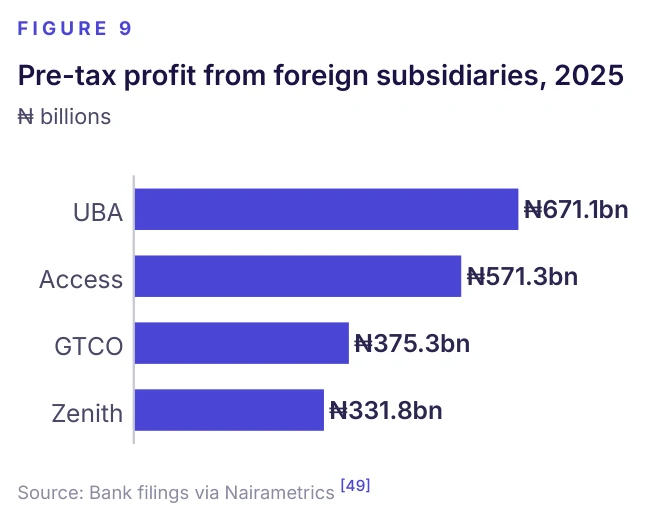
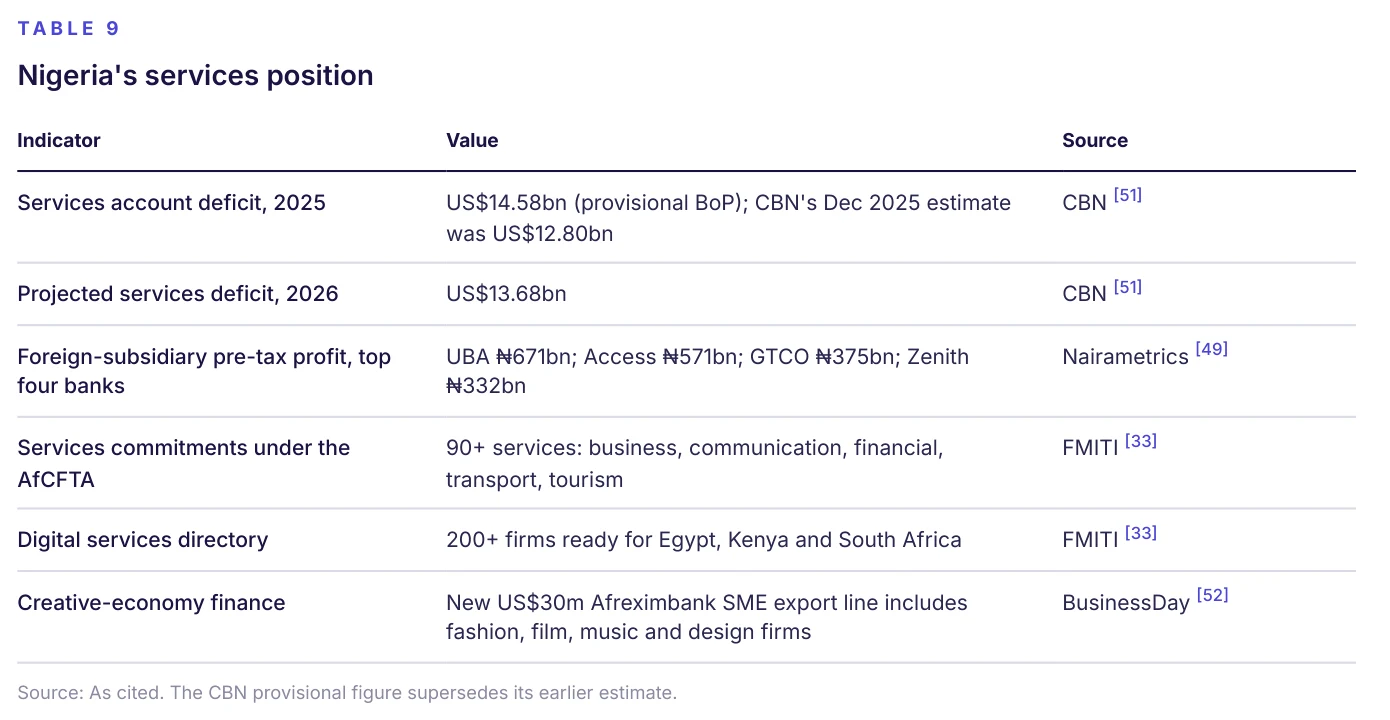
₦1.95trn: Pre-tax profit earned by Nigeria's four largest banks from foreign subsidiaries in 2025 [49]
Nigeria's banks are often cited as its clearest comparative advantage in services, and the numbers bear this out. Banking is already Nigeria's most successful pan-African export, yet it barely appears in trade statistics.
Invisible exports
Foreign units supplied 77% of UBA's net income and 48% of Access Bank's, according to Fitch, though part of the rise reflects the naira's depreciation inflating foreign earnings [50]. These profits come 9.1 Digital trade: first mover on the rules
Nigeria was the first State Party to ratify the Digital Trade Protocol, in November 2025 [27]. The protocol enters into force only after 22 ratifications, so Nigeria's advantage for now is in shaping the rules on data flows, digital payments and e-commerce rather than in legal market access. The National Digital Economy and E- Governance Bill is the vehicle for aligning domestic law.
from commercial presence abroad, so they appear in the balance of payments as investment income, not services exports. The same is true of fintechs such as Flutterwave, Moniepoint and Paystack, and of Nollywood and Afrobeats revenues.
9.2 PAPSS: payments are starting to move
The CBN directed all banks to adopt the Pan-African Payment and Settlement System in April 2025 [31]. PAPSS reported network transaction volumes up about 1,000% and values up about 120% between comparable periods of 2025 and 2026; Nigerian volumes rose about 1,100% [53, 54]. Volumes growing faster than values implies smaller average payments, a sign that SMEs and individuals are arriving. Absolute volumes have not been published, which makes progress hard to verify.
Twenty product–market priorities
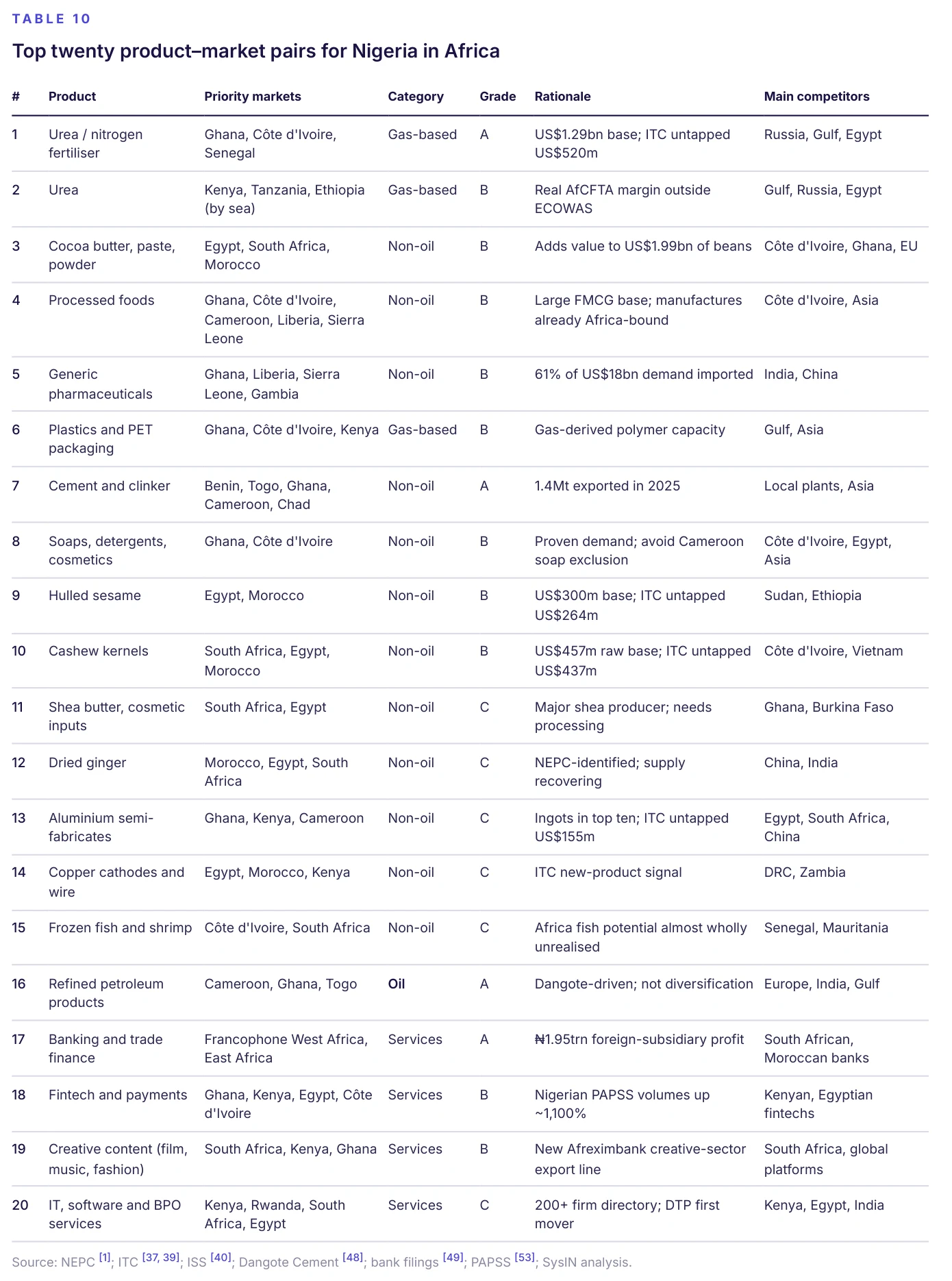
20 Product–market pairs ranked by proven Nigerian supply, evidenced African demand and route to market
The list below combines verified Nigerian supply data with African demand signals and geography. Evidence grades show how firm each pair is: A = Nigerian supply proven at scale and demand quantified; B = supply proven, demand evidenced qualitatively; C = emerging or hypothesis. Refined petroleum is included for completeness but is not diversification.
Using this list
Two rules of thumb follow. Sell into ECOWAS for scale, because proximity and existing duty-free access make volumes easier; sell outside ECOWAS for margin, because that is where AfCFTA preferences and the new air corridors add most. Each pair should be quantified through ITC queries (US$ potential, tariff margin, main competitor) before agencies allocate promotion budgets or credit lines.
Financing exporters and MSMEs
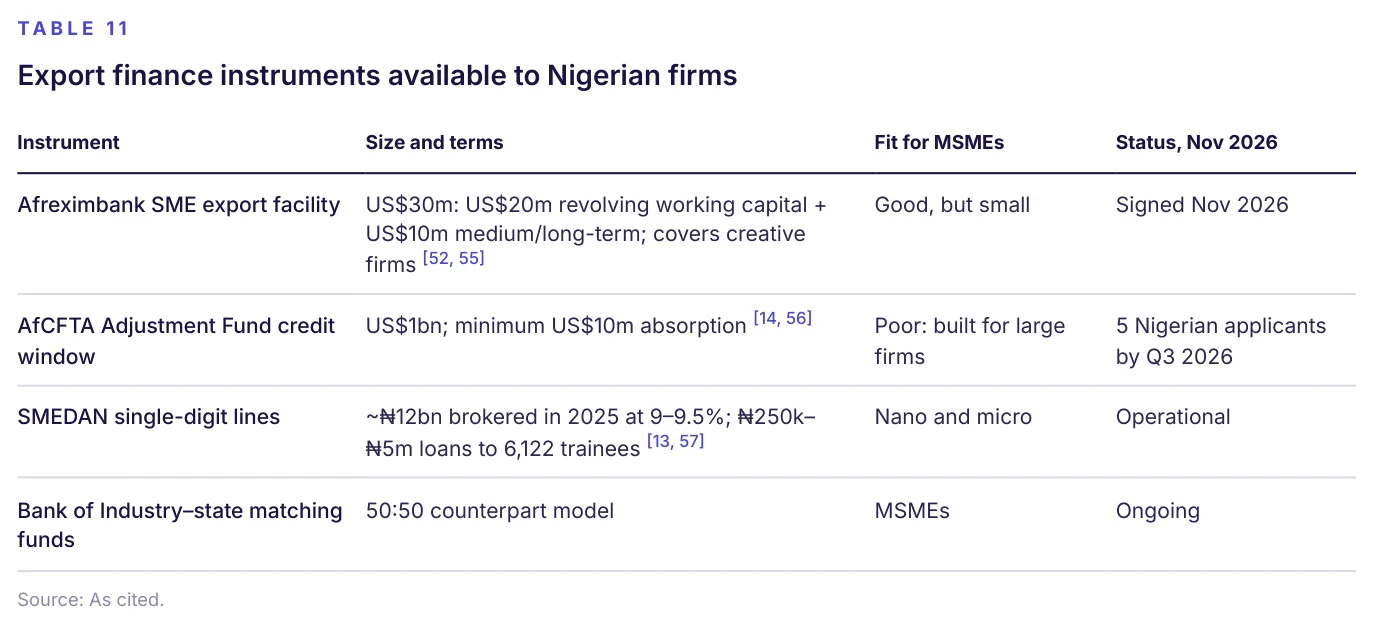
5 Nigerian firms that had applied to the AfCFTA Adjustment Fund by Q3 2026, three of them women-led [24]
Exporters consistently name finance as their biggest constraint. The instruments exist, but they cluster at the two ends of the size spectrum and leave out the firms most likely to become regional exporters.
11.1 Why the middle matters
The firms best placed to sell into Africa are mid-sized food processors, cosmetics and packaging makers, and creative businesses that need US$50,000 to US$2 million for working capital and equipment. They are too big for SMEDAN tickets and far too small for the Adjustment Fund. The wider African picture is similar: only 18% of African banks' trade-finance portfolios support intra-African trade [58], and the AfDB estimates Africa's unmet trade-finance demand at US$74–92 billion in 2024.
11.2 Finance aggregators, not individual nano firms
MSMEs supply about 6% of Nigeria's exports. That share will not move by lending to millions of nano businesses one at a time. International experience points to three models that work: export trading companies and aggregators that consolidate small producers' output and carry the cost of compliance; cluster-based quality infrastructure, with shared testing laboratories, cold chains and packaging; and digital export platforms that handle payments and logistics. State governments that co-fund MSMEs will get most from that money if it builds clusters and aggregators rather than spreading small loans thinly.
How big can Nigerian exports get?
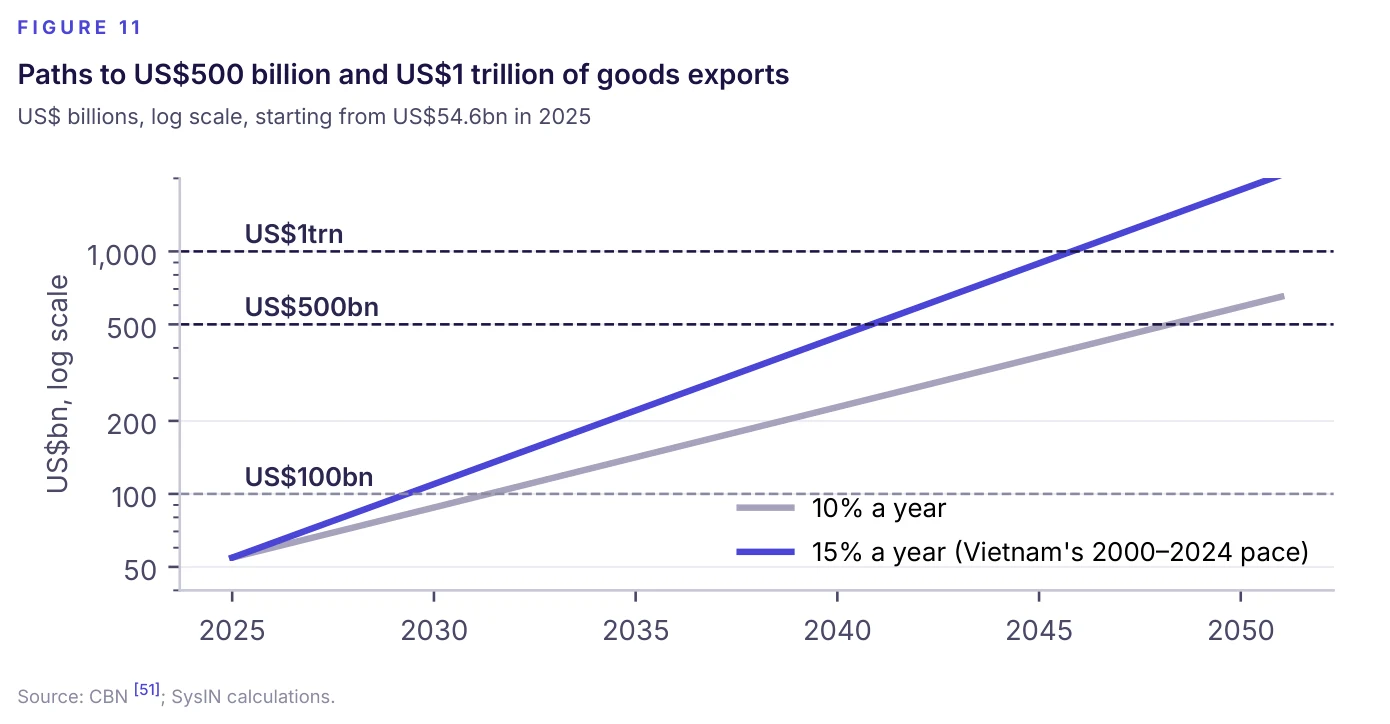
16 yrs Time needed to reach US$500 billion of goods exports from today's US$55 billion, at Vietnam's historic growth rate of 15% a year
Targets of US$500 billion to US$1 trillion of exports are sometimes put forward in Nigeria's policy debate. The ambition is welcome, but it needs to be set against the base. Nigeria's total goods exports, oil included, were about US$54.6 billion in 2025 [51], so even US$100 billion would be a step change.
12.1 What it took elsewhere
Vietnam's goods exports rose from about US$14 billion in 2000 to about US$405 billion in 2024, roughly 15% a year for 24 years, with foreign-invested firms supplying about 72% of the 2024 total. That rested on foreign direct investment in electronics assembly, deep-water ports, single-digit lending rates and integration into Asian supply chains. Morocco built an automotive industry worth about MAD 158 billion of exports in 2024 within some fifteen years, around anchor investors and the Tanger Med port. Egypt's non-oil exports reached about US$48.5 billion in 2025. These are indicative benchmarks from national statistics agencies. Nigeria has none of these preconditions in place yet.
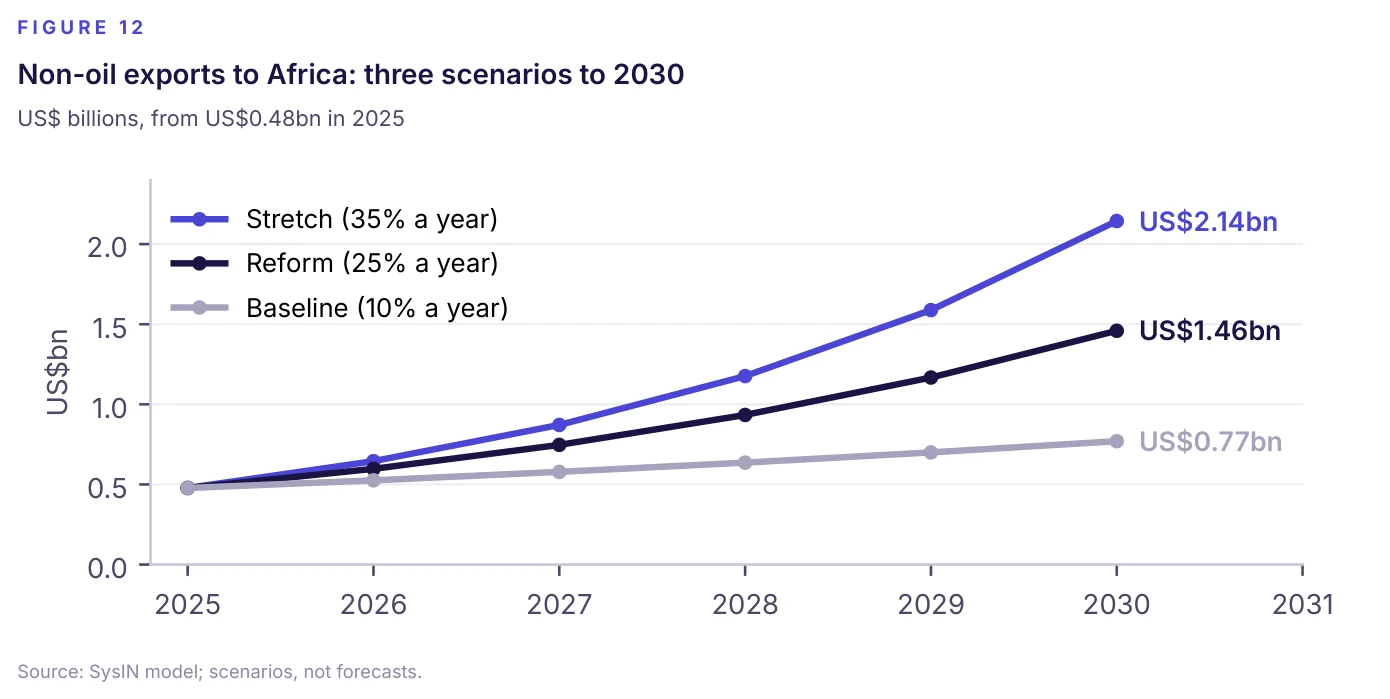
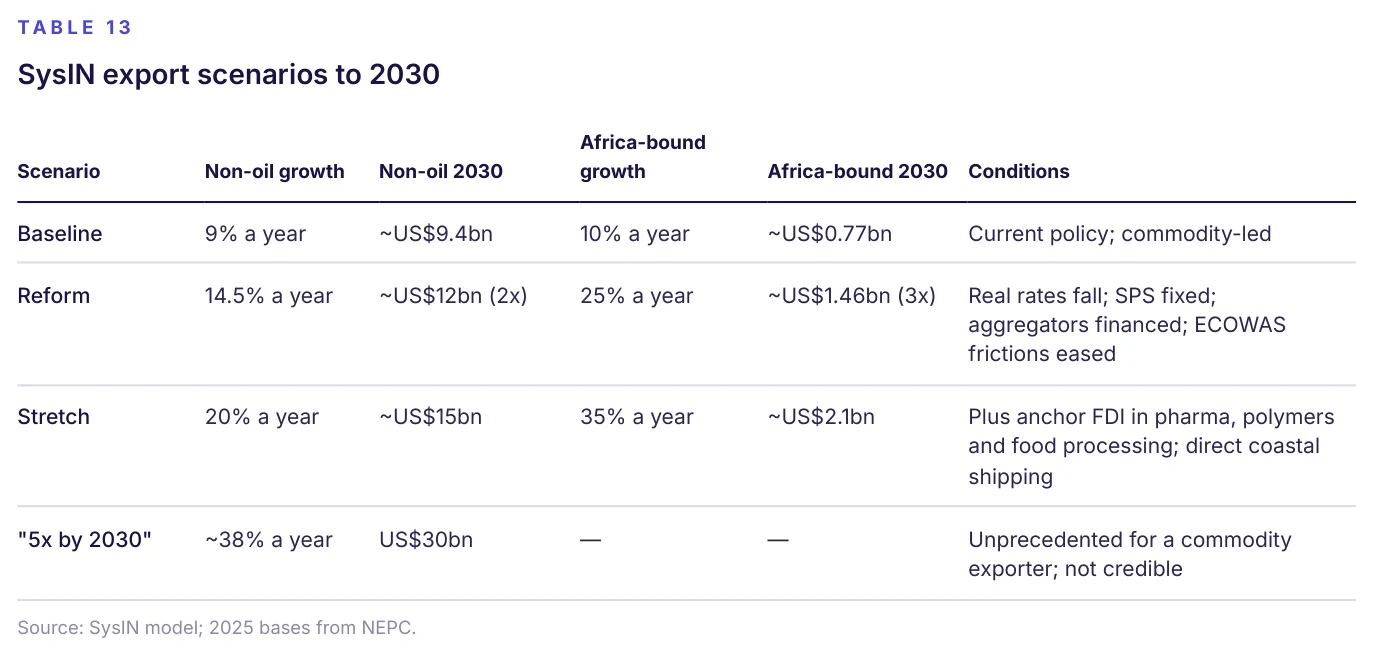
12.2 Scenarios to 2030
SysIN's view
Treat US$500 billion to US$1 trillion as a 2040s horizon, achievable only with an FDI-led manufacturing model Nigeria does not yet have. For the next five years, staged and measurable targets are more useful: the Reform scenario above, adopted as an AfCFTA 2030 compact and reported quarterly, so that ambition does not become an excuse for missing nearer milestones.
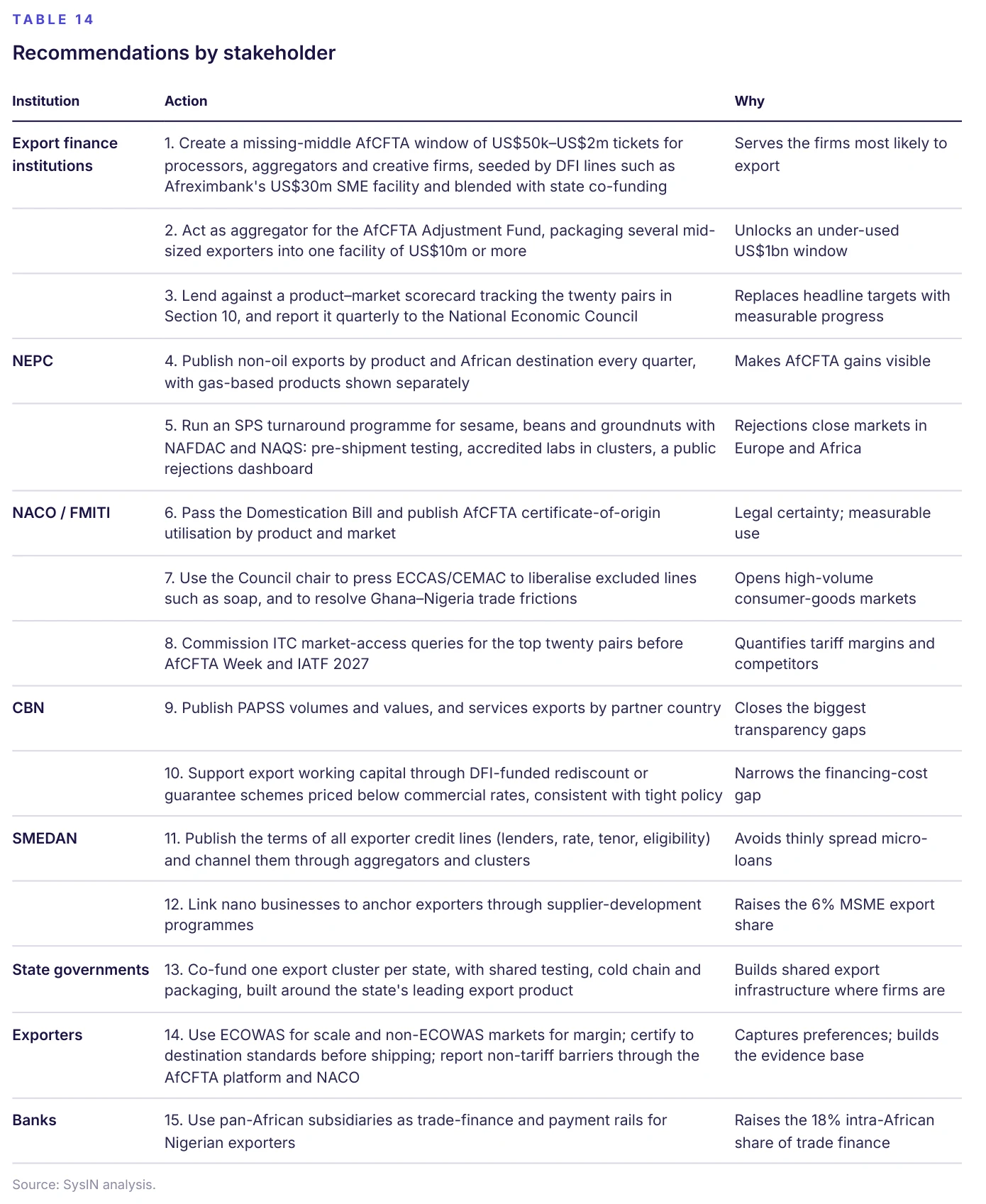
Recommendations by stakeholder
15 Actions for government agencies, finance institutions, state governments, banks and exporters
The AfCFTA 2030 compact
Four measurable targets for 2030: non-oil exports of US$12 billion (double 2025); Africa-bound non-oil exports of US$1.5 billion (three times 2025); 1,000 new MSME exporters linked to anchor firms and aggregators; and quarterly publication of exports by product and African destination, including services.
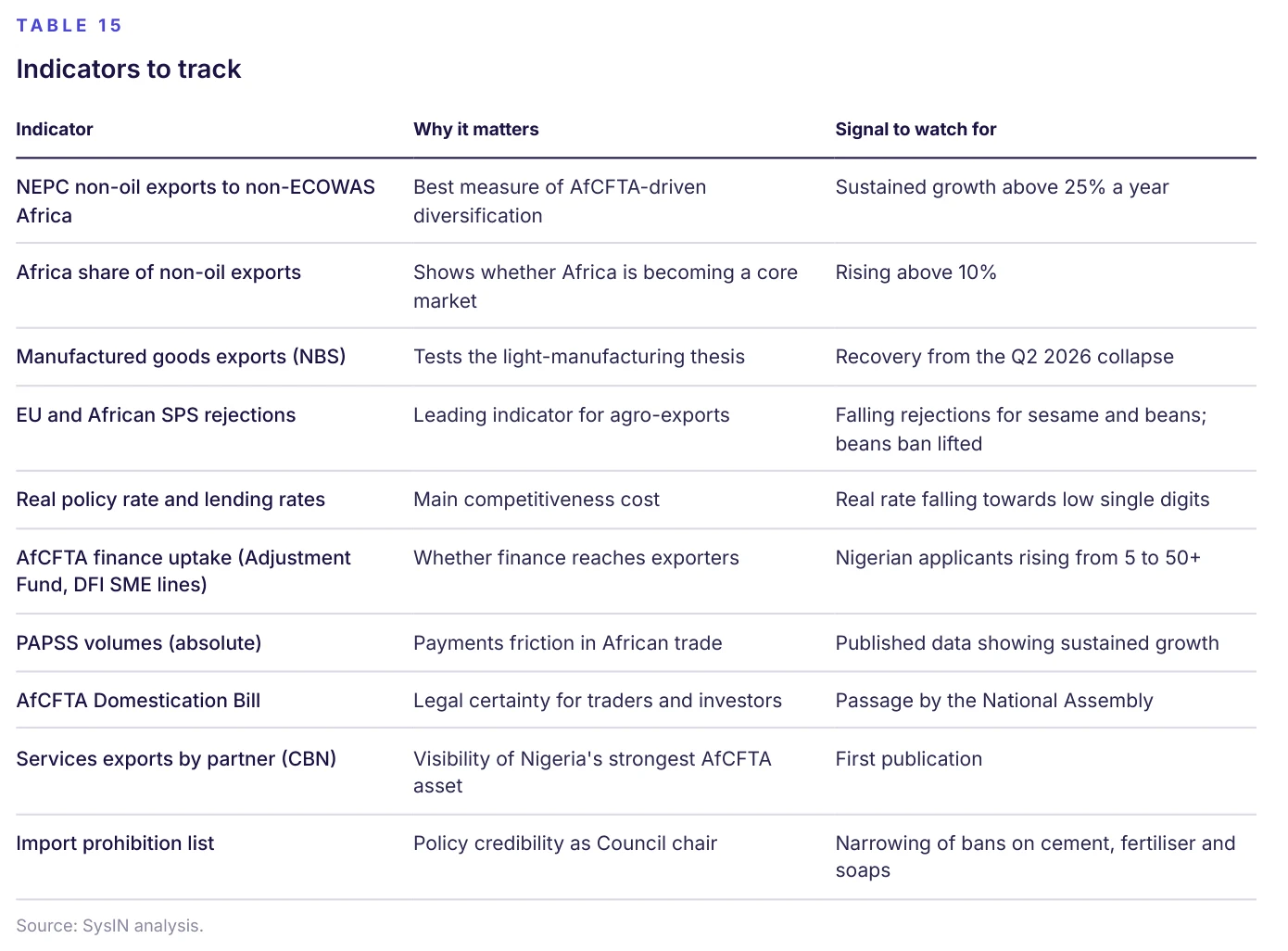
Indicators to watch
2027 The year the AfCFTA compact can first be tested: Import Adjustment Tax phase- out begins and IATF comes to Nigeria
Methodology and data notes
3 Separate categories used throughout: oil, gas-based and non-oil 15.1 Approach
This report draws on official statistics (NBS, NEPC, CBN), multilateral sources (Afreximbank, ITC, World Bank, IMF, AfDB, UNECA, WTO), research institutions (Harvard Growth Lab, ISS African Futures), company filings and Nigerian business media, current to 26 November 2026.
15.2 Definitions and data issues
Oil, gas and non-oil. NBS reports crude, non-crude (including gas and refined products) and non-oil separately. NEPC counts urea and other gas-based products as non-oil. This report uses NEPC for non-oil exports and NBS or CBN for totals, and labels urea as gas-based.
Conflicting series. Afreximbank revised Nigeria's 2024 intra-African trade from US$18.4 billion (ATR 2025) to US$7.47 billion (ATR 2026). The CBN's 2025 services deficit is US$14.58 billion (provisional BoP) against an earlier US$12.80 billion estimate. NEPC has cited both 120 and 210 destination markets. The Atlas ECI rank is 141st or 142nd depending on methodology.
Naira values. NBS naira figures are inflated by the 2023–24 devaluation; growth in naira overstates growth in volume. Conversions use about ₦1,380–1,400 per US$.
Estimates are not actuals. ITC export potential, Afreximbank unrealised potential, World Bank and ISS projections, and SysIN scenarios are model outputs.
Informal trade. Excluded from all official figures; Nigeria's real exports to its neighbours are understated.
Peer benchmarks. Vietnam, Morocco and Egypt figures are indicative, drawn from national statistics agencies as reported, and should be verified before citation.
Gaps for the next edition. World Bank B-READY trade scores, port dwell times, container freight quotes, NAFDAC and SON certification times and costs, AfCFTA non-tariff barrier platform data and state-level export data.
SysIN data. SysIN's Nigeria Macro Monitor reports exports by regional destination aggregates. Country- level destination data in this report come from NBS, NEPC, Afreximbank and ITC.
References
[1] Authority News: Nigeria rakes in $6.1bn from non-oil export in 2025 – NEPC (Jan 2026) https://authorityngr.com/2026/01/19/nigeria-rakes-in-6-1bn-from-non-oil-export-in-2025-nepc/
[2] Nairametrics: Nigeria earned $31.54 billion from crude oil exports in 2025 (Mar 2026) https://nairametrics.com/2026/03/23/nigeria-earned-31-54-billion-from-crude-oil-exports-in-2025/
[3] Brand Icon Image: Nigeria's non-oil exports to ECOWAS drop (Jan 2026) https://www.brandiconimage.com/2026/01/nigerias-non-oil-exports-to-ecowas-drop.html
[4] Legit.ng: Nigeria's trade with Africa hits ₦7.76tn as exports surge in Q2 2026 (Sep 2026) https://www.legit.ng/business-economy/industry/1731203-nigerias-trade-africa-hits-n776tn-exports-surge-q2-2026/
[5] ThisDay: Foreign trade hits ₦41.44tn, yields ₦12.60tn surplus in Q2 (Sep 2026) https://www.thisdaylive.com/2026/09/08/foreign-trade-hits-n41-44tn-yields-n12-60tn-surplus-in-q2/
[6] Central Bank of Nigeria: MPC Communiqué No. 165 (Nov 2026) https://www.cbn.gov.ng/Out/2026/CCD/MPC%20Communique%20No%20165%20of%20November%202026.pdf
[7] The Star: Nigeria can unlock $3.9bn from untapped non-oil exports – ITC (2025) https://www.thestar.ng/nigeria-can-unlock-3-9bn-from-untapped-non-oil-exports-itc/
[8] Nigerian Export Promotion Council: Nigeria's historic non-oil export performance signals a new era of economic possibility (Feb 2026) https://nepc.gov.ng/blog/2026/02/24/nigerias-historic-non-oil-export-performance-signals-a-new-era-of-economic-possibility/
[9] Harvard Growth Lab: Atlas of Economic Complexity, Nigeria country profile https://atlas.hks.harvard.edu/countries/566/None
[10] Harvard Growth Lab: Atlas of Economic Complexity, country rankings (2026) https://atlas.hks.harvard.edu/rankings/
[11] Nations Inquiry: Logistics Performance Index statistics (World Bank LPI 2023) https://nationsinquiry.com/statistics/logistics-performance
[12] Fruit-Risk: EU RASFF border rejections by origin (tracker) https://rasff.fruit-risk.com/origins/
[13] Nigeria Startup Act: SMEDAN to fund 6,122 entrepreneurs with ₦250,000 to ₦5m loans https://www.nigeriastartupact.ng/smedan-to-fund-6122-entrepreneurs-with-n250000-to-n5m-loans/
[14] Leadership: Nigeria mobilises companies for AfCFTA $1bn credit window access https://leadership.ng/nigeria-mobilises-companies-for-afcfta-1bn-credit-window-access-launches-abc-simulation-to-boost-exports/
[15] ThisDay: Afreximbank – Nigeria's share of intra-African trade grew to $9.02bn in 2025 (Jun 2026) https://www.thisdaylive.com/2026/06/22/afreximbank-nigerias-share-of-intra-african-trade-grew-to-9-02bn-in-2025/ Nigeria AfCFTA Export Competitiveness Report 2026
[16] Financial Nigeria (via PressReader): estimate of Nigeria's informal exports (Mar 2020) https://www.pressreader.com/nigeria/financial-nigeria-magazine/20200320/281543702984385
[17] UNDP Nigeria: Nigeria opens Eastern/Southern Africa corridor with Uganda Airlines (May 2025) https://www.undp.org/nigeria/press-releases/nigeria-opens-eastern/southern-africa-corridor-uganda-airlines-boost-regional-trade
[18] Leadership: Nigerian goods competitive as AfCFTA certificate processing now 24 hours – Minister (2026) https://leadership.ng/nigerian-goods-competitive-afcfta-certificate-processing-now-24-hours-minister/
[19] Vanguard: Nigeria's intra-African trade up 127% to $18.4bn – Afreximbank (Jun 2025) https://www.vanguardngr.com/2025/06/nigerias-intra-african-trade-up-127-to-18-4bn-afreximbank/
[20] Streamline Feed: CBN holds 23% rate as naira weakens before election (Nov 2026) https://streamlinefeed.co.ke/news/cbn-holds-23-rate-as-naira-weakens-before-election
[21] Vanguard: Agro exports crash 31% as port delays, pesticides trigger global rejections (Jul 2026) https://www.vanguardngr.com/2026/07/agro-exports-crash-31-as-port-delays-pesticides-trigger-global-rejections/
[22] ExportReady Africa: EU import conditions for African sesame seeds https://exportready.africa/eu-import-requirements/eu-import-conditions-african-sesame-seeds-sudan-ethiopia-salmonella/
[23] Nairametrics: Nigeria loses $363 million annually over EU ban on beans exports – AAPN (Aug 2025) https://nairametrics.com/2025/08/07/nigeria-loses-363-million-annually-over-eu-ban-on-beans-exports-aapn/
[24] AllAfrica: AfCFTA Central Coordination Committee Q3 2026 meeting (Sep 2026) https://allafrica.com/stories/202609090105.html
[25] MSME Africa: FG expands import ban list to 17 items under new fiscal policy measures (2026) https://msmeafricaonline.com/fg-expands-import-ban-list-to-17-items-under-new-fiscal-policy-measures/
[26] ThisDay: Nigeria becomes first country to complete AfCFTA five-year implementation review (Jul 2025) https://www.thisdaylive.com/2025/07/24/nigeria-becomes-first-country-to-complete-afcfta-five-year-implementation-review/
[27] Diplomatic Times: AfCFTA boss hails Nigeria's landmark ratification of Digital Trade Protocol (Nov 2025) https://www.diplomatictimesonline.com/afcfta-boss-hails-nigerias-landmark-ratification-of-digital-trade-protocol/
[28] Naija News Break: Nigeria leads AfCFTA Council (Jul 2026) https://www.naijanewsbreak.com.ng/2026/07/nigeria-leads-afcfta-council-sets.html
[29] UNECA: Nigeria becomes 34th country to ratify AfCFTA Agreement (Dec 2020) https://www.uneca.org/?q=storys%2Fnigeria-becomes-34th-country-ratify-afcfta-agreement
[30] GBC: Nigeria initiates shipment under AfCFTA Guided Trade Initiative (Jul 2024) https://gbc1.net/index.php/2024/07/18/nigeria-initiates-shipment-under-afcfta-guided-trade-initiative/
[31] Central Bank of Nigeria: AfCFTA https://www.cbn.gov.ng/MonetaryPolicy/AfCFTA.html Nigeria AfCFTA Export Competitiveness Report 2026
[32] Federal Ministry of Industry, Trade and Investment: Nigeria AfCFTA Achievements 2025 (Jan 2026) https://fmiti.gov.ng/wp-content/uploads/2026/01/Nigeria-AfCFTA-Achievements-2025.pdf
[33] BusinessDay: Ministry says Nigeria is ready, equipped to trade in AfCFTA market https://businessday.ng/maritime/article/ministry-says-nigeria-is-ready-equipped-to-trade-in-afcfta-market/
[34] Nigeria AfCFTA Coordination Office: AfCFTA 2024–2025 Consolidated Implementation Report (Mar 2026) https://it-rc.org/wp-content/uploads/2026/03/AfCFTA-2024-2025-Implementation-Report.pdf
[35] Ecofin Agency: Nigeria begins 10-year phase-out of import adjustment taxes under AfCFTA tariff plan (2026) https://www.ecofinagency.com/news-services/3107-57895-nigeria-begins-10-year-phase-out-of-import-adjustment-taxes-under-afcfta-tariff-pl
[36] Tribune: Nigeria, RwandAir partner to accelerate export routes under AfCFTA (2026) https://tribuneonlineng.com/nigeria-rwandair-partner-to-accelerate-export-routes-under-afcfta-trade-minister/
[37] Legit.ng: Report reveals Nigeria's untapped export products worth billions of dollars (2025) https://www.legit.ng/business-economy/industry/1683849-report-reveals-nigerias-untap-export-products-worth-billions-dollars/
[38] APA News: Nigeria's unrealised export potential stands at $3bn – ITC (2025) https://apanews.net/nigerias-unrealised-export-potential-stands-at-3bn-itc/
[39] International Trade Centre: Made by Africa – Creating value through integration https://umbraco.exportpotential.intracen.org/media/q5vctg0u/made-by-africa_en.pdf
[40] ISS African Futures: Manufacturing https://futures.issafrica.org/thematic/07-manufacturing/
[41] World Bank: The African Continental Free Trade Area – Economic and Distributional Effects (2020) https://documents1.worldbank.org/curated/en/216831595998182418/pdf/The-African-Continental-Free-Trade-Area-Economic-and-Distributional-Effects.pdf
[42] IMF: Nigeria Selected Issues – the AfCFTA (2022) https://www.elibrary.imf.org/downloadpdf/view/journals/002/2022/034/article-A004-en.pdf
[43] ISS African Futures: AfCFTA https://futures.issafrica.org/thematic/08-afcfta/
[44] International Trade Centre: Regional trade for sustainable recovery and growth in Africa (2021) https://umbraco.exportpotential.intracen.org/media/1255/regionaltradeafrica_20211206.pdf
[45] World Bank Blogs: The giant is starting to move – Nigeria's big step toward Africa (2026) https://blogs.worldbank.org/en/trade/the-giant-is-starting-to-move--nigeria-s-big-step-toward-africa-
[46] African Development Bank: $200 million support for Nigeria's Special Agro-Industrial Processing Zones programme https://www.afdb.org/en/news-and-events/press-releases/nigeria-african-development-bank-provides-200-million-support-special-agro-industrial-processing-zones-program-89292 Nigeria AfCFTA Export Competitiveness Report 2026
[47] WTO: Information note on African trade https://www.wto.org/english/res_e/statis_e/miwi_e/info_note_atig_e.pdf
[48] MarketScreener: Dangote Cement earnings release for full year 2025 https://www.marketscreener.com/news/dangote-cement-earnings-release-for-full-year-2025-ce7e5cdddb8bf221
[49] Nairametrics: Nigerian banks' earnings from foreign subsidiaries hit ₦1.949 trillion in 2025 (Jun 2026) http://nairametrics.com/2026/06/19/nigerian-banks-earnings-from-foreign-subsidiaries-hit-n1-949-trillion-in-2025/
[50] Nairametrics: Naira devaluation boosts foreign subsidiaries' earnings contribution to Nigerian banks – Fitch (Sep https://nairametrics.com/2026/09/17/naira-devaluation-boosts-foreign-subsidiaries-earnings-contribution-to-nigerian-banks-fitch/
[51] Central Bank of Nigeria: Macroeconomic Outlook for Nigeria (Dec 2025) https://www.cbn.gov.ng/Out/2025/CCD/CBN%20Macroeconomic%20Outlook%20for%20Nigeria%20Report_28_122025_DG.pdf
[52] BusinessDay: NEXIM secures $30m Afreximbank facility to boost SME exports (Nov 2026) https://businessday.ng/bd-weekender/small-business/article/nexim-secures-30m-afreximbank-facility-to-boost-sme-exports/
[53] TechArena: PAPSS transactions surge 1,000% across Africa (Sep 2026) https://www.techarena.co.ke/2026/09/17/papss-transactions-surge-1000-percent-africa/
[54] Tech Africa: PAPSS volumes and average payment size https://tech.africa/papss-volumes-average-payment-size/
[55] Vanguard: Afreximbank provides $30m to finance Nigerian SME exports through NEXIM (Nov 2026) https://www.vanguardngr.com/2026/11/afreximbank-provides-30-m-to-finance-nigerian-sme-exports-through-nexim/
[56] Business Post: FG encourages businesses to tap $1bn AfCFTA financing scheme https://businesspost.ng/economy/fg-encourages-businesses-to-tap-1bn-afcfta-financing-scheme/
[57] Authority News: SMEDAN targets single-digit loans, job creation in 2026 MSME expansion plan (Dec 2025) https://authorityngr.com/2025/12/17/smedan-targets-single-digit-loans-job-creation-skills-drive-in-2026-msmes-expansion-plan/
[58] Afreximbank: African Trade Report 2025 https://media.afreximbank.com/afrexim/African-Trade-Report_2025.pdf