Nigeria & Cabo Verde Trade Brief 2026
A micro-scale corridor with no anchor product — Nigerian exports swung roughly 20x in four years, and 2024 delivered Nigeria's first recorded bilateral deficit with Cabo Verde.
Executive summary
No single product anchors this corridor — and the ranking changes every year.
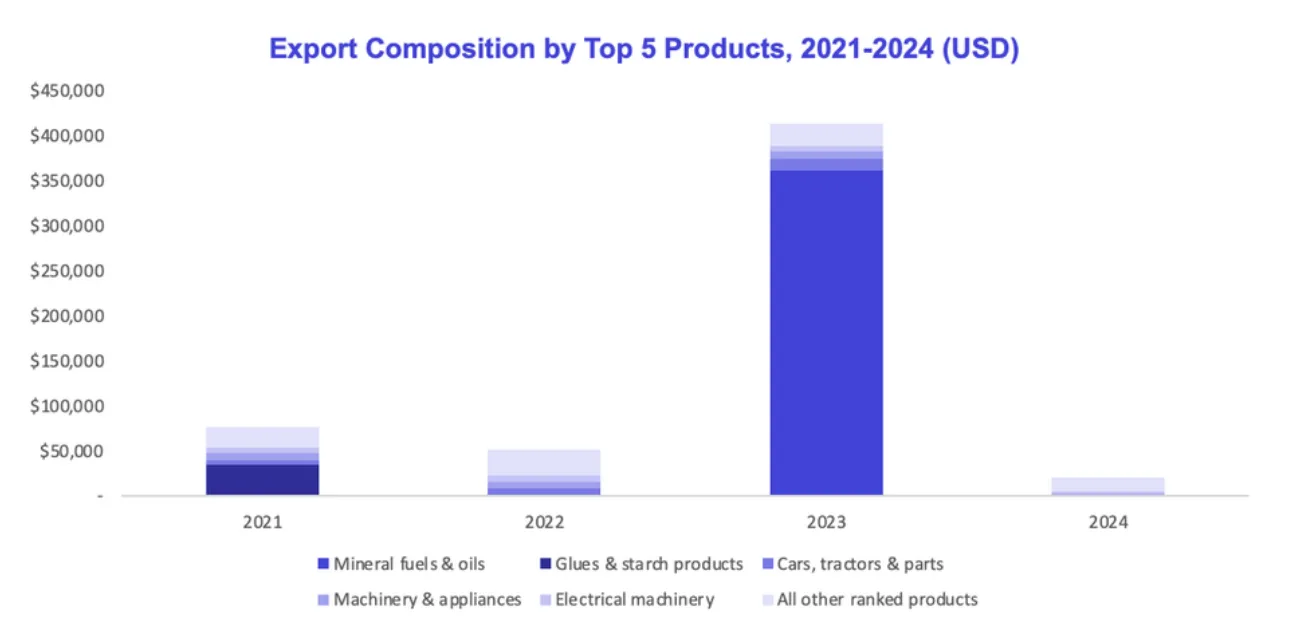
Nigerian exports to Cabo Verde moved from $80,325 (2021) to $55,285 (2022), spiked to $421,631 (2023) on the back of a single Mineral Fuels shipment, then collapsed to $21,051 (2024) — a swing of roughly 20x across four years. The top-ranked export product changed every year: glues & albuminoid products (2021), beverages, spirits & vinegar (2022), mineral fuels (2023), and cocoa & cocoa preparations (2024).
Four Nigerian export lines recur every year, but none of them lead. Machinery, cars/tractors, electrical machinery, and rubber articles are the only four product lines Nigeria exported to Cabo Verde in all four years — Nigeria's standard manufactured-goods export basket, present every year but never large enough to top the ranking. Cabo Verde's return flow is even more volatile: Iron/Steel articles led in 2021, a single Electrical machinery line was the entire 2022 total, fish and food-residue products dominated 2023, and one large Optical/photo & medical-equipment shipment made up 98% of the 2024 total.
Nigeria's uninterrupted surplus ended in 2024. Because Cabo Verde's imports were negligible relative to exports in 2021–2023, Nigeria ran a surplus in each of those years ($73,588; $54,778; $276,665). That reversed in 2024: a single large Cabo Verdean shipment of optical, photo & medical equipment ($118,418) pushed Cabo Verde's imports to $120,754 against Nigeria's $21,051 in exports, producing Nigeria's first bilateral deficit with Cabo Verde on record, of –$99,703.
Cabo Verde's institutional stability has not moved the trade numbers. Cabo Verde is, by most measures, the most stable and fastest-institutionally-upgrading economy among Nigeria's West African trading partners covered in this series: a multi-party democracy since 1991 with no coup history, a 2025 World Bank upgrade to upper-middle-income status, and real GDP growth that reached 7.2–7.3% in 2024 before moderating to an estimated 5.2% in 2025. None of that stability has yet translated into materially larger trade with Nigeria — the corridor's dollar values remain in the tens to hundreds of thousands, smaller in share-of-trade terms than any other Nigerian West African corridor in this series.
The Nigeria–Cabo Verde corridor is the smallest of Nigeria's West African trade relationships covered in this series in share-of-trade terms, yet the most structurally diverse: unlike single-commodity corridors, both its export and import baskets rotate almost completely from one year to the next. It sits at the intersection of two contrasting facts — a trade relationship too small to register as more than a rounding error, and a partner country that is, by most measures, the most institutionally stable and fastest-upgrading economy Nigeria trades with in the region.
Key findings
Trade corridor lacks anchor products and shows extreme volatility.
No single product consistently leads exports or imports, with top-ranked products changing annually and significant year-on-year swings in trade values, such as a 20x spike then collapse in Nigerian exports.
Nigeria's trade balance with Cabo Verde flipped from surplus to deficit.
After running surpluses from 2021 to 2023, Nigeria recorded its first bilateral deficit of –$99,703 in 2024, driven by a single large Cabo Verdean import shipment.
The corridor is the smallest among Nigeria's West African trade relationships.
Trade values are in the tens to hundreds of thousands of dollars, representing between 0.00003% and 0.00068% of Nigeria's total global exports, making it a mere rounding error in aggregate terms.
Cabo Verde's stability and economic upgrades have not boosted trade with Nigeria.
Despite being a stable multi-party democracy, an upper-middle-income economy, and experiencing robust GDP growth, these factors have not translated into materially larger trade volumes with Nigeria.
Nigerian exports show limited recurring manufactured goods.
Only four product lines (machinery, cars/tractors, electrical machinery, and rubber articles) are consistently exported by Nigeria, but they are never dominant and remain small in value.
Cabo Verdean imports to Nigeria are highly erratic and lack a recurring base.
Imports cycle through different dominant products each year, with notable one-off shipments like a single electrical machinery line in 2022 or optical/medical equipment in 2024.
Geography dictates sea or air trade, with no shared land border.
Cabo Verde is an archipelago located far off the Senegalese coast and from Nigeria, ensuring all bilateral trade occurs via sea or air transport.
Both nations are ECOWAS and AfCFTA members, but the framework hasn't spurred trade growth.
Despite both being part of ETLS and AfCFTA, the trade corridor's small scale suggests these agreements have not yet significantly impacted trade volumes.
| Product (HS Chapter) | 2021 | 2022 | 2023 | 2024 | Status |
|---|---|---|---|---|---|
| Mineral Fuels, Oils, Waxes & Distillates | n/a | n/a | $361.0k | n/a | 1 of 4 yrs — 86% of 2023 total |
| Glues, starches & albuminoid products | $34.5k | n/a | n/a | n/a | 2021 only — 43% of 2021 total |
| Beverages, spirits & vinegar | n/a | $15.2k | n/a | n/a | 2022 only — 27% of 2022 total |
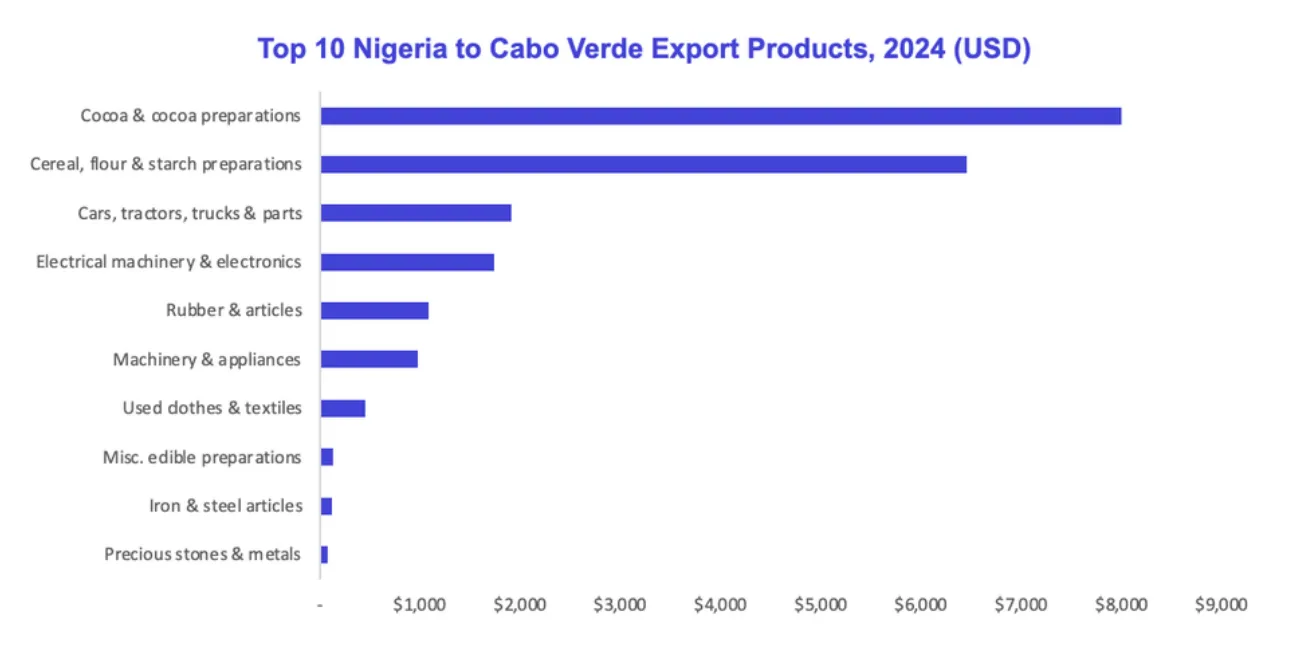
| Cocoa & cocoa preparations | n/a | n/a | n/a | $8.0k | 2024 only — 38% of 2024 total |
| Preparations of cereals, flour, starch or milk | n/a | n/a | $14.0k | $6.4k | 2 of 4 yrs, 2023–2024 only |
| Cars, tractors, trucks & parts thereof | $5.3k | $7.9k | $13.3k | $1.9k | Present all 4 yrs |
| Machinery, mechanical appliances & parts | $8.1k | $8.3k | $8.2k | $1.0k | Present all 4 yrs |
| Electrical machinery and electronics | $5.7k | $6.8k | $6.6k | $1.7k | Present all 4 yrs |
| Rubber & articles thereof | $7.7k | $4.5k | $5.3k | $1.1k | Present all 4 yrs |
| Feather articles, feathers & artificial flowers | $2.7k | $5.0k | $2.8k | n/a | 3 of 4 yrs |
| Product (HS Chapter) | 2021 | 2022 | 2023 | 2024 | Status |
|---|---|---|---|---|---|
| Optical, photo & film equip.; medical instruments | n/a | n/a | $12.6k | $118.4k | 2 of 4 yrs — 98% of 2024 total |
| Preparations of fish, crustaceans & molluscs | n/a | n/a | $86.8k | n/a | 2023 only — 60% of 2023 total |
| Iron/Steel articles | $5.2k | n/a | n/a | n/a | 2021 only — 77% of 2021 total |
| Food residues & wastes; animal fodder | n/a | n/a | $28.7k | n/a | 2023 only |
| Fish, Crustaceans & Molluscs | n/a | n/a | $16.8k | n/a | 2023 only |
| Electrical machinery and electronics | $1.3k | $0.5k | n/a | $2.3k | 3 of 4 yrs, always minor |
| Machinery, mechanical appliances & parts | $0.2k | n/a | n/a | n/a | 2021 only |
| Books, newspapers & other printed matter | $7 | n/a | n/a | n/a | 2021 only — nominal value |
| Dimension | Assessment |
|---|---|
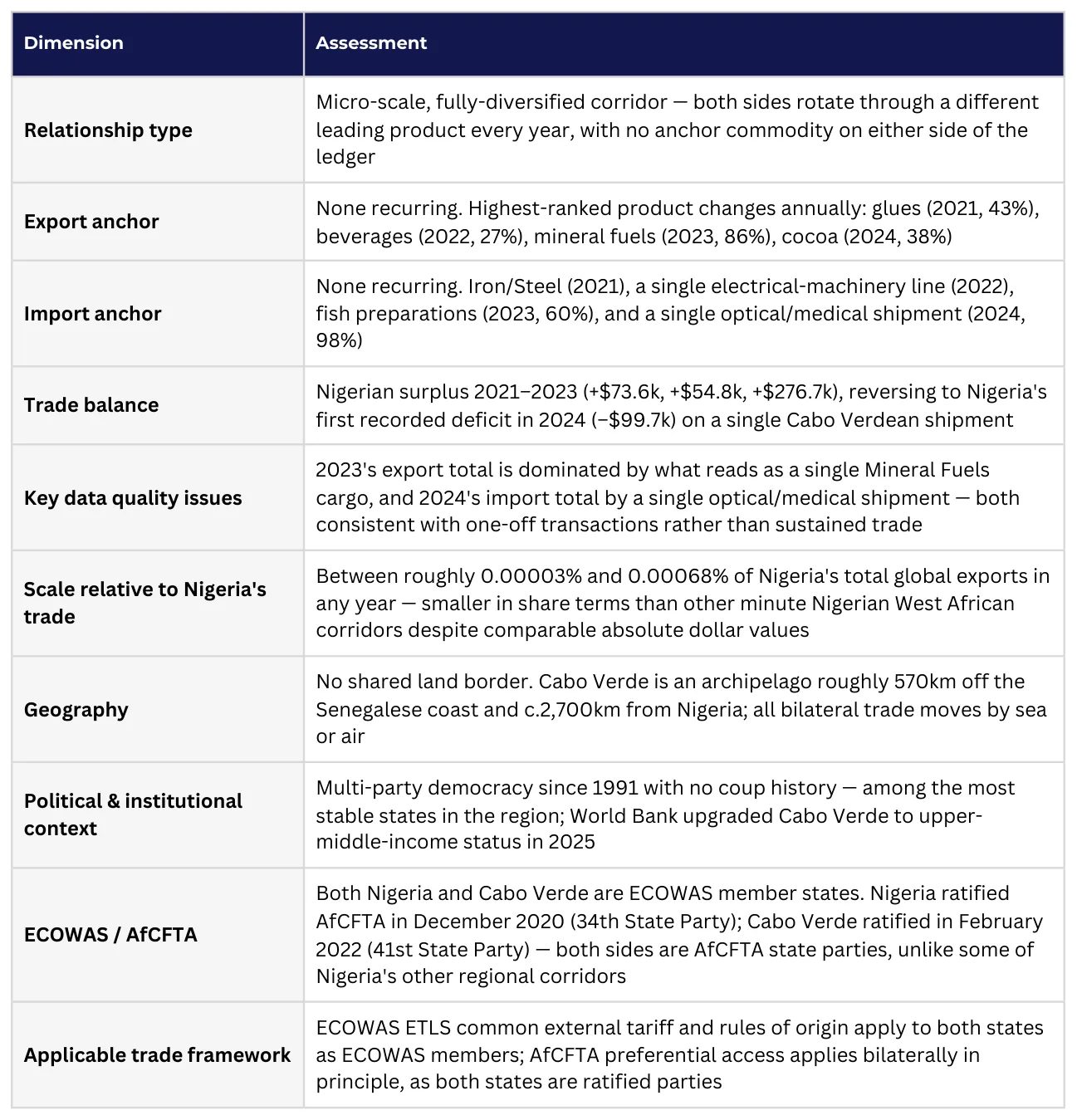
| Relationship type | Micro-scale, fully-diversified corridor — both sides rotate through a different leading product every year, with no anchor commodity on either side of the ledger |
| Export anchor | None recurring. Highest-ranked product changes annually: glues (2021, 43%), beverages (2022, 27%), mineral fuels (2023, 86%), cocoa (2024, 38%) |
| Import anchor | None recurring. Iron/Steel (2021), a single electrical-machinery line (2022), fish preparations (2023, 60%), and a single optical/medical shipment (2024, 98%) |
| Trade balance | Nigerian surplus 2021–2023 (+$73.6k, +$54.8k, +$276.7k), reversing to Nigeria's first recorded deficit in 2024 (–$99.7k) on a single Cabo Verdean shipment |
| Key data quality issues | 2023's export total is dominated by what reads as a single Mineral Fuels cargo, and 2024's import total by a single optical/medical shipment — both consistent with one-off transactions rather than sustained trade |
| Scale relative to Nigeria's trade | Between roughly 0.00003% and 0.00068% of Nigeria's total global exports in any year — smaller in share terms than other minute Nigerian West African corridors despite comparable absolute dollar values |
| Geography | No shared land border. Cabo Verde is an archipelago roughly 570km off the Senegalese coast and c.2,700km from Nigeria; all bilateral trade moves by sea or air |
| Political & institutional context | Multi-party democracy since 1991 with no coup history — among the most stable states in the region; World Bank upgraded Cabo Verde to upper-middle-income status in 2025 |
| ECOWAS / AfCFTA | Both Nigeria and Cabo Verde are ECOWAS member states. Nigeria ratified AfCFTA in December 2020 (34th State Party); Cabo Verde ratified in February 2022 (41st State Party) — both sides are AfCFTA state parties, unlike some of Nigeria's other regional corridors |
| Applicable trade framework | ECOWAS ETLS common external tariff and rules of origin apply to both states as ECOWAS members; AfCFTA preferential access applies bilaterally in principle, as both states are ratified parties |
BILATERAL TRADE SNAPSHOT
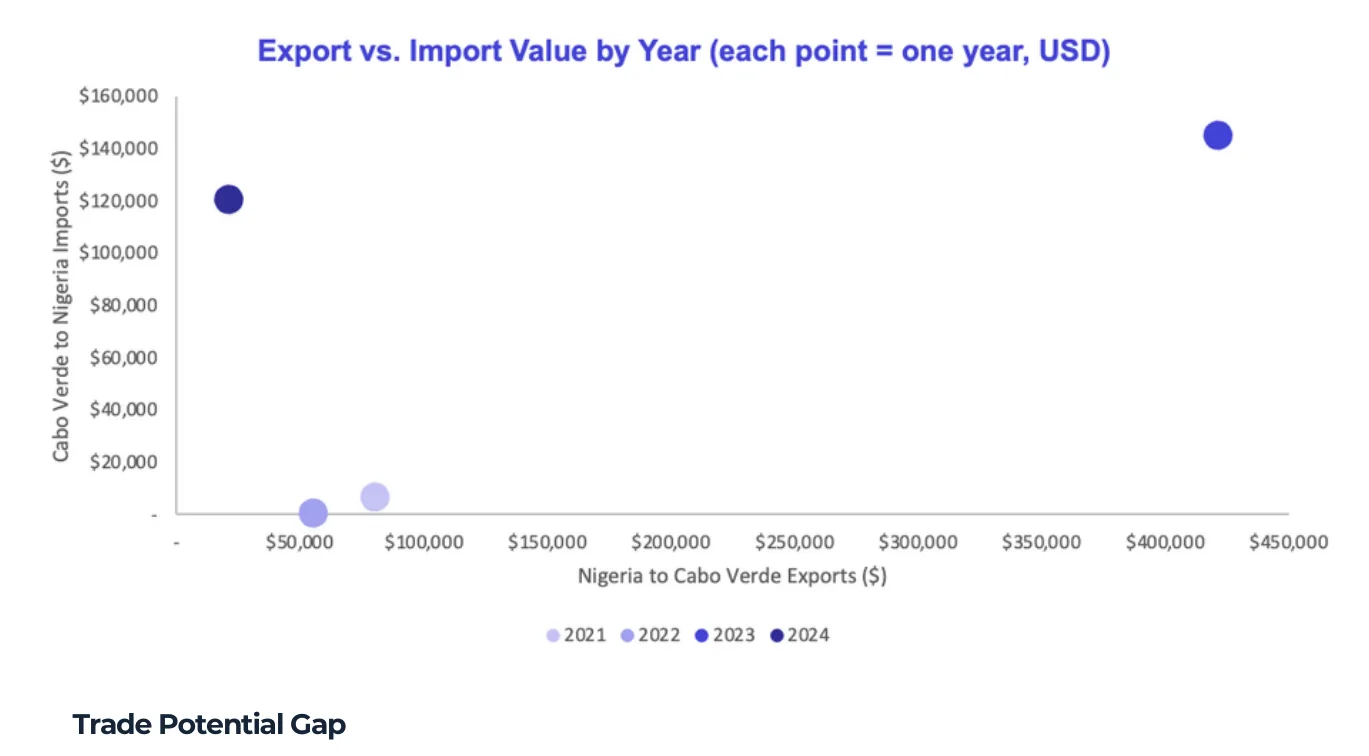
Both flows are volatile, small, and move independently of each other. Nigeria's exports to Cabo Verde have ranged from $21,051 to $421,631 across the 2021–2024 period, while Cabo Verde's recorded exports to Nigeria have ranged from $507 to $144,966 — both series moving independently of one another rather than in a consistent direction. The export series fell 31.2% from 2021 ($80,325) to 2022 ($55,285), surged 662.6% to $421,631 in 2023 on a single Mineral Fuels cargo, then fell 95.0% back to $21,051 in 2024.
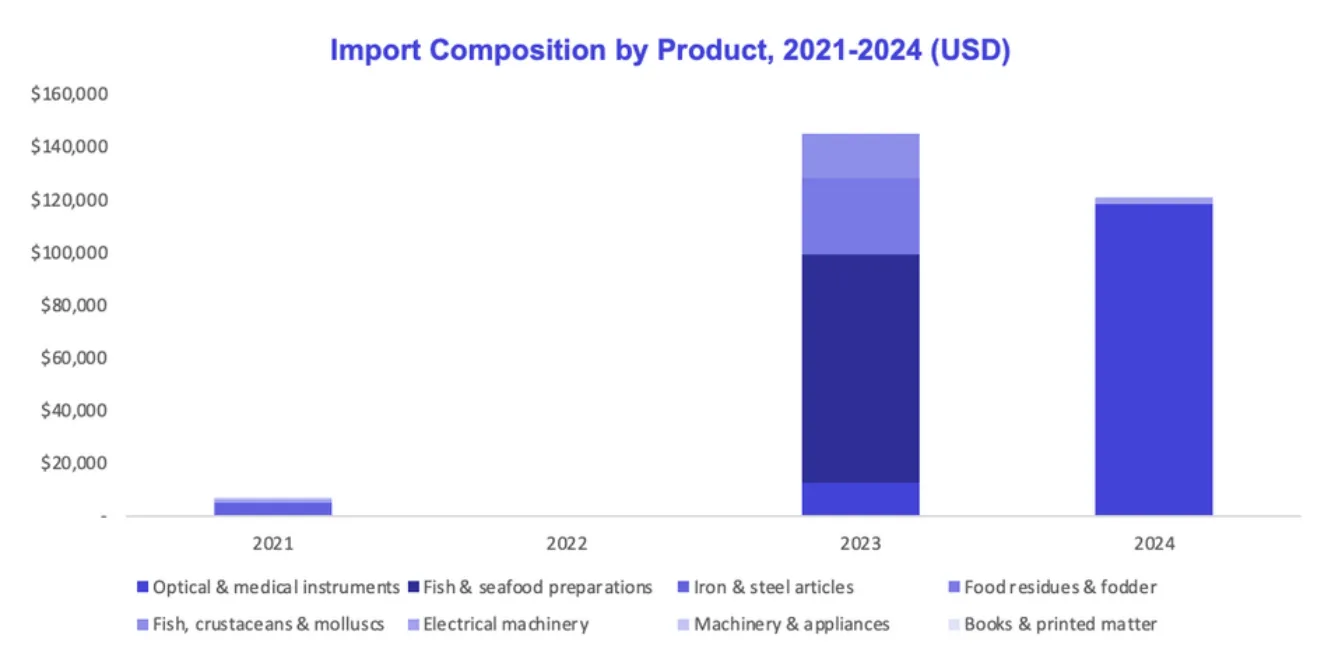
The balance flipped from Nigeria's largest surplus to its first deficit in a single year. Cabo Verde's import-side flows moved even more sharply: down 92.5% from $6,737 (2021) to $507 (2022), then up from that near-zero base to $144,966 (2023) and down 16.7% to $120,754 (2024). Because the two series do not move together, the trade balance has swung from a Nigerian surplus of $276,665 in 2023 — the corridor's largest surplus on record — to a Nigerian deficit of $99,703 the very next year, a reversal of $376,368 in a single year.
Even among Nigeria's smallest trading partners, this corridor barely registers. Set against Nigeria's global trade — exports ranging $58.1bn–$71.6bn and imports $48.1bn–$67.4bn across the same four years — the Cabo Verde corridor represents between roughly 0.00003% and 0.00068% of Nigeria's total export book in any given year. This is smaller in share terms than Nigeria's other minute West African corridors already documented in this series, despite Cabo Verde's bilateral dollar values being broadly comparable in absolute size — a reflection of how large Nigeria's aggregate trade base is, not of Cabo Verde being unusually marginal among small partners.
EXPORT PROFILE
Export Concentration Assessment
No export product has led this corridor in consecutive years. Nigeria's export basket to Cabo Verde rotates completely from year to year: the top-ranked product changed in every single year of the dataset, and no product has ever accounted for more than 86% of the annual total more than once. Glues, starches & albuminoid products led in 2021 (42.9% of that year's $80,325 total); beverages, spirits & vinegar led in 2022 (27.5% of $55,285); Mineral Fuels, Oils, Waxes & Distillates dominated 2023 (85.6% of $421,631, from what reads as a single cargo shipment); and cocoa & cocoa preparations led 2024 (38.0% of $21,051).
The only recurring products are Nigeria's standard manufactured-goods lines — present, but never dominant. Machinery & mechanical appliances, cars/tractors/trucks & parts, electrical machinery & electronics, and rubber & articles thereof are the only four lines present in all four years — a recognisable slice of Nigeria's standard manufactured-goods export basket, the same category of goods it ships to most West African partners. None of the four has ever ranked first; each sits consistently in the $1,000–$13,300 range, present but never dominant.
Nigeria's export basket to Cabo Verde is genuinely diversified by the standards of this brief series — ten or more distinct HS-chapter lines rank in most years — but that diversification produces volatility, not stability: with no anchor product, the annual total is at the mercy of whichever single shipment happens to rank first that year, as 2023's fuel cargo demonstrates.
IMPORT PROFILE
Import Concentration Assessment
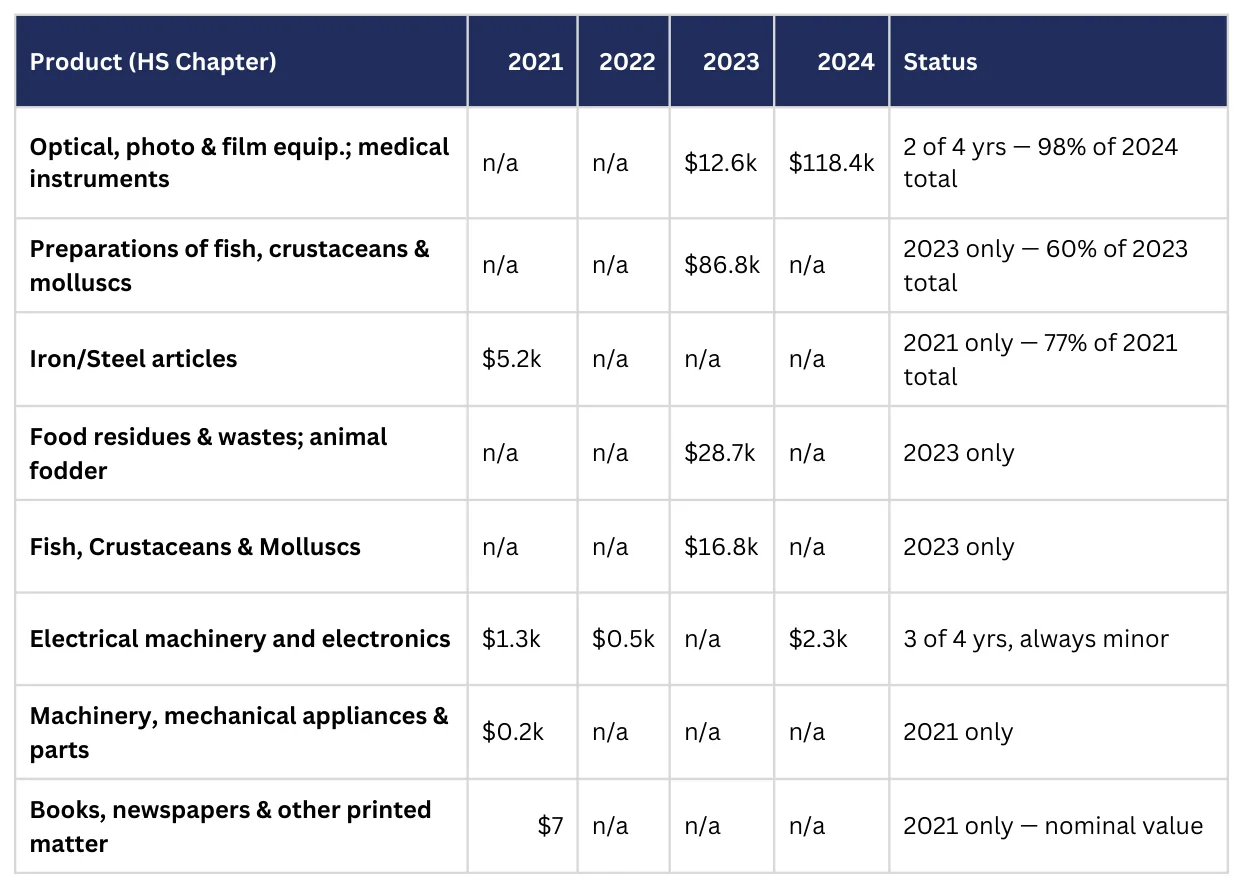
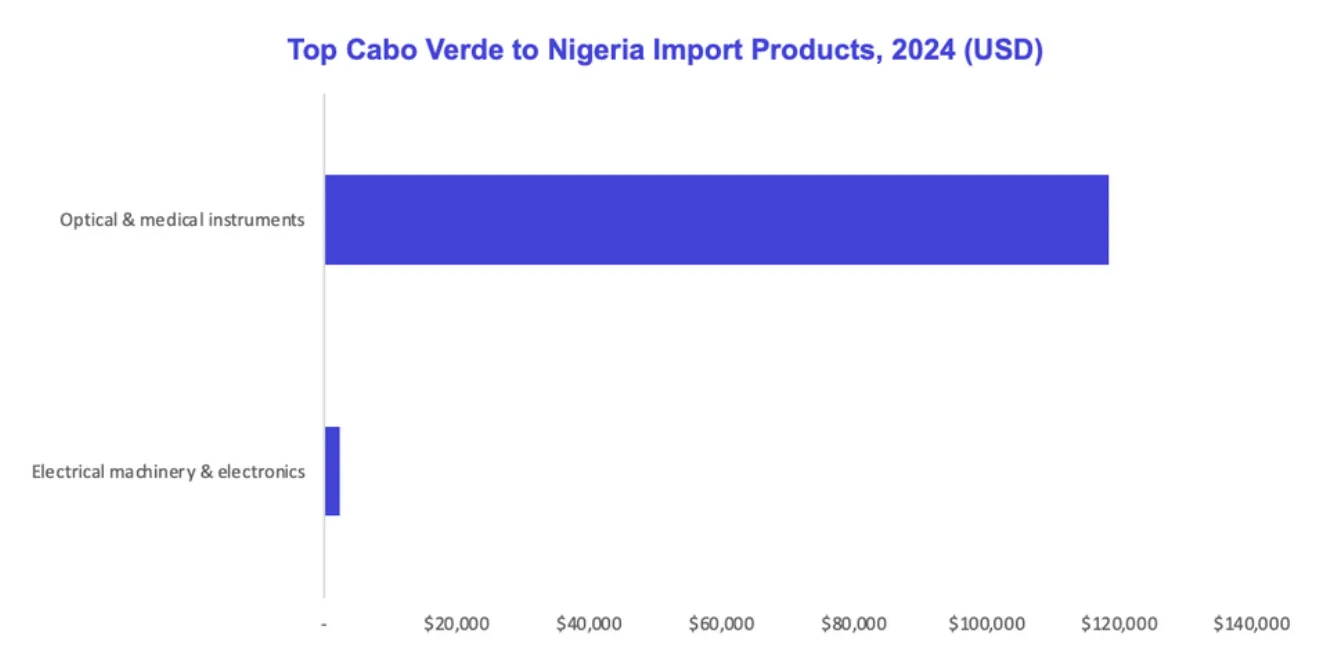
Cabo Verde has no import anchor product either — each year is dominated by a different single line. Iron/Steel articles led 2021 (76.5% of $6,737); a single Electrical machinery line was the entire 2022 total ($507); Preparations of fish, crustaceans & molluscs led 2023 (59.9% of $144,966); and Optical, photo & film equipment together with medical instruments made up 98.1% of the 2024 total ($118,418 of $120,754) — almost certainly a single large institutional or medical-equipment shipment rather than a recurring commercial flow.
Only one product recurs more than twice, and it has never been more than a minor line. Electrical machinery and electronics is the only product appearing in more than two of the four years (2021, 2022 and 2024), and even then it never exceeded $2,336 — present, but structurally minor in every year it appears. 2023 stands apart as the only year with a genuinely diversified import basket: fish preparations, food residues & animal fodder, fish/crustaceans, and optical/medical equipment together, rather than one dominant line.
This distinguishes the corridor from a typical commodity relationship: Cabo Verde's own best-known export sectors — fish products, and re-export/bunkering activity tied to its position as a mid-Atlantic shipping waypoint — appear only glancingly (fish products in 2023) in the Nigeria-bound data. The 2024 optical/medical spike in particular reads as a one-off institutional purchase or re-export rather than the start of a commercial trend.
| Product (HS Chapter) | 2021 | 2022 | 2023 | 2024 | Status |
|---|---|---|---|---|---|
| Optical, photo & film equip.; medical instruments | n/a | n/a | $12.6k | $118.4k | 2 of 4 yrs — 98% of 2024 total |
| Preparations of fish, crustaceans & molluscs | n/a | n/a | $86.8k | n/a | 2023 only — 60% of 2023 total |
| Iron/Steel articles | $5.2k | n/a | n/a | n/a | 2021 only — 77% of 2021 total |
| Food residues & wastes; animal fodder | n/a | n/a | $28.7k | n/a | 2023 only |
| Fish, Crustaceans & Molluscs | n/a | n/a | $16.8k | n/a | 2023 only |
| Electrical machinery and electronics | $1.3k | $0.5k | n/a | $2.3k | 3 of 4 yrs, always minor |
| Machinery, mechanical appliances & parts | $0.2k | n/a | n/a | n/a | 2021 only |
| Books, newspapers & other printed matter | $7 | n/a | n/a | n/a | 2021 only — nominal value |
About the Nigerian Macro Monitor
The Nigeria Macro Monitor is a macroeconomic intelligence platform that consolidates key Nigerian economic indicators into a single, structured environment — built by SysIN Insights Products.
It is an institutional data platform covering 1,000+ macroeconomic indicators, powered by our AI copilot Nkem IQ and a causal knowledge graph — deployed first in Nigeria and expanding to nine African economies by end-2027.
Asymmetry Analysis
The asymmetry here is not concentration on one side against diversity on the other — both sides are diversified, and both sides are volatile. Nigeria's exports at least draw on a recognisable, recurring manufactured-goods base (machinery, vehicles, electricals, rubber); Cabo Verde's return flow has no such recurring base at all, cycling through iron/steel, a single electrical line, fish products, and medical equipment with almost no overlap year to year. Cabo Verde's own best-known export sectors — tourism services, fish and seafood processing, and re-export/bunkering activity tied to its position as a mid-Atlantic shipping waypoint — barely intersect with Nigerian demand, which is not a natural buyer of Cabo Verdean fish products or transshipped fuel at any meaningful scale
Trade Potential Gap
The structural gap is one of market size and orientation rather than political friction. Cabo Verde's resident population is under 600,000 and its consumption patterns are heavily EU-anchored — its currency, the Cabo Verdean escudo, has been pegged to the euro since 1998, and its trade infrastructure and consumer preferences are oriented toward Portugal and the wider EU rather than toward Nigeria or the CFA-franc zone. Nigeria's recurring manufactured-goods exports (machinery, vehicles, electricals) could plausibly scale somewhat as Cabo Verde's upper-middle-income consumer base grows, but the country's small population puts a low structural ceiling on volumes regardless of tariff conditions. A first low-cost step would be establishing whether 2023's fuel cargo and 2024's medical-equipment shipment were commercial sales or institutional/re-export transactions, since the corridor's real organic trade level may be closer to its 2021–2022 range than its 2023–2024 spikes suggest.
AfCFTA and ECOWAS Framework
Nigeria and Cabo Verde are both ECOWAS member states, so the ECOWAS Trade Liberalisation Scheme (ETLS) applies to this corridor as it does to Nigeria's other regional partners. Unlike some of Nigeria's other West African trading partners, both countries are also ratified AfCFTA state parties — Nigeria ratified in December 2020 (34th country), and Cabo Verde ratified in February 2022, becoming the 41st State Party to deposit its instrument of ratification. Cabo Verde sits outside the WAEMU/UEMOA CFA-franc zone that several of Nigeria's other regional partners belong to; its euro-pegged escudo instead insulates the corridor from CFA-franc-specific dynamics while tying its trade and monetary conditions closely to the eurozone rather than to the naira or to WAEMU policy.
STRUCTURAL CONTEXT
Cabo Verde: Africa's Stability Anchor Reaches Upper-Middle-Income Status
Cabo Verde has no coup history and just crossed into upper-middle-income status. Cabo Verde has held multi-party elections without interruption since 1991 and has no coup history in its post-independence record, making it, by most governance measures, one of the most stable states in West Africa. That institutional stability was formally recognised in 2025, when the World Bank upgraded Cabo Verde to upper-middle-income status. The country nonetheless ranks 135th of 193 on the 2025 Human Development Index (value 0.668, life expectancy 72.9 years) — a reminder that income-classification upgrades and human-development outcomes do not move in lockstep, and that Cabo Verde's roughly 600,000 residents remain a genuinely small consumer market by any regional standard.
Tourism, transport and public investment continue to drive above-potential growth. Growth remained strong into 2026: GDP expanded 6.4% year-on-year in the first quarter of 2026, a slight cooling from 7.3% in the final quarter of 2025, driven by tourism, transport, and public investment — sectors that together make up more than half of national output.
Tourism is the single largest driver of the modern Cabo Verdean economy and its most dynamic source of employment growth, supported by continued airport modernisation and hotel investment.
Cabo Verde: Tourism-Led Growth Meeting Fiscal Consolidation
Growth is moderating from an exceptional 2024, but remains well above potential. Real GDP growth reached 7.2–7.3% in 2024 before moderating to an estimated 5.2% in 2025, converging toward the IMF's estimated potential growth rate of around 4.8% over the medium term. Forecasts for 2026 diverge by source — the African Development Bank projects a further slowdown to 4.7%, the IMF forecasts 5.1%, and Fitch Ratings expects an average of roughly 5.4% through 2026–2027 — but all three converge on continued, if moderating, above-potential growth. Inflation rose to 2.3% in 2025 from 1.0% in 2024, prompting Cabo Verde's central bank to raise its policy rate from 1.50% to 2.50% in February 2025; the IMF projects inflation stabilising around 2% over the medium term, broadly in line with the eurozone given the escudo's euro peg.
Fiscal consolidation is genuinely underway, though debt remains high and external risk is rising. Cabo Verde's fiscal position improved markedly in 2025: the budget balance moved to a surplus of 1.1% of GDP from a deficit of 1.1% in 2024, and the IMF projects the primary surplus reaching 1.3% of GDP in 2026 under its ongoing Extended Credit Facility and Resilience and Sustainability Facility arrangements. Public debt fell to 103.7% of GDP in 2025 from 109.2% in 2024 — a genuine improvement, though the absolute debt level remains high by any regional standard. The current account surplus narrowed to 3.2% of GDP in 2025 from 3.7%, and the IMF expects the balance to move toward a moderate deficit over 2026–2030 as climate-related spending and import demand from robust domestic consumption both rise. Foreign reserves stood at €978 million in November 2025, up from €729 million a year earlier, providing a stronger buffer for the currency peg. The IMF flags global growth slowdown, trade tensions, financing pressures and climate shocks — particularly drought and cyclone risk — as the principal downside risks, alongside slower-than-planned reform of state-owned enterprises.
None of this stability or fiscal progress has yet translated into materially larger trade with Nigeria. Cabo Verde's growth is domestically and tourism-driven rather than trade-driven, its import demand is overwhelmingly EU-oriented given the escudo's euro peg, and its consumer market of under 600,000 people offers limited absorptive capacity for Nigerian export volumes at any scale — macro conditions and bilateral trade volume are, in this corridor, largely decoupled from one another.
On the Trajectory (2025-2028 Outlook)
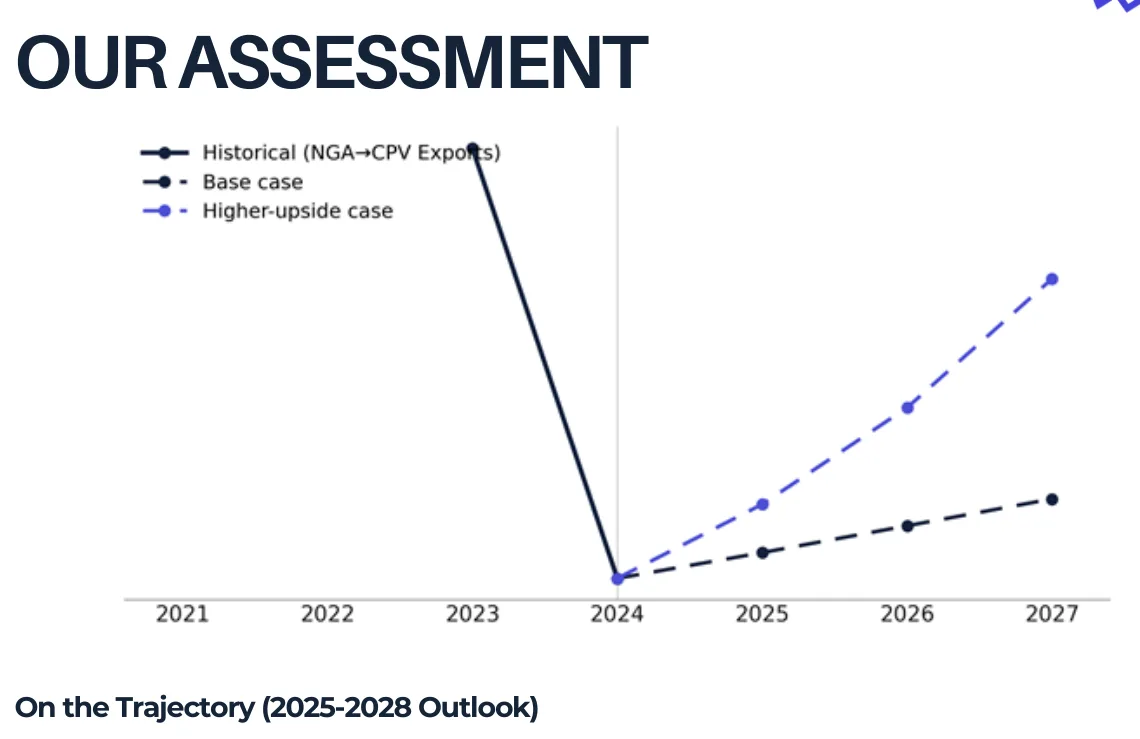
The base-case scenario for 2026–2028 is a corridor that continues to oscillate in a roughly $20,000–$150,000 range for Nigerian exports, with no single product taking a durable lead and annual totals remaining sensitive to individual shipments rather than reflecting a sustained trend. This assumes Cabo Verde's tourism-led growth continues to moderate toward its potential rate without a hard landing, and that 2023's fuel spike and 2024's medical-equipment spike are read as the one-off transactions they most plausibly represent, rather than as the start of a new pattern in either direction.
The higher-upside scenario would see Cabo Verde's upper-middle-income consumer base and continued tourism-driven demand gradually lift the four recurring Nigerian export lines — machinery, vehicles, electricals, rubber — into a more consistent $100,000–$300,000 annual range by 2027–2028, still immaterial to Nigeria's aggregate trade figures but a genuine improvement on the corridor's 2021–2022 base. The downside scenario is a corridor that reverts toward its smallest recorded years ($21,000–$55,000) if Cabo Verde's fiscal consolidation proves harder than planned, its high public debt level constrains import demand, or global tourism demand softens — none of which is Nigeria-specific risk, since this corridor's trajectory is overwhelmingly a function of conditions inside Cabo Verde rather than of Nigerian trade policy.
For the Reader's Action
For a trade ministry or policy body: Confirming whether 2023's Mineral Fuels export spike and 2024's Optical/medical import spike were commercial sales, re-exports, or institutional purchases is the priority, since the answer materially changes whether the corridor's “real” organic trade level is closer to its 2021–2022 range or its later years. Given the corridor's near-total immateriality to Nigeria's aggregate trade figures, this is a relationship to monitor for data quality and diplomatic value rather than to actively develop through trade-policy instruments in the near term.
For a commercial institution or investor: Cabo Verde's political and macroeconomic stability make it a genuinely lower-risk partner than most of Nigeria's other West African corridors, but its small population, EU-anchored consumption patterns, and services-dominated economy cap the realistic scale of any Nigerian export opportunity well below what its stability alone might suggest. Any commercial engagement is more likely to succeed in niche manufactured-goods categories — the four recurring lines already present in the data — than in any attempt to displace Cabo Verde's EU-oriented supply chains wholesale.
About SysIN R&D
Most economic research produced about Africa is written for external funders, shaped by external assumptions, and consumed in rooms where Africans are rarely the principal. SysIN R&D exists to change the supply side of that equation — producing institutional-grade intelligence authored from inside the continent, calibrated to the decision-makers who act on it.
We operate on several research tracks.
Internal Research anchors SysIN's analytical identity. Flagship sector reports cover the macro-structural forces shaping Nigeria's economy — monetary conditions, trade flows, fiscal positioning, and sectoral investment dynamics.
Commissioned policy research is available for sovereign clients, development institutions, think-tanks and multilaterals requiring bespoke analytical depth on defined questions.
External Intelligence is produced for actors navigating Nigeria from the outside. Foreign economic strategy reports give governments, trade bodies, and multinational enterprises the structural framing they need to engage Nigeria with precision. Country trade intelligence briefs distil bilateral flow data, market access conditions, and sector-level opportunity into formats designed for ministerial briefings, investment committees, and development agency submissions.
References
[1] OEC BACI (Trade Explorer) — Nigeria bilateral trade with Cabo Verde, 2021–2024
[2] IMF — Cabo Verde: 2025 Article IV Consultation, Seventh Review under the ECF Arrangement (Country Report No. 25/43) https://www.imf.org/-/media/files/publications/cr/2025/english/1cpvea2025001-print-pdf.pdf
[3] IMF — Cabo Verde: Country Report No. 26/53 https://www.imf.org/-/media/files/publications/cr/2026/english/1cpvea2026001-source-pdf.pdf
[4] IMF — Executive Board Concludes 2025 Article IV Consultation, 7th ECF Review and 3rd RSF Review with Cabo Verde (Feb 2026) https://www.imf.org/en/news/articles/2026/02/07/pr26036-cabo-verde-imf-concl-2025-aiv-consultation-7th-rev-under-ecf-and-3rd-rev-under-rsf
[5] African Development Bank — Cabo Verde Economic Outlook https://www.afdb.org/en/countries/west-africa/cabo-verde/cabo-verde-economic-outlook
[6] Cabo-Verde.cv — Cape Verde Economy Grows 6.4% in Q1 2026 https://cabo-verde.cv/cape-verde-economy-grows-6-4-in-q1-2026-gdp-report/
[7] African Union — Republic of Cabo Verde becomes 41st State Party to deposit AfCFTA ratification https://au.int/en/pressreleases/20220206/republic-cabo-verde-became-forty-first-41st-deposit-agreement-establishing
[8] UNECA — Nigeria becomes 34th country to ratify AfCFTA agreement https://www.uneca.org/storys/nigeria-becomes-34th-country-ratify-afcfta-agreement
[9] Wikipedia — African Continental Free Trade Area (ratification status) https://en.wikipedia.org/wiki/African_Continental_Free_Trade_Area
[10] tralac — Status of AfCFTA Ratification https://www.tralac.org/resources/infographic/13795-status-of-afcfta-ratification.html
[11] tralac / ECOWAS — ECOWAS member states and legal texts https://www.tralac.org/resources/by-region/ecowas.html
[12] CaboVerdeExpert.com — Cabo Verde Economic Partnerships: ECOWAS, EU, GSP, US AGOA, AfCFTA https://www.caboverdeexpert.com/cabo-verde-economic-partnerships-ecowas-eu-gsp-us-agoa-afcfta/
Frequently asked questions
What is the overall trade relationship between Nigeria and Cabo Verde?
The trade relationship between Nigeria and Cabo Verde is characterized by small, volatile, and independent flows, lacking an anchor product from either side. It is the smallest of Nigeria's West African trade relationships in terms of share of Nigeria's global trade.
What products does Nigeria typically export to Cabo Verde?
Nigeria's top-ranked export products to Cabo Verde change annually, but four recurring manufactured-goods lines are consistently present: machinery & mechanical appliances, cars/tractors/trucks & parts, electrical machinery & electronics, and rubber & articles thereof, though none of these are dominant in value.
What products does Cabo Verde typically import from Nigeria?
Cabo Verde's imports from Nigeria also lack an anchor product, with different single lines dominating each year. Examples include Iron/Steel articles (2021), a single Electrical machinery line (2022), preparations of fish, crustaceans & molluscs (2023), and optical, photo & film equipment along with medical instruments (2024).
How has Cabo Verde's economic stability affected its trade with Nigeria?
Despite Cabo Verde's institutional stability, its upgrade to upper-middle-income status, and robust economic growth, these factors have not translated into materially larger trade with Nigeria. The corridor's dollar values remain low, and its import demand is primarily EU-oriented.
What is the outlook for Nigeria-Cabo Verde trade in 2025-2028?
The base-case scenario for 2026–2028 projects Nigerian exports to Cabo Verde oscillating in a $20,000–$150,000 range, with no durable leading product and annual totals sensitive to individual shipments. A higher-upside scenario could see recurring manufactured-goods exports reach $100,000–$300,000 annually if Cabo Verde's consumer base grows.