Nigeria & China Trade Brief 2026
China is Nigeria's largest import source and its largest bilateral deficit — a gap that narrowed from 2022 to 2024 only because Nigeria bought less.
Executive summary
China is Nigeria’s largest import source and its largest bilateral deficit. The gap narrowed from 2022 to 2024 only because Nigeria bought less.
Key findings
China was Nigeria’s largest import source in all four years.
It supplied 24.5% to 31.8% of all imports and 52.6% to 57.4% of machinery and electrical imports, but took only 2.4% to 5.7% of exports.
Nigeria ran a deficit with China every year, peaking at −$16.35bn in 2022.
It narrowed to −$10.76bn in 2024. In 2023 it exceeded Nigeria’s entire global goods deficit of −$5.4bn.
The 2022 to 2024 narrowing came mostly from import compression.
Imports from China fell 21.2% from 2021 to 2024, then rose 36.7% in 2025 (NBS). China’s import share hit 39.3% in H1 2026.
Minerals and metals exports to China rose every year, from $418.6m to $1.05bn.
Ores led, up from $212.0m to $553.4m. Mineral fuels still supplied 49.1% to 78.8% of exports, and most of the volatility.
China’s zero-tariff offer has applied to Nigerian goods since 1 May 2026.
China reports imports from Nigeria up 81% to $2.25bn in H1 2026, but total trade rose 35% to $17.4bn: the deficit is still widening.
| Year | Nigeria → China | China → Nigeria | Balance | Export cover | Export growth | Import growth |
|---|---|---|---|---|---|---|
| 2021 | $3.3bn | $18.23bn | −$14.93bn | 18.1% | Base year | Base year |
| 2022 | $1.7bn | $18.05bn | −$16.35bn | 9.4% | −48.5% | −1.0% |
| 2023 | $2.5bn | $16.51bn | −$14.01bn | 15.1% | +47.1% | −8.6% |
| 2024 | $3.6bn | $14.36bn | −$10.76bn | 25.1% | +44.0% | −13.0% |
| Product | HS | 2021 | 2022 | 2023 | 2024 | Pattern |
|---|---|---|---|---|---|---|
| Mineral fuels and oils | 27 | 2,600 | 835.4 | 1,400 | 2,400 | All 4 years; 49% to 79% of total |
| Ores, slag and ash | 26 | 212.0 | 397.2 | 406.8 | 553.4 | All 4 years; up every year |
| Salt, sulphur and stone | 25 | n.t. | 96.5 | 306.0 | 243.3 | Entered 2022 |
| Copper and articles | 74 | 138.3 | 118.4 | 188.1 | 231.1 | All 4 years; up 67% |
| Aluminium and articles | 76 | 68.3 | 93.1 | 28.8 | 24.0 | All 4 years; down since 2022 |
| Oil seeds (mainly sesame) | 12 | 36.9 | 28.7 | 57.5 | 37.2 | All 4 years; sesame-led |
| Raw hides and skins | 41 | 23.8 | 27.8 | 7.9 | n.t. | Left the top 10 in 2024 |
| Ships and boats | 89 | 19.8 | 24.5 | 8.1 | n.t. | Left the top 10 in 2024 |
| Live trees and plants | 06 | n.t. | n.t. | 42.3 | 6.1 | Entered 2023 |
| Wood and articles | 44 | n.t. | 9.0 | n.t. | 13.1 | 2 of 4 years |
| Glass and glassware | 70 | 27.1 | n.t. | n.t. | n.t. | 2021 only |
| Lead and articles | 78 | 19.7 | n.t. | n.t. | n.t. | 2021 only |
| Animal and vegetable fats | 15 | 19.1 | n.t. | n.t. | n.t. | 2021 only |
| Inorganic chemicals | 28 | n.t. | 6.1 | n.t. | n.t. | 2022 only |
| Organic chemicals | 29 | n.t. | n.t. | 10.2 | n.t. | 2023 only |
| Product | HS | 2021 | 2022 | 2023 | 2024 | Pattern |
|---|---|---|---|---|---|---|
| Machinery and parts | 84 | 3,600 | 3,200 | 2,800 | 2,300 | First every year; down 36.1% |
| Electrical machinery | 85 | 2,600 | 2,700 | 2,300 | 2,000 | Second every year; down 23.1% |
| Plastics and articles | 39 | 1,200 | 1,200 | 1,200 | 1,000 | All 4 years |
| Vehicles and parts | 87 | 1,000 | 1,100 | 978.6 | 1,000 | All 4 years; flat |
| Iron or steel articles | 73 | 945.7 | 1,100 | 1,000 | 779.9 | All 4 years |
| Iron and steel | 72 | 705.5 | 488.4 | n.t. | 506.4 | 3 of 4 years |
| Aluminium articles | 76 | 675.7 | 589.3 | 473.8 | 390.6 | All 4 years; down every year |
| Furniture, prefab buildings | 94 | n.t. | 401.1 | 418.2 | 441.8 | Entered 2022; up every year |
| Artificial hair and wigs | 67 | n.t. | n.t. | 437.0 | 382.7 | 2023 and 2024 |
| Medical and optical goods | 90 | 609.4 | n.t. | 384.7 | n.t. | 2021 and 2023 |
| Clothing accessories | 62 | 515.0 | n.t. | 397.2 | n.t. | 2021 and 2023 |
| Other chemical products | 38 | 423.5 | 609.2 | n.t. | n.t. | 2021 and 2022 |
| Footwear | 64 | n.t. | 655.4 | n.t. | n.t. | 2022 only |
| Man-made filaments | 54 | n.t. | n.t. | n.t. | 491.3 | New entry 2024 |
| Top-10 total | 12,275 | 12,043 | 10,390 | 9,293 | Coverage 62.9% to 67.3% |
| Scenario | Exports | Imports | Balance | Conditions |
|---|---|---|---|---|
| Base | $5.41bn | $24.13bn | −$18.72bn | Brent $80; minerals +45% in 2026; imports rebound in line with NBS 2025 data |
| Upside | $6.94bn | $21.62bn | −$14.68bn | Brent near $90; minerals +60% then +30%; local assembly slows consumer imports |
| Downside | $3.66bn | $27.27bn | −$23.61bn | Brent toward $65; minerals stall; import surge on tariff cuts and election spending |
| Factor | Status, September 2026 | Implication for the corridor |
|---|---|---|
| China zero-tariff regime | In force 1 May 2026 to 30 April 2028; Africa-wide partnership agreement under negotiation | Duty-free window for Nigerian agricultural and processed goods; renewal terms set the post-2028 outlook |
| Chinese export redirection | Exports to Africa +25.8% in 2025 and +32.1% in Q1 2026; China → Nigeria +42.3% y/y in June | Main driver of a re-widening deficit and of pressure on Nigerian manufacturers |
| Nigerian import demand | NBS: imports from China +36.7% in 2025; share of imports 39.3% in H1 2026 | The import compression of 2023 and 2024 has reversed |
| Nigeria 2026 tariff changes | 127 lines cut from 1 April; vehicle tariff 70% to 40% | Supports Chinese vehicle and industrial-input sales |
| Critical minerals | Raw-lithium export ban; 6,000 tpd Nasarawa plant commissioned in July; solid-mineral exports +80% in H1 | Fastest-growing export line; value depends on processing and enforcement |
| Oil and gas | Brent about $100; China diversifying toward Atlantic crude and LNG | Lifts the fuel line in 2026; the most volatile component |
| Ports and logistics | Lagos yards saturated; lithium shipments below capacity in Q1 | Imports crowd out export logistics; Lekki Deep Sea Port is the key relief valve |
| Monetary policy and FX | MPR cut to 23% on 22 September; ₦1,331/$; CNY15bn swap to December 2027 | Cheaper credit and stable FX raise demand for Chinese goods; the swap aids yuan settlement |
| Domestic backlash | NAFDAC counterfeit enforcement; dependency concerns in public debate | Risk of non-tariff measures or local-content rules targeting Chinese goods |
| Nigerian elections | Presidential poll on 16 January 2027; campaigns open since August | Policy-continuity risk for trade, FX and mining regulation |
Bilateral trade snapshot
Headline flows, balances and Nigeria’s dependence on China, 2021 to 2024.
Nigeria’s exports to China halved from $3.3bn in 2021 to $1.7bn in 2022, then rose 47.1% to $2.5bn in 2023 and 44.0% to $3.6bn in 2024, the highest point in the series. Chinese exports to Nigeria moved the other way on a far larger base, falling from $18.23bn to $14.36bn. Even in its best year, Nigeria earned about one dollar from China for every four it spent there.
The deficit widened from −$14.93bn in 2021 to a peak of −$16.35bn in 2022, when Nigeria’s oil exports to China collapsed, then narrowed to −$14.01bn in 2023 and −$10.76bn in 2024, a 34.2% improvement from the peak. About one-third came from higher Nigerian exports (+$1.9bn from 2022 to 2024) and two-thirds from lower Chinese imports (−$3.7bn), in years when naira devaluation, subsidy removal and falling household purchasing power were compressing Nigeria’s imports from almost every source.
The gap to Nigeria’s second-largest import origin is wide: India at $4.9bn in 2021, Belgium at $6.8bn in 2022, Singapore at $9.3bn in 2023 and Belgium at $4.5bn in 2024. In 2024, China supplied more than three times as much as the next country.
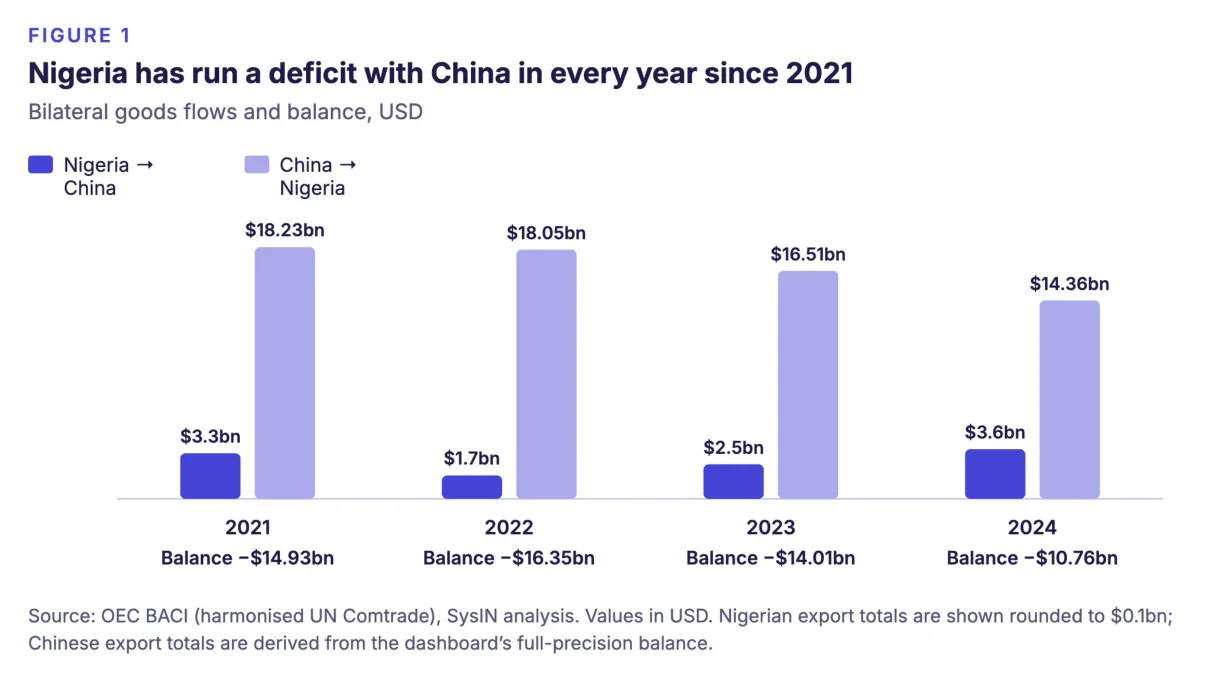
| Year | Nigeria → China (USD) | China → Nigeria (USD) | Balance (USD) |
|---|---|---|---|
| 2021 | $3.3bn | $18.23bn | −$14.93bn |
| 2022 | $1.7bn | $18.05bn | −$16.35bn |
| 2023 | $2.5bn | $16.51bn | −$14.01bn |
| 2024 | $3.6bn | $14.36bn | −$10.76bn |
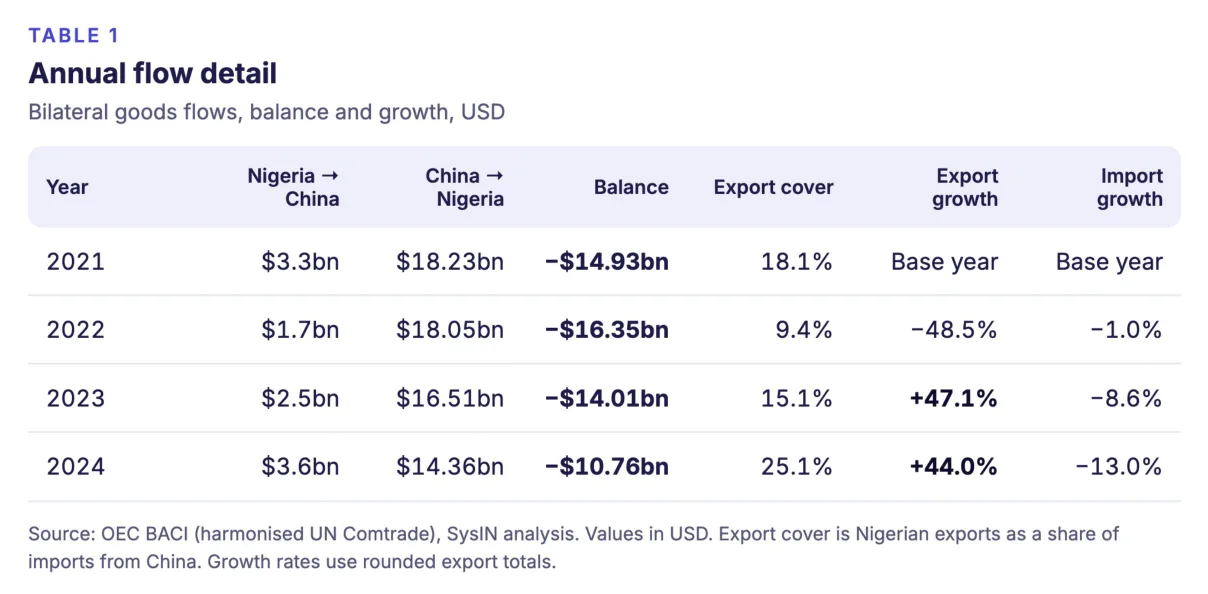
| Year | Nigeria → China (USD) | China → Nigeria (USD) | Balance (USD) | Export cover | Export growth | Import growth |
|---|---|---|---|---|---|---|
| 2021 | $3.3bn | $18.23bn | −$14.93bn | 18.1% | Base year | Base year |
| 2022 | $1.7bn | $18.05bn | −$16.35bn | 9.4% | −48.5% | −1.0% |
| 2023 | $2.5bn | $16.51bn | −$14.01bn | 15.1% | +47.1% | −8.6% |
| 2024 | $3.6bn | $14.36bn | −$10.76bn | 25.1% | +44.0% | −13.0% |
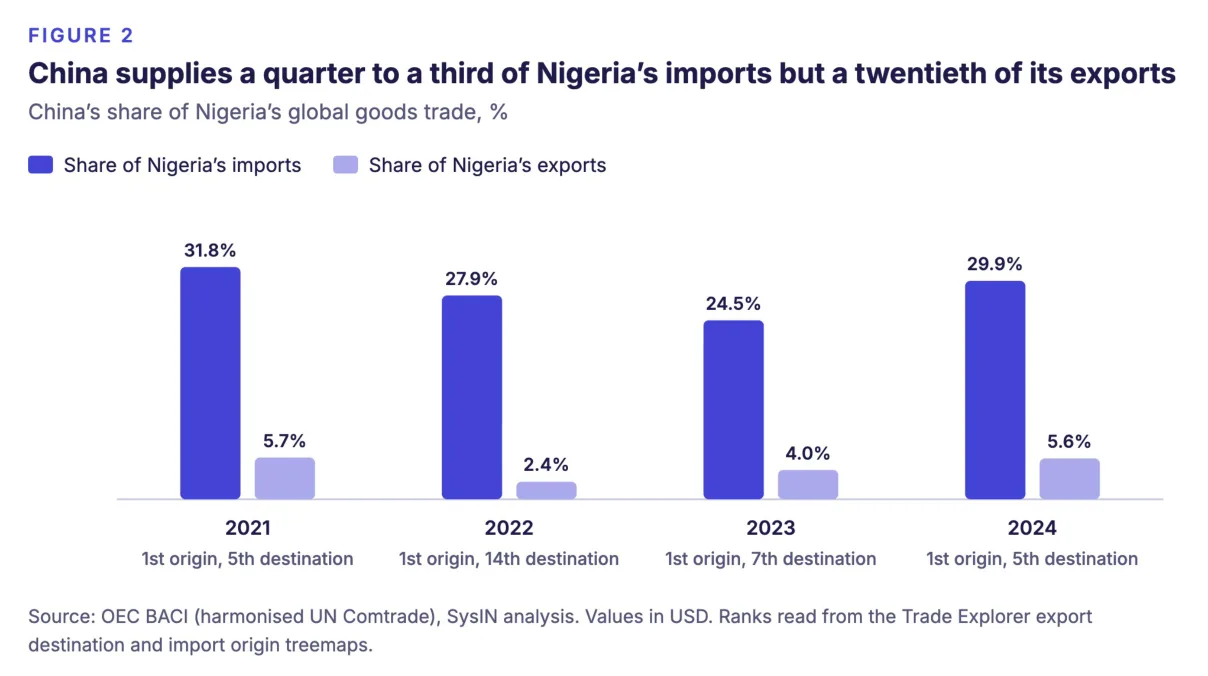
| Year | Share of Nigeria’s imports (%) | Share of Nigeria’s exports (%) | Rank annotation |
|---|---|---|---|
| 2021 | 31.8% | 5.7% | 1st origin, 5th destination |
| 2022 | 27.9% | 2.4% | 1st origin, 14th destination |
| 2023 | 24.5% | 4.0% | 1st origin, 7th destination |
| 2024 | 29.9% | 5.6% | 1st origin, 5th destination |
Export profile
Nigeria → China: the structure of outbound trade.
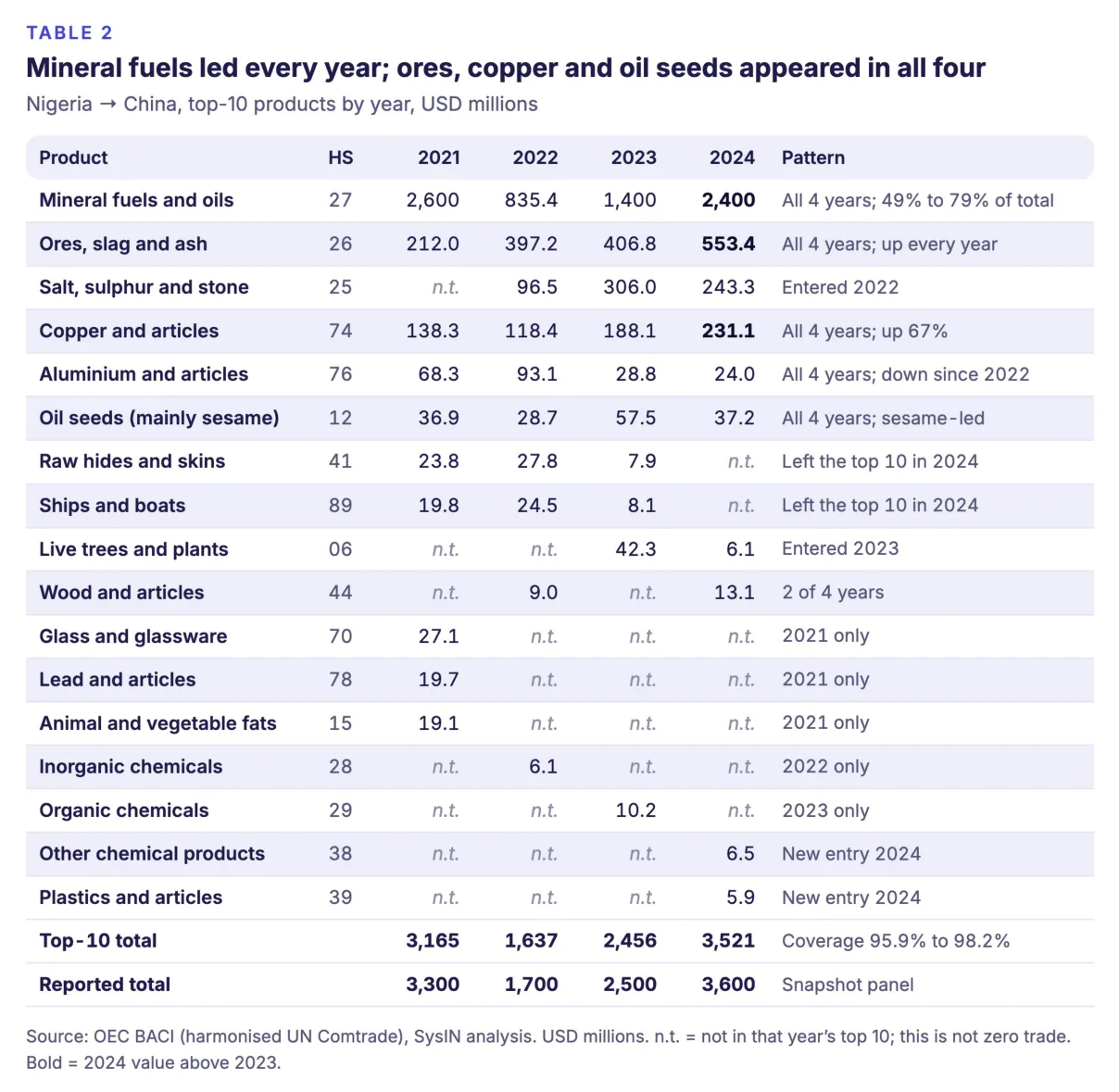
| Product | HS | 2021 (USD millions) | 2022 (USD millions) | 2023 (USD millions) | 2024 (USD millions) | Pattern |
|---|---|---|---|---|---|---|
| Mineral fuels and oils | 27 | 2,600 | 835.4 | 1,400 | 2,400 | All 4 years; 49% to 79% of total |
| Ores, slag and ash | 26 | 212.0 | 397.2 | 406.8 | 553.4 | All 4 years; up every year |
| Salt, sulphur and stone | 25 | n.t. | 96.5 | 306.0 | 243.3 | Entered 2022 |
| Copper and articles | 74 | 138.3 | 118.4 | 188.1 | 231.1 | All 4 years; up 67% |
| Aluminium and articles | 76 | 68.3 | 93.1 | 28.8 | 24.0 | All 4 years; down since 2022 |
| Oil seeds (mainly sesame) | 12 | 36.9 | 28.7 | 57.5 | 37.2 | All 4 years; sesame-led |
| Raw hides and skins | 41 | 23.8 | 27.8 | 7.9 | n.t. | Left the top 10 in 2024 |
| Ships and boats | 89 | 19.8 | 24.5 | 8.1 | n.t. | Left the top 10 in 2024 |
| Live trees and plants | 06 | n.t. | n.t. | 42.3 | 6.1 | Entered 2023 |
| Wood and articles | 44 | n.t. | 9.0 | n.t. | 13.1 | 2 of 4 years |
| Glass and glassware | 70 | 27.1 | n.t. | n.t. | n.t. | 2021 only |
| Lead and articles | 78 | 19.7 | n.t. | n.t. | n.t. | 2021 only |
| Animal and vegetable fats | 15 | 19.1 | n.t. | n.t. | n.t. | 2021 only |
| Inorganic chemicals | 28 | n.t. | 6.1 | n.t. | n.t. | 2022 only |
| Organic chemicals | 29 | n.t. | n.t. | 10.2 | n.t. | 2023 only |
| Other chemical products | 38 | n.t. | n.t. | n.t. | 6.5 | New entry 2024 |
| Plastics and articles | 39 | n.t. | n.t. | n.t. | 5.9 | New entry 2024 |
| Top-10 total | 3,165 | 1,637 | 2,456 | 3,521 | Coverage 95.9% to 98.2% | |
| Reported total | 3,300 | 1,700 | 2,500 | 3,600 | Snapshot panel |
Mineral fuels: large but volatile
Mineral fuels and oils (HS 27), crude oil and liquefied natural gas, supplied $2.6bn in 2021 (78.8% of the total), $835.4m in 2022 (49.1%), $1.4bn in 2023 (56.0%) and $2.4bn in 2024 (66.7%). The 68% fall in 2022, as Nigerian crude was pulled toward European buyers after Russia’s invasion of Ukraine and Nigerian output fell to multi-decade lows, explains the entire fall in total exports that year.
China never took more than 5.1% of Nigeria’s global fuel exports in any year. For Chinese buyers, Nigerian crude is swing supply rather than core supply.
Minerals and metals: the steadiest growth line
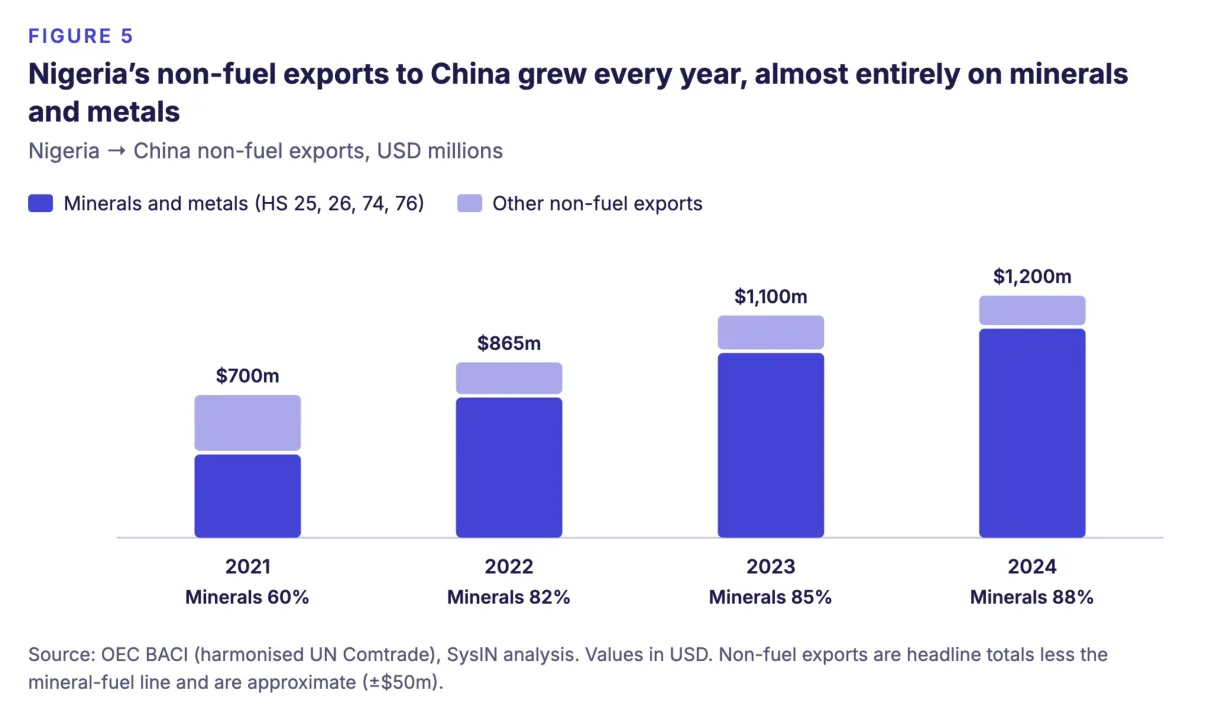
Four chapters, ores, slag and ash (HS 26), salt, sulphur, earth and stone (HS 25), copper (HS 74) and aluminium (HS 76), grew from $418.6m in 2021 to $1.05bn in 2024, a 2.5-fold rise that lifted the non-fuel share of exports to China from 21.2% to 33.3%.
Ores, slag and ash, which captures Nigeria’s tin, columbite, lithium and lead-zinc concentrates, rose from $212.0m to $553.4m and was the second-largest line in all four years. In 2022 China took half of Nigeria’s global ore exports. The copper and aluminium lines are largely scrap and semi-finished metal.
A thin agricultural basket
Agricultural exports are small despite their political prominence. Oil seeds, mainly sesame, ranged only from $28.7m to $57.5m, and raw hides and skins dropped out of the top 10 after 2023.
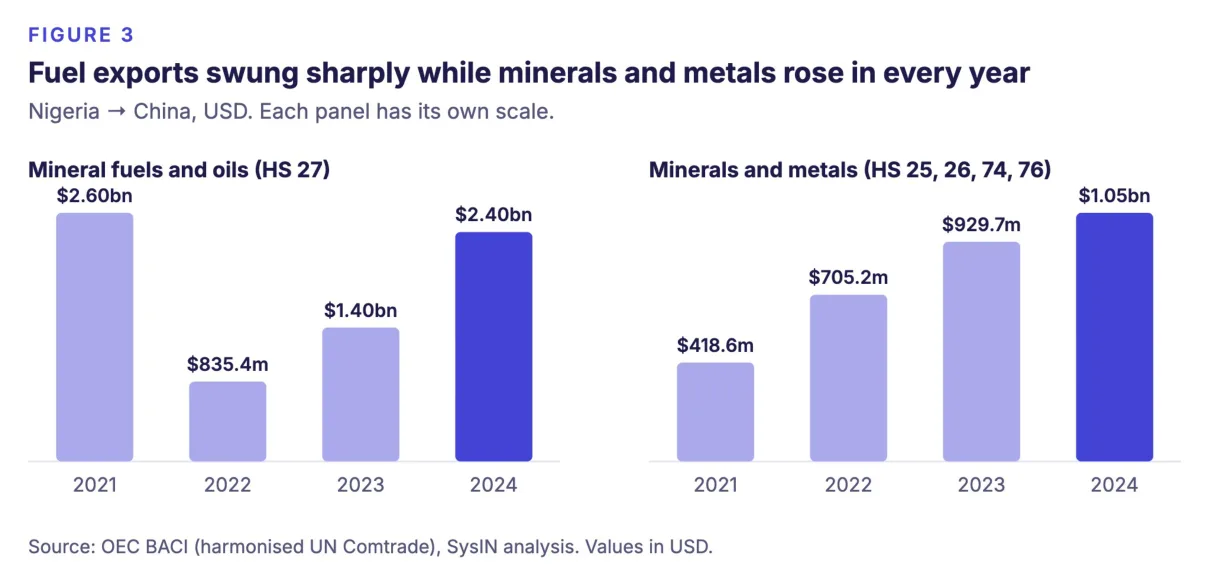
| Year | Mineral fuels and oils (HS 27), USD | Minerals and metals (HS 25, 26, 74, 76), USD |
|---|---|---|
| 2021 | $2.60bn | $418.6m |
| 2022 | $835.4m | $705.2m |
| 2023 | $1.40bn | $929.7m |
| 2024 | $2.40bn | $1.05bn |
Import profile
China → Nigeria: the structure of inbound trade.
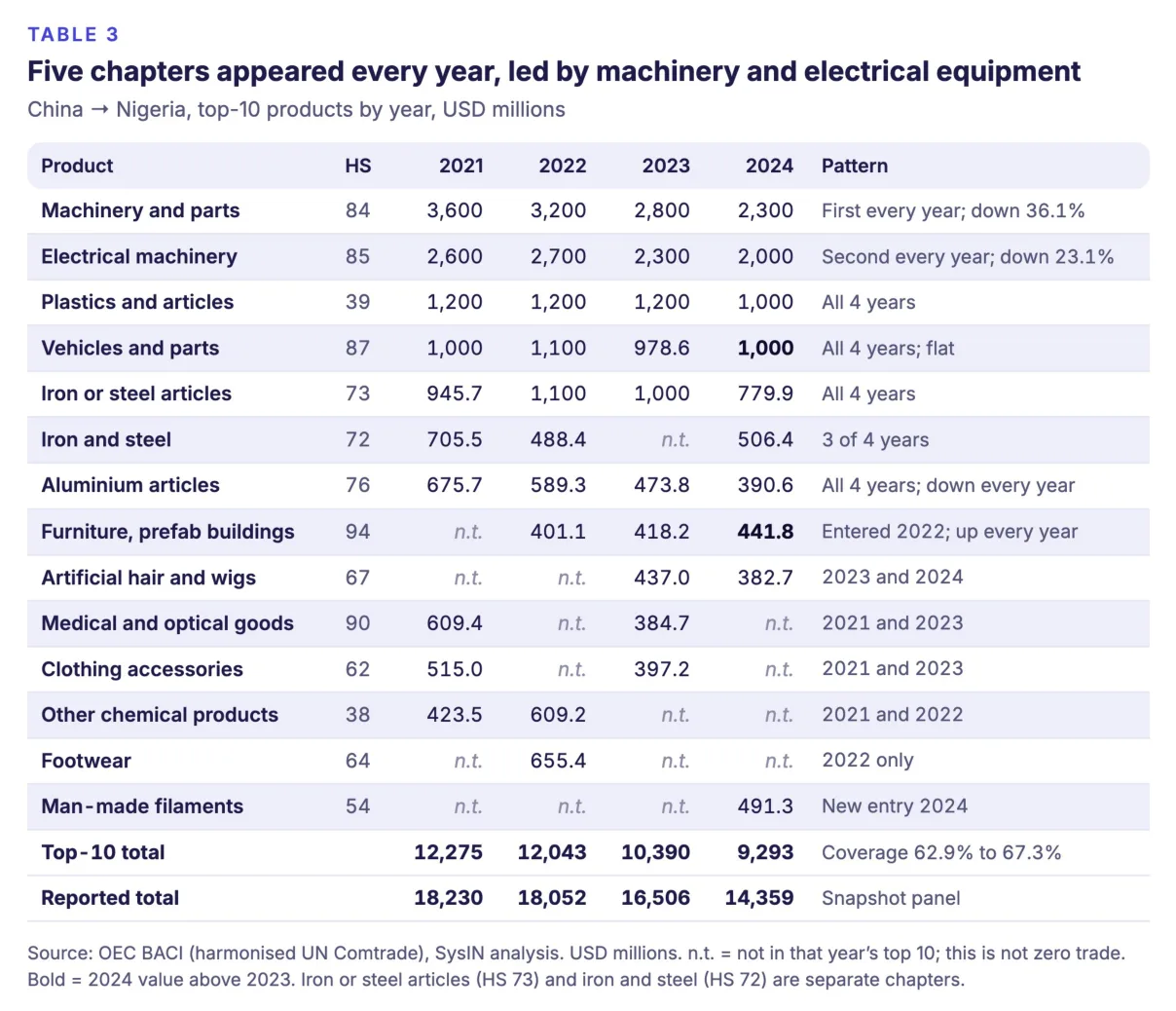
| Product | HS | 2021 (USD millions) | 2022 (USD millions) | 2023 (USD millions) | 2024 (USD millions) | Pattern |
|---|---|---|---|---|---|---|
| Machinery and parts | 84 | 3,600 | 3,200 | 2,800 | 2,300 | First every year; down 36.1% |
| Electrical machinery | 85 | 2,600 | 2,700 | 2,300 | 2,000 | Second every year; down 23.1% |
| Plastics and articles | 39 | 1,200 | 1,200 | 1,200 | 1,000 | All 4 years |
| Vehicles and parts | 87 | 1,000 | 1,100 | 978.6 | 1,000 | All 4 years; flat |
| Iron or steel articles | 73 | 945.7 | 1,100 | 1,000 | 779.9 | All 4 years |
| Iron and steel | 72 | 705.5 | 488.4 | n.t. | 506.4 | 3 of 4 years |
| Aluminium articles | 76 | 675.7 | 589.3 | 473.8 | 390.6 | All 4 years; down every year |
| Furniture, prefab buildings | 94 | n.t. | 401.1 | 418.2 | 441.8 | Entered 2022; up every year |
| Artificial hair and wigs | 67 | n.t. | n.t. | 437.0 | 382.7 | 2023 and 2024 |
| Medical and optical goods | 90 | 609.4 | n.t. | 384.7 | n.t. | 2021 and 2023 |
| Clothing accessories | 62 | 515.0 | n.t. | 397.2 | n.t. | 2021 and 2023 |
| Other chemical products | 38 | 423.5 | 609.2 | n.t. | n.t. | 2021 and 2022 |
| Footwear | 64 | n.t. | 655.4 | n.t. | n.t. | 2022 only |
| Man-made filaments | 54 | n.t. | n.t. | n.t. | 491.3 | New entry 2024 |
| Top-10 total | 12,275 | 12,043 | 10,390 | 9,293 | Coverage 62.9% to 67.3% | |
| Reported total | 18,230 | 18,052 | 16,506 | 14,359 | Snapshot panel |
Machinery and electrical: the structural core
Machinery (HS 84) and electrical machinery and electronics (HS 85) together supplied $6.2bn in 2021, $5.9bn in 2022, $5.1bn in 2023 and $4.3bn in 2024, about a third of the bilateral total each year. These are Nigeria’s generators, pumps, compressors, industrial equipment, telecoms hardware, solar components, batteries and consumer electronics. China supplied 47.5% to 53.7% of all Nigerian machinery imports and 60.5% to 65.9% of all electrical imports.
Decline without substitution
Every major line fell in value between 2021 and 2024, machinery by 36.1% and electrical by 23.1%. This was import compression, not substitution: China’s share of Nigeria’s combined machinery and electrical imports held between 52.6% and 57.4%, and its share of vehicle imports rose to 33.3% in 2024.
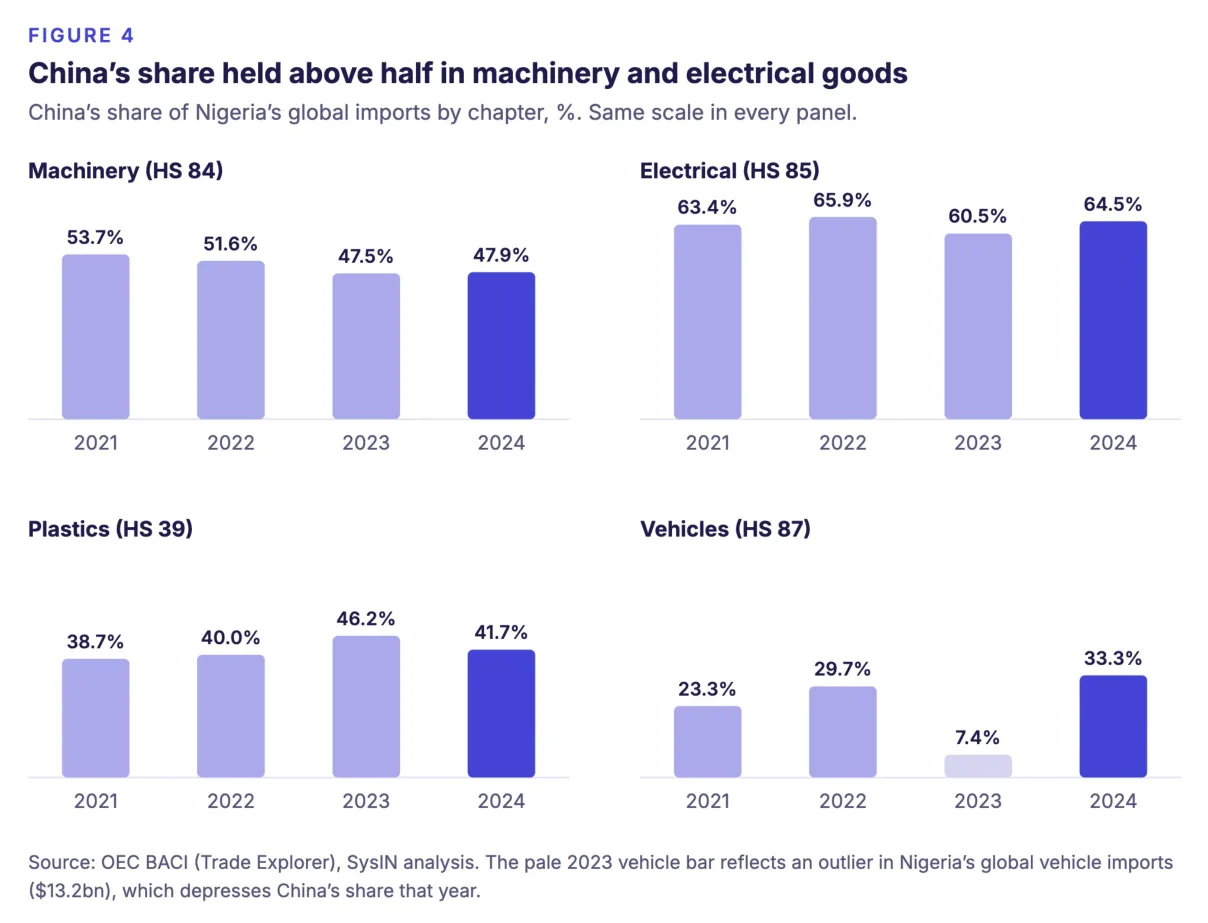
| Year | Machinery (HS 84): China’s share of Nigeria’s global imports (%) | Electrical (HS 85): China’s share of Nigeria’s global imports (%) | Plastics (HS 39): China’s share of Nigeria’s global imports (%) | Vehicles (HS 87): China’s share of Nigeria’s global imports (%) |
|---|---|---|---|---|
| 2021 | 53.7% | 63.4% | 38.7% | 23.3% |
| 2022 | 51.6% | 65.9% | 40.0% | 29.7% |
| 2023 | 47.5% | 60.5% | 46.2% | 7.4% |
| 2024 | 47.9% | 64.5% | 41.7% | 33.3% |
Beyond the core
Below the five core chapters, the ranked list rotates among consumer and construction goods: furniture and prefabricated buildings ($401.1m to $441.8m from 2022), artificial hair and wigs ($437.0m in 2023, $382.7m in 2024), footwear ($655.4m in 2022), clothing accessories, optical and medical instruments, and man-made filaments ($491.3m in 2024). The ranked top 10 captured only 62.9% to 67.3% of imports from China, so roughly $5.1bn to $6.1bn a year sits in lines too small to rank individually.
Bilateral relationship assessment
Nature, depth and asymmetries of the relationship.
Asymmetry analysis
The asymmetry in this corridor is the starkest in the brief series, and it is structural rather than cyclical. China ships Nigeria a full-spectrum manufactured basket of capital goods, intermediate inputs and consumer products; Nigeria ships China a handful of raw or lightly processed commodities.
The 2021 to 2024 fall in Chinese import values should not be read as declining dependence. China’s share of Nigeria’s imports dipped to 24.5% in 2023 but recovered to 29.9% in 2024, and NBS data for the first half of 2026 put it at 39.3%, and about 41% of non-fuel imports.
This is the one part of the corridor where Nigerian supply is shaping the relationship rather than absorbing it, and it is the part most exposed to Nigerian policy on raw-mineral exports and processing.
Trade potential gap
No plausible scenario closes the deficit before 2030. The realistic opportunity is to change what Nigeria sells into the corridor, along three threads.
First, beneficiated minerals: converting ore shipments into lithium concentrate, tin metal and refined products would raise unit values in the one export line already growing consistently. Second, agriculture under zero tariffs: sesame, ginger, cashew, cocoa and shea now enter China duty-free, but the oil-seed line has never exceeded $57.5m, and phytosanitary protocols, grading and traceability, not tariffs, are the binding constraints. Third, gas: petroleum gas was China’s largest single import from Nigeria in June 2026, and the Gulf supply shock has made Atlantic LNG more valuable to Asian buyers.
On the import side, the opportunity is to steer Chinese supply toward capital goods and local assembly, such as solar, batteries, vehicles and agro-processing equipment, rather than finished consumer goods that compete with Nigerian manufacturers.
Trade framework and China’s zero-tariff offer
There is no Nigeria-China free-trade agreement. Since 1 May 2026, China has unilaterally granted zero tariffs on all tariff lines to the 53 African countries with which it has diplomatic relations. For the 20 non-LDC economies, Nigeria among them, this is a preferential rate valid to 30 April 2028, while Beijing negotiates a China-Africa Economic Partnership for Shared Development agreement to lock the terms in. Goods under Chinese tariff-rate quotas enter duty-free only within quota, and rules of origin, inspection and quarantine requirements still apply.
Chinese officials report imports from Nigeria up 81% to $2.25bn in the first half of 2026, with growth above 40% in both May and June. At an August 2026 seminar in Abuja, Minister of State for Agriculture Aliyu Sabi Abdullahi cautioned that tariff removal alone does not guarantee export success. Much of Nigeria’s existing basket (crude, gas and ores) already entered China at low or zero duty, so the policy’s marginal effect falls mainly on agricultural and processed goods. The CBN and PBoC swap line offers a naira-yuan settlement channel that bypasses the dollar, though historical drawdowns have been modest relative to the trade flows involved.
Structural context
The external and domestic forces shaping the corridor in 2025 and 2026.
China’s export redirection: Africa as the overflow market
The most important external driver of this corridor in 2025 and 2026 is the redirection of Chinese exports away from the United States. China-Africa trade reached a record $348bn in 2025, up 17.7%. Chinese exports to Africa rose 25.8% to $225bn while imports from Africa grew only 5.4%, pushing Africa’s deficit with China up 64.5% to $102bn. China-Africa trade reached a record $197bn in the first half of 2026, and Chinese exports to Nigeria were up 42.3% year on year in June, led by electric batteries, synthetic woven fabrics and semiconductor devices.
Nigeria’s own policy has widened the door. The 2026 Fiscal Policy Measures, effective 1 April, cut import duties on 127 tariff lines and reduced the total effective tariff on fully built passenger vehicles from 70% to 40%. Rising inbound volumes also strain the export leg: Benchmark Mineral Intelligence reported in April 2026 that Nigerian lithium shipments in the first quarter ran well below mining capacity, as Lagos terminals periodically refused returned empty containers.
Critical minerals: Nigeria’s lithium build-out
After significant lithium discoveries in 2022, the Federal Government barred exports of unprocessed lithium and required miners to process in Nigeria, and Chinese investors have financed most of that capacity. In July 2026 President Tinubu commissioned a $250m, 6,000-tonne-per-day processing plant in Nasarawa State built by Diamond New Energy, described by the government as Africa’s largest. NBS data show solid-mineral export earnings up more than 80% to ₦249.7bn in the first half of 2026, with China among the largest buyers, though critics note that much of the growth still came from unprocessed ore.
Chinese demand is strong and strategic. Chinese imports of unwrought copper from Africa more than doubled in May 2026, and purchases of spodumene and platinum-group metals rose sharply. Zimbabwe’s halt to lithium concentrate exports in February 2026 has raised the strategic value of Nigerian supply. The open question is whether Nigeria can enforce its processing rules, secure its mining districts and move concentrate through its ports.
Energy: the Hormuz shock pulls Chinese buyers toward Atlantic barrels
The US-Israeli war with Iran and the effective closure of the Strait of Hormuz since late February 2026 have pushed Asian refiners away from Gulf supply. Crude remained China’s largest import from Africa in May 2026, up 21% to $3.11bn, and petroleum gas was China’s largest single import from Nigeria in June. Brent peaked near $118 in late March and traded around $100 on 21 September; the US EIA expects a 2026 average of $87. Nigeria produced 1.68m bpd of crude and condensate in August 2026. Nigerian crude still competes with discounted Russian and Iranian barrels, and the fuel line remains the corridor’s most volatile component.
Nigeria: easing cycle, import rebound and the election clock
The conditions that compressed imports in 2023 and 2024 have largely lifted. Real GDP grew 4.43% in the second quarter of 2026, inflation eased to 15.39% in August, the naira has held near ₦1,331/$ with reserves around $55bn, and on 22 September the CBN cut its policy rate by 350 basis points to 23%. Each supports stronger demand for Chinese goods.
The rise in China’s import share has also triggered a political reaction, including tighter NAFDAC enforcement against counterfeit products. With campaigns under way since August, the 16 January 2027 presidential election makes trade-protection rhetoric, local-content demands and changes to import-licensing or FX policy more likely before year-end.
Analyst’s assessment
Strategic verdict, outlook and implications for the reader.
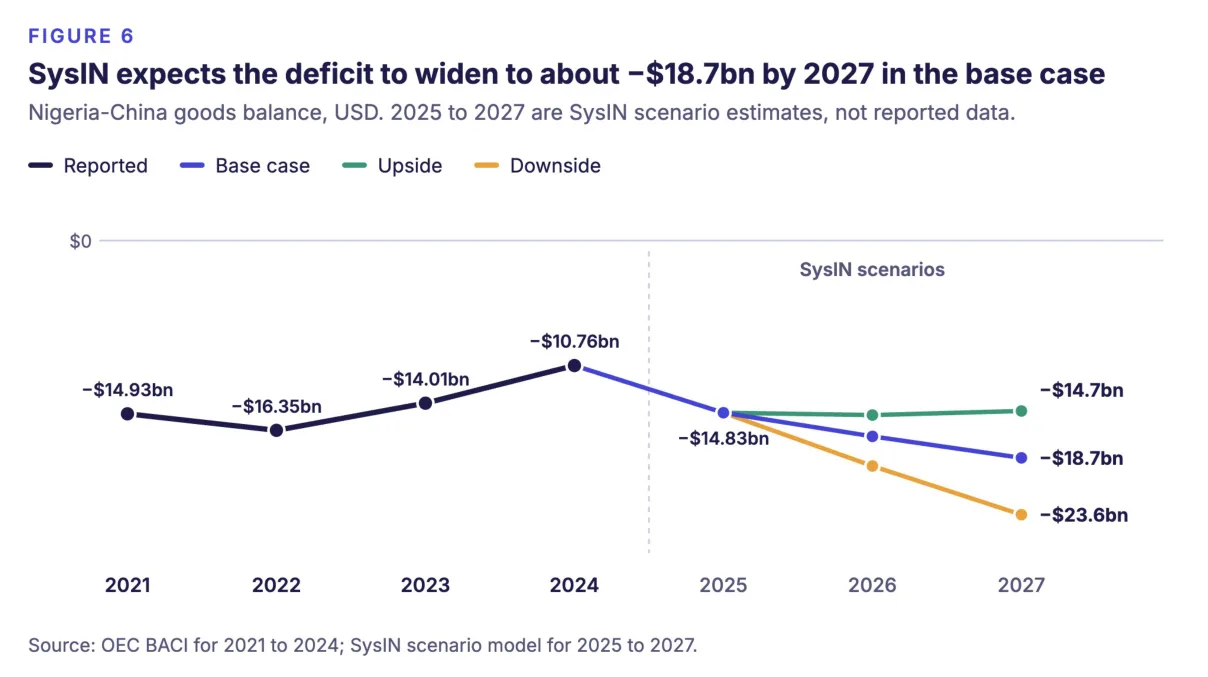
Outlook, 2025 to 2027
SysIN’s base case, built from the 2024 product composition and explicit price, volume and growth assumptions, sees Nigerian exports to China holding near $3.3bn in 2025 as lower oil prices offset minerals growth. Exports then rise to about $5.6bn in 2026 on higher crude and gas volumes during the Hormuz disruption, a 45% rise in minerals shipments and zero-tariff agricultural gains, before easing to about $5.4bn in 2027 as oil prices normalise.
Chinese exports to Nigeria rebound faster in absolute terms, to about $18.2bn in 2025, $22.5bn in 2026 and $24.1bn in 2027, in line with the 36.7% rise NBS recorded for 2025. The deficit therefore widens to about −$16.9bn in 2026 and −$18.7bn in 2027.
Upside and downside
The upside case requires Brent near $90 through 2027, minerals exports growing 60% in 2026 and 30% in 2027 as Nasarawa plants reach capacity and ports clear, strong agricultural take-up of zero tariffs, and slower growth in Chinese consumer imports as local assembly expands. The deficit would then stabilise near −$14.7bn.
The downside combines a Gulf settlement that takes Brent toward $65, stalled minerals growth due to insecurity, licensing disputes or port congestion, and an unchecked import surge fed by tariff cuts, a stronger naira and election-season spending. The deficit would reach about −$23.6bn, the widest in the series.
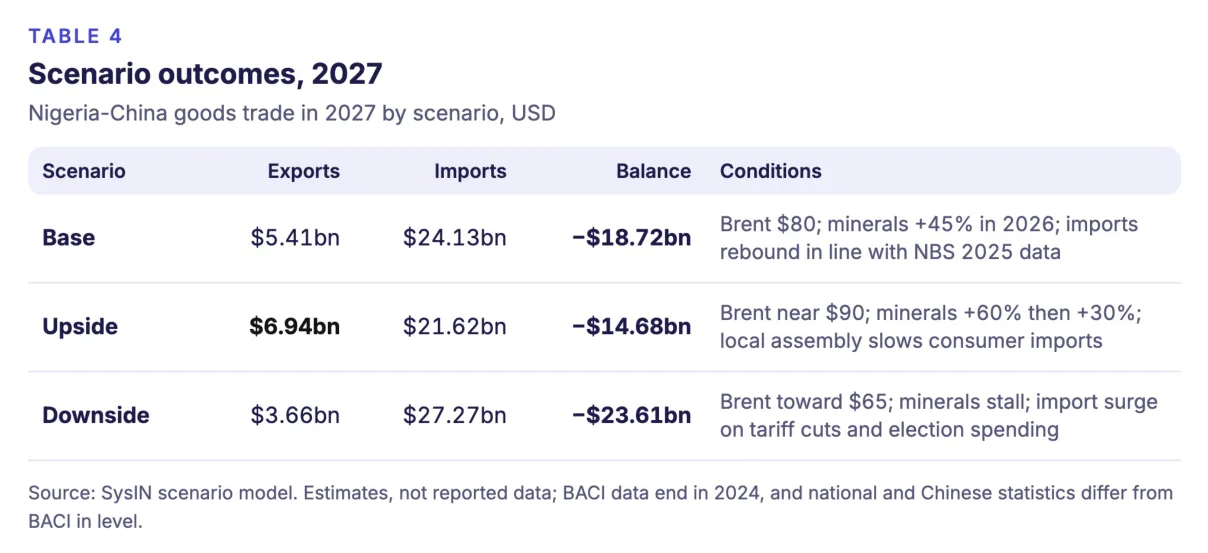
| Scenario | Exports (2027, USD) | Imports (2027, USD) | Balance (2027, USD) | Conditions |
|---|---|---|---|---|
| Base | $5.41bn | $24.13bn | −$18.72bn | Brent $80; minerals +45% in 2026; imports rebound in line with NBS 2025 data |
| Upside | $6.94bn | $21.62bn | −$14.68bn | Brent near $90; minerals +60% then +30%; local assembly slows consumer imports |
| Downside | $3.66bn | $27.27bn | −$23.61bn | Brent toward $65; minerals stall; import surge on tariff cuts and election spending |
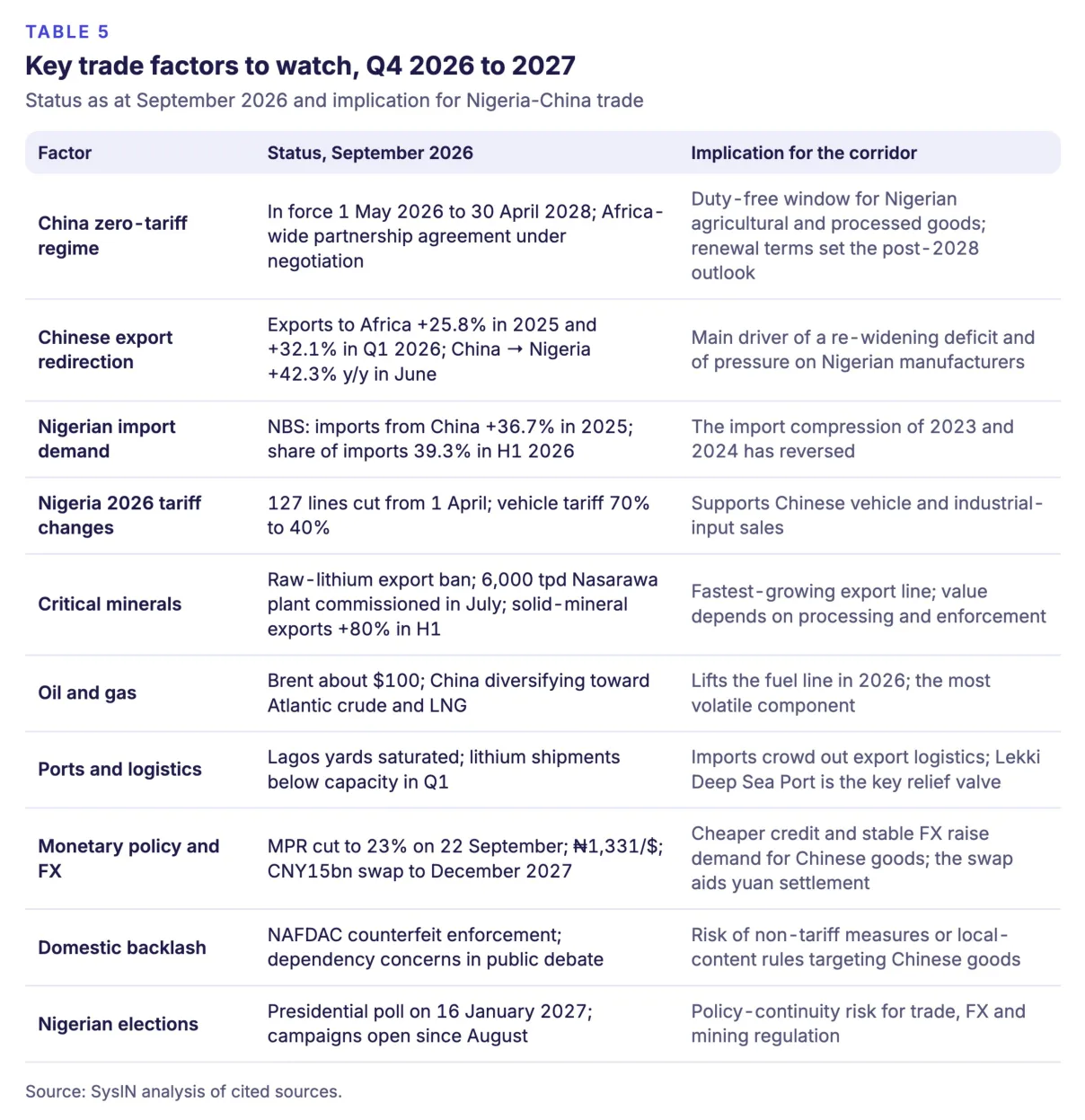
Trade ministries and policy bodies
Convert the zero-tariff window, which runs only to April 2028 unless renewed, into durable, higher-value export lines. That means a phytosanitary and market-access programme with China’s customs authority for five or six agricultural products (sesame, ginger, cashew, soybean, shea and cassava derivatives), enforcement of the raw-lithium export ban with faster permitting for in-country processing, and a negotiating position on the China-Africa partnership agreement that ties market access to local processing and technology transfer. On imports, a surge-monitoring framework for sensitive consumer lines, run through ECOWAS and AfCFTA trade-defence tools rather than unilateral bans, would give early warning as imports rebound.
Commercial institutions and investors
The clearest opportunity is the minerals processing chain (concentrate, logistics and trade finance for Chinese offtakers), where Chinese capital is committed and policy is pushing value addition onshore. Second, agricultural aggregation and certification businesses that can deliver China-compliant sesame, ginger and cashew at scale now face zero tariffs for the first time. Third, distributors and assemblers of Chinese solar, battery, vehicle and machinery products stand to gain from tariff cuts and the easing cycle, but should price in election-season policy risk, port congestion and possible new non-tariff measures. The naira-yuan swap is worth testing for settlement but should not be relied on as primary liquidity.
References
[1] Nigeria bilateral trade with China, 2021 to 2024 OEC BACI Trade Explorer, dataset
[2] China begins zero tariffs with 53 African countries from 1 May HKTDC Research https://research.hktdc.com/en/article/MjI3MzQ0MDE0Mw
[3] China to grant zero-tariff treatment to all African countries with diplomatic ties Gov.cn and Xinhua, April 2026 https://english.www.gov.cn/news/202604/28/content_WS69f0a1d7c6d00ca5f9a0aad0.html
[4] China implements historic zero tariffs for all African nations with diplomatic ties Gov.cn, May 2026 https://english.www.gov.cn/policies/policywatch/202605/01/content_WS69f45e35c6d00ca5f9a0ac01.html
[5] China rolls out zero-tariff access for Nigeria, 52 other African countries Vanguard, May 2026 https://www.vanguardngr.com/2026/05/china-rolls-out-zero-tariff-access-for-nigeria-52-other-african-countries/
[6] China’s free-trade offer to Africa won’t solve the trade imbalance The Diplomat, September 2026 https://thediplomat.com/2026/09/chinas-free-trade-offer-to-africa-wont-solve-the-trade-imbalance/
[7] China zero-tariff measures create new opportunities for Nigeria’s industrialization Xinhua, August 2026 https://english.news.cn/africa/20260815/4434eebbef26440d898707edb22efb89/c.html
[8] Nigeria’s exports to China soar 81% after zero-tariff policy P.M. News, 25 August 2026 https://pmnewsnigeria.com/2026/08/25/nigerias-exports-to-china-soar-81-after-zero-tariff-policy/
[9] Nigeria’s exports to China surge 80% to $2.3 billion in H1 2026 Nairametrics, 15 August 2026 https://nairametrics.com/2026/08/15/nigerias-exports-to-china-surge-80-to-2-3-billion-in-h1-2026/
[10] China (CHN) and Nigeria (NGA) trade OEC https://oec.world/en/profile/bilateral-country/chn/partner/nga
[11] China’s exports to Nigeria surge 37% to $13bn in 2025 Finance in Africa https://financeinafrica.com/insights/chinas-exports-to-nigeria-surge/
[12] China wins shopping trip nobody agreed to SBM Intelligence https://sbmintelligence.substack.com/p/china-wins-shopping-trip-nobody-agreed
[13] China now supplies 39% of Nigeria’s imports Fellow Press, 2026 https://www.fellowpress.com/china-39-percent-nigeria-imports-2026/
[14] China-Africa trade hits record US$348bn as deficit balloons NTU Centre for African Studies https://www.ntu.edu.sg/cas/news-events/news/detail/china-africa-trade-hits-record-us-348bn-as-deficit-balloons Nigeria & China Trade Brief 2026
[15] China-Africa trade in 2026: cooperation, but not on equal terms Ecofin Agency https://www.ecofinagency.com/insights/2704-55047-china-africa-trade-in-2026-cooperation-but-not-on-equal-terms
[16] China-Africa trade hits record high as zero-tariff policy boosts African exports African Times https://www.atnews.co.za/china-africa-trade-hits-record-high-as-zero-tariff-policy-boosts-african-exports/
[17] China’s imports from Africa surge after zero-tariff policy Trade World News https://www.tradeworldnews.com/chinas-imports-from-africa-surge
[18] China’s export growth surges in 2026, driving record trade surplus Global Banking & Finance https://www.globalbankingandfinance.com/china-exports-turbocharge-2026-record-breaking-year/
[19] PBOC and CBN renew bilateral currency swap agreement People’s Bank of China http://www.pbc.gov.cn/en/3688110/3688172/5188125/5547103/index.html
[20] Nigeria, China renew $2 billion currency swap deal Premium Times https://www.premiumtimesng.com/business/business-news/763887-nigeria-china-renew-2-billion-currency-swap-deal.html
[21] Nigeria’s lithium industry enters global spotlight as China expands its footprint Pan-African Genius News https://panageniusnews.substack.com/p/nigerias-lithium-industry-enters
[22] Solid mineral exports surge to N249.7bn The Journal https://thejournalnigeria.com/solid-mineral-exports-surge-to-n249-7bn/
[23] Lithium feedstock concerns over Nigeria port, security challenges Benchmark Mineral Intelligence https://source.benchmarkminerals.com/article/lithium-feedstock-concerns-over-nigeria-port-security-challenges
[24] Nigeria to open two Chinese-backed lithium processing plants this year Ground News https://ground.news/article/nigeria-to-launch-800m-lithium-processing-plants
[25] Zimbabwe freezes raw mineral exports as processing race begins CB Insights (Sinomine) https://www.cbinsights.com/investor/sinomine
[26] FG cuts tariffs on cars, palm oil, sugar in new 2026 fiscal policy measures TheCable https://www.thecable.ng/exclusive-fg-cuts-tariffs-on-cars-palm-oil-sugar-in-new-2026-fiscal-policy-measures/
[27] Nigeria announces 2026 fiscal and trade policy changes USDA FAS, May 2026 https://www.fas.usda.gov/data/gain/2026/05/nigeria-nigeria-announces-2026-fiscal-and-trade-policy-changes
[28] 2026 Iran war fuel crisis Wikipedia https://en.wikipedia.org/wiki/2026_Iran_war_fuel_crisis
[29] Brent crude oil Trading Economics https://tradingeconomics.com/commodity/brent-crude-oil Nigeria & China Trade Brief 2026
[30] Oil prices rise as attacks dent hopes for Strait of Hormuz reopening Al Jazeera, 12 August 2026 https://www.aljazeera.com/economy/2026/8/12/oil-prices-rise-as-attacks-dent-hopes-for-strait-of-hormuz-reopening
[31] Nigeria’s crude oil output rises 0.4% in August, NUPRC Vanguard, September 2026 https://www.vanguardngr.com/2026/09/nigerias-crude-oil-output-rises-0-4-in-august-nuprc/
[32] Nigeria’s economy grows 4.43% in Q2 2026, NBS Premium Times https://www.premiumtimesng.com/business/business-news/906587-nigerias-economy-grows-4-43-in-q2-2026-nbs.html
[33] Nigeria inflation rate Trading Economics https://tradingeconomics.com/nigeria/inflation-cpi
[34] CBN cuts interest rate to 23% Blueprint https://blueprint.ng/cbn-cuts-interest-rate-to-23/
[35] Dollar to naira exchange rate today, September 21, 2026 Opinion Nigeria https://www.opinionnigeria.com/dollar-to-naira-exchange-rate-today-september-21-2026/
[36] INEC issues revised timetable for 2027 general election Voice of Nigeria https://von.gov.ng/inec-issues-revised-timetable-for-2027-general-election/
Frequently asked questions
What is the trade balance between Nigeria and China?
Nigeria has run a deficit with China every year since 2021, peaking at −$16.35bn in 2022 and narrowing to −$10.76bn in 2024. Nigerian exports cover only 9.4% to 25.1% of imports from China.
What are Nigeria's main exports to China?
Mineral fuels and oils lead Nigeria's exports to China, supplying 49.1% to 78.8% of total exports. Ores, slag and ash, copper, and aluminium are also significant, with ores, slag and ash being the second-largest line in all four years, rising from $212.0m to $553.4m.
What does Nigeria primarily import from China?
Nigeria primarily imports machinery (HS 84) and electrical machinery and electronics (HS 85) from China, which together supplied about a third of the bilateral total each year. China supplied 47.5% to 53.7% of all Nigerian machinery imports and 60.5% to 65.9% of all electrical imports.
How does China's zero-tariff offer impact Nigeria?
Since May 1, 2026, China has granted zero tariffs on all tariff lines for Nigerian goods, valid until April 30, 2028. This offers a preferential rate for agricultural and processed goods, as much of Nigeria's existing basket (crude, gas, ores) already entered China at low or zero duty. However, officials caution that tariff removal alone does not guarantee export success.
What is the outlook for the Nigeria-China trade deficit?
SysIN expects the deficit to widen again, reaching approximately −$16.9bn in 2026 and −$18.7bn in 2027 under the base case scenario. This is primarily due to Chinese exports to Nigeria rebounding faster than Nigerian exports grow, driven by China's export redirection away from the US and Nigeria's recovering import capacity.