Human-Hair Wigs & Extensions: Nigeria in the Global Market 2026
Nigeria is the world’s second-largest importer of human-hair wigs, yet its own customs record about one-eightieth of what China reports shipping. The report sizes the trade, the consumer market and how Nigerians buy hair.
Executive summary
Nigeria spends more on imported human hair than any country except the United States, and almost none of it is made, recorded or taxed at home.
This report looks at HS 6704.20, finished wigs, extensions and hairpieces made of human hair. It sets Nigeria's trade data against the global consumer market and then looks closely at Nigerian buyers: who they are, what they pay and how they buy.
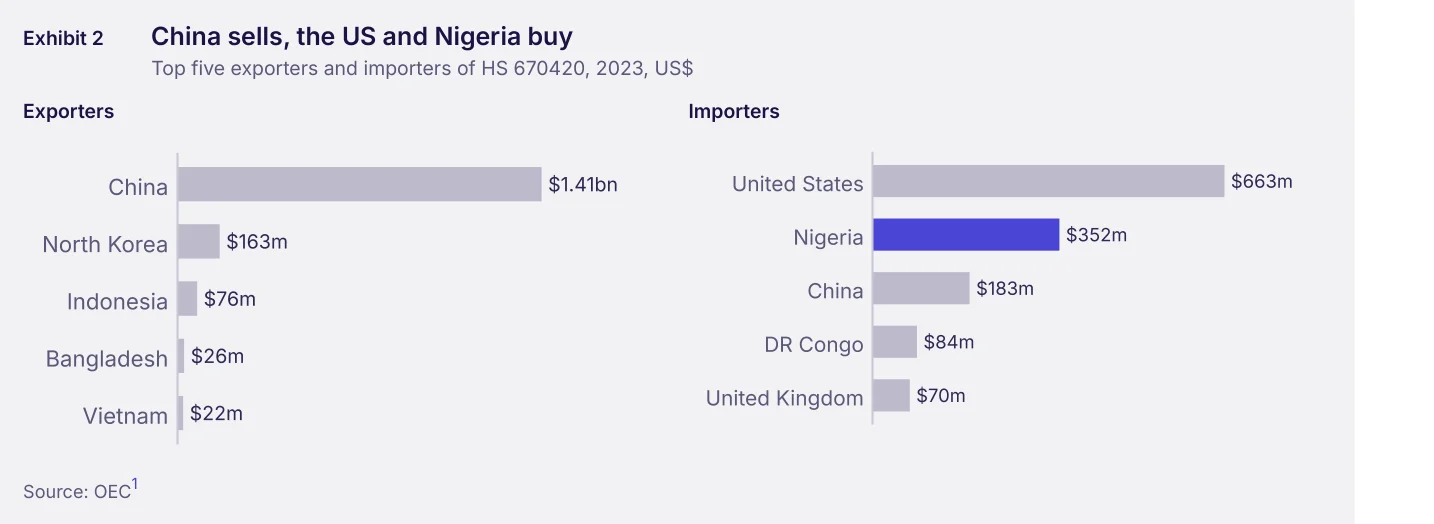
World trade in the product was $1.84bn in 2023. China exported $1.41bn of it1.
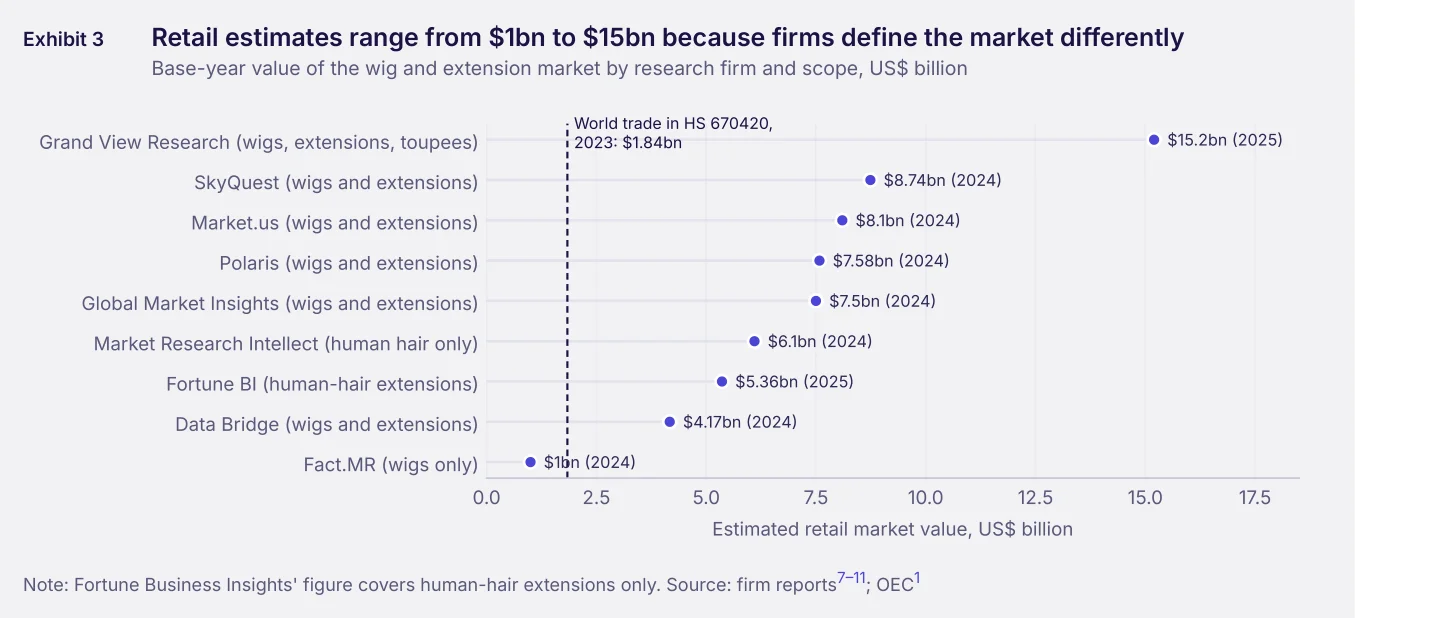
$15bn depending on scope. Most cluster at $7.5– 8.7bn for 2024, with human hair about 55–70% of value7,9,11.
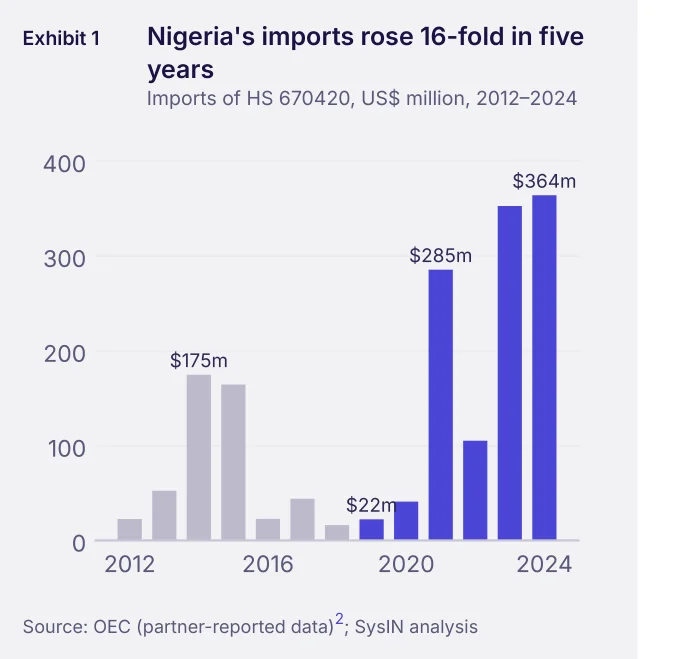
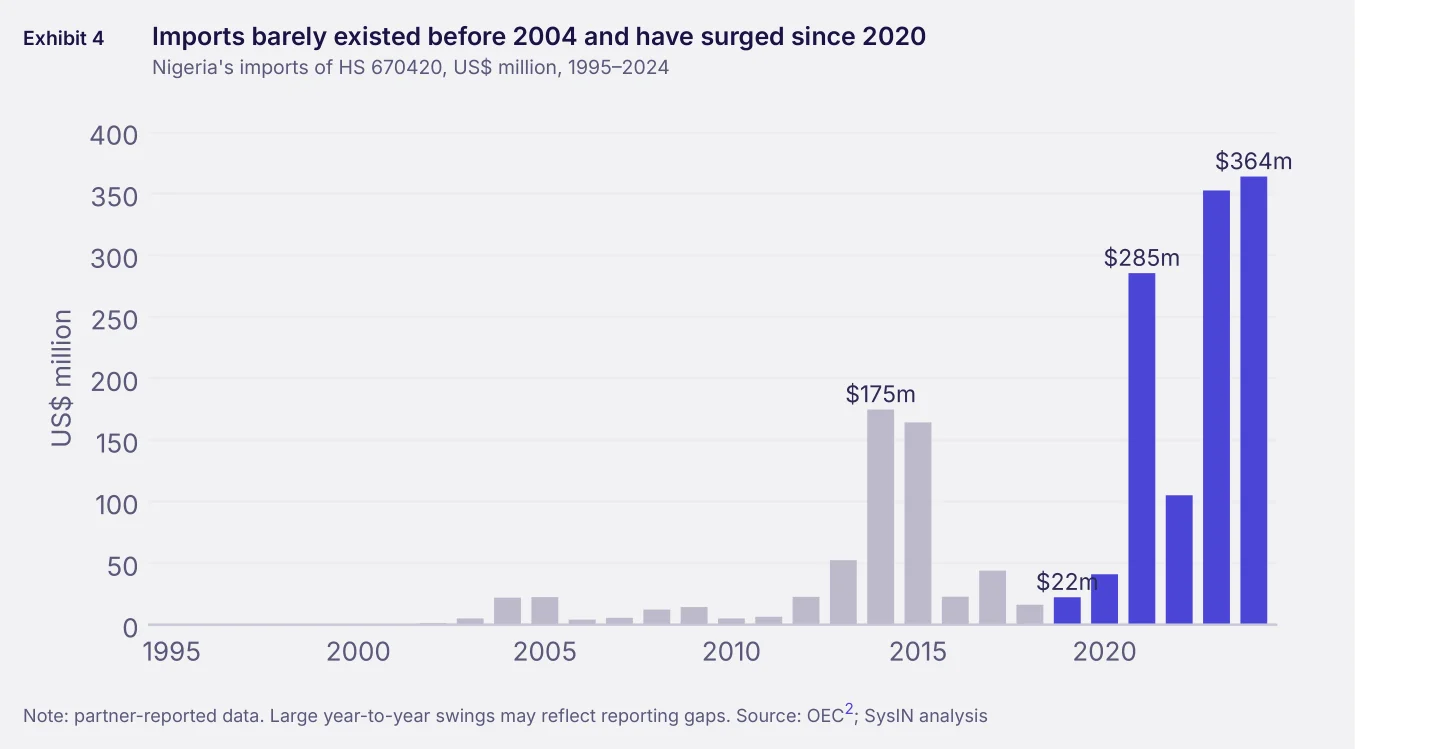
Imports rose from $22.3m in 2019 to $363.8m in 2024. China supplied over 99.8%2.
Nigeria ranks behind only the US and ahead of China, DR Congo and the UK1.
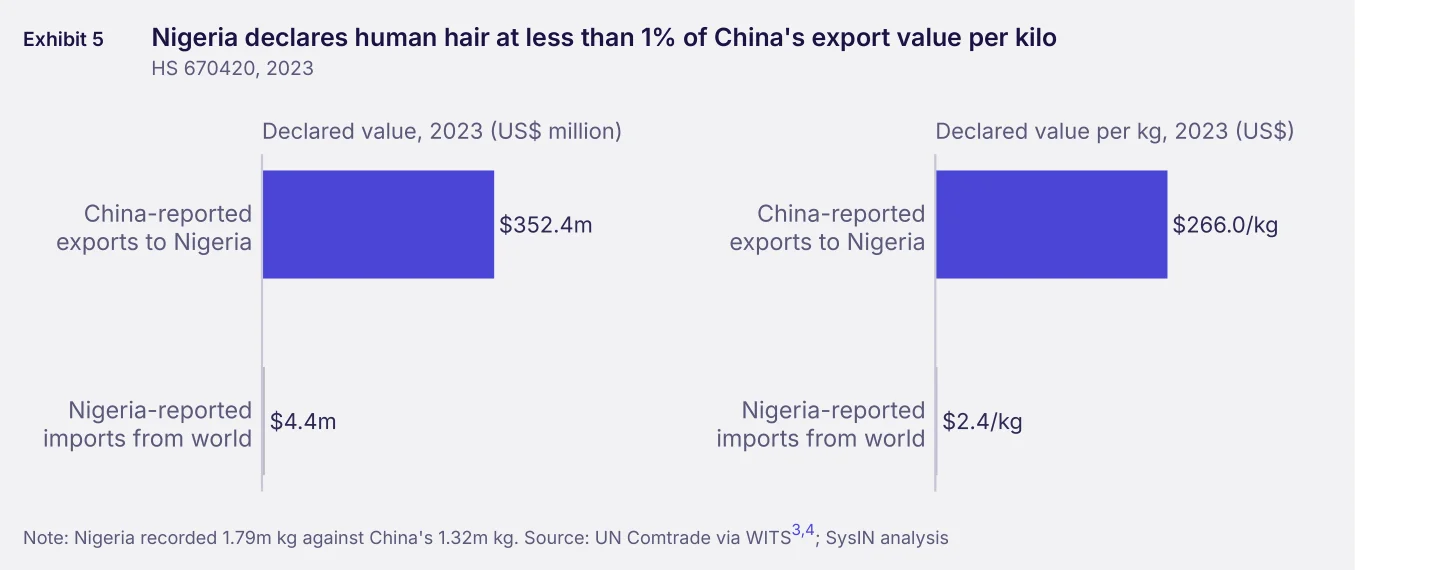
Nigerian customs recorded $4.4m in 2023, at about $2.4/kg, against China's $352.4m at about $266/kg3,4.
Under-valuation, misclassification and transit through Benin are the likely causes. At full rates the gap implies over $100m a year of uncollected duty and VAT (an upper bound).
Nigeria's imports of human-hair wigs and extensions, 2024 (partner-reported)
Urban women aged about 18–45 drive demand. Many in cities own more than one human-hair wig17.
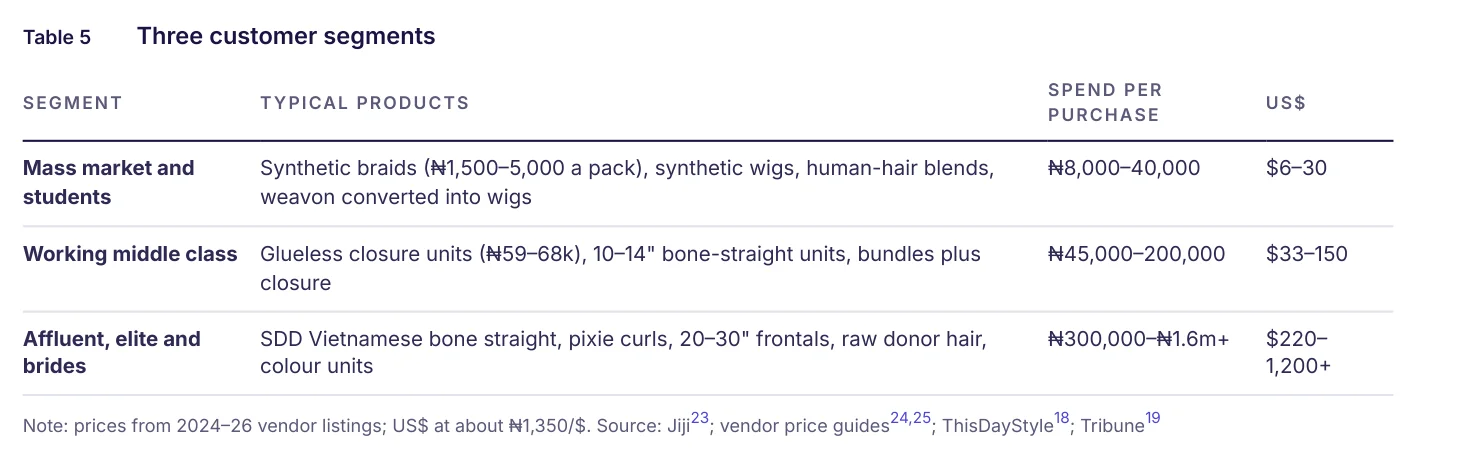
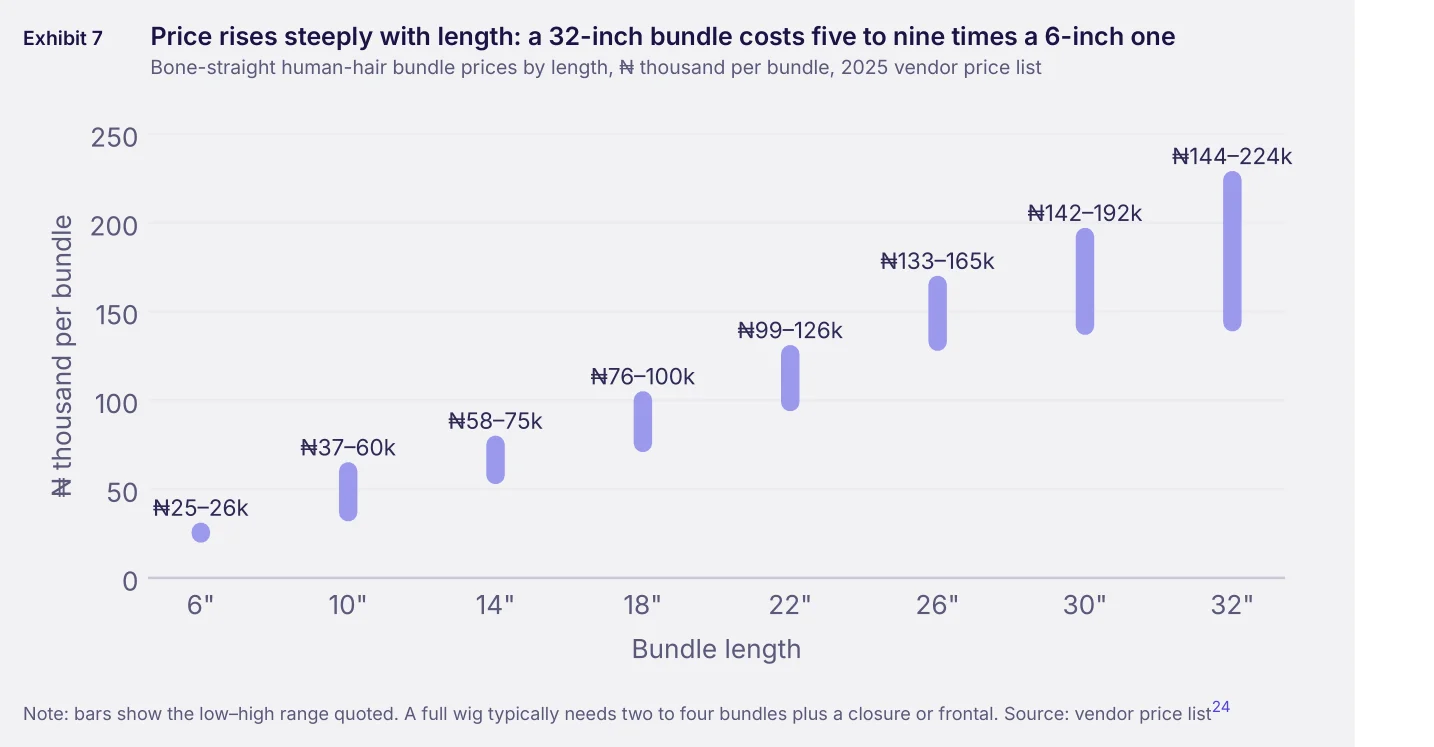
Spending runs from ₦8–40k for blends and synthetics to ₦45–220k for mainstream human-hair units and ₦300k–₦1.6m+ for premium raw hair23,24,25,18.
Balogun Market and Trade Fair are the wholesale hubs. Most retail runs through Instagram, WhatsApp, TikTok and Jiji vendors.
Instalment plans, pre-orders and wig revamping are standard. Trust is weak: blends are often sold as pure human hair29.
Naira prices rose roughly 2–4 times in 2023–24. In dollar terms, mid-market prices barely moved20,21.
Buyers kept buying but traded down: wigs over salon braiding, blends over pure human hair, and longer use.
What it means. The opportunity is not processing raw hair. It is accurate market data, working capital for vendors, and local wig assembly, customisation and services that can also serve Ghana, Cameroon and the diaspora.
Key findings
A record import bill
Nigeria imported $363.8m of human-hair wigs and extensions in 2024, 16 times the 2019 level, on partner-reported data.
One supplier
China supplied 99.8–100% of Nigeria's imports every year from 2022 to 2024.
Second only to the US
Nigeria is the world's second-largest importer of the product, behind the United States ($663m in 2023).
Mostly invisible at home
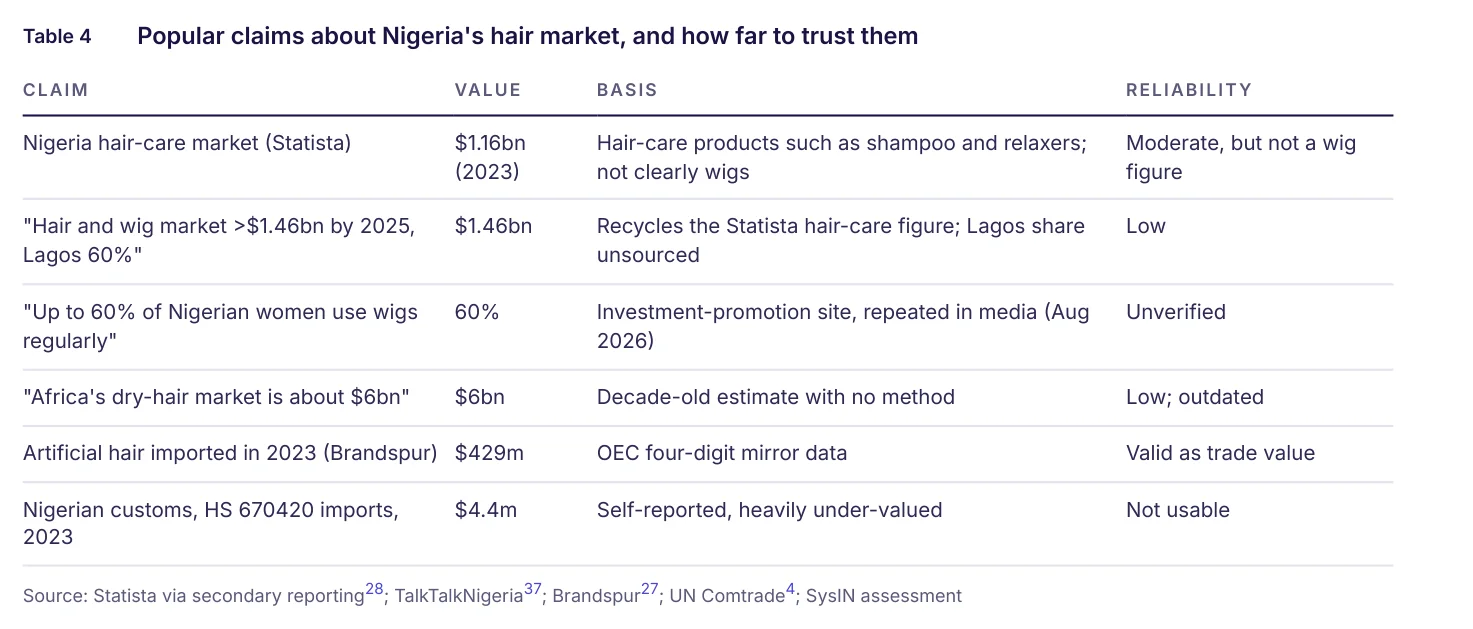
Nigerian customs recorded $4.4m of these imports in 2023, against $352.4m reported by China: a gap of about 80 times.
A $0.8–1.2bn consumer market
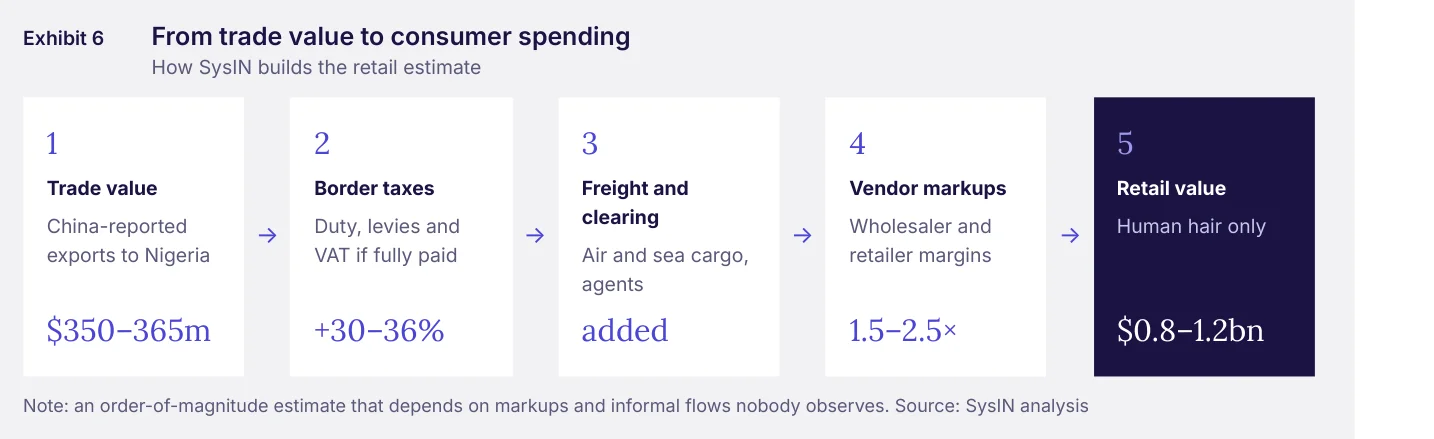
Adding duties, freight and vendor markups gives a SysIN estimate of the retail value of human hair sold in Nigeria each year.
Prices rose, demand held
The 2023–24 devaluation pushed naira hair prices up roughly 2–4 times; buyers traded down to blends, braids and longer wig lifespans rather than stopping.
What HS 6704.20 covers
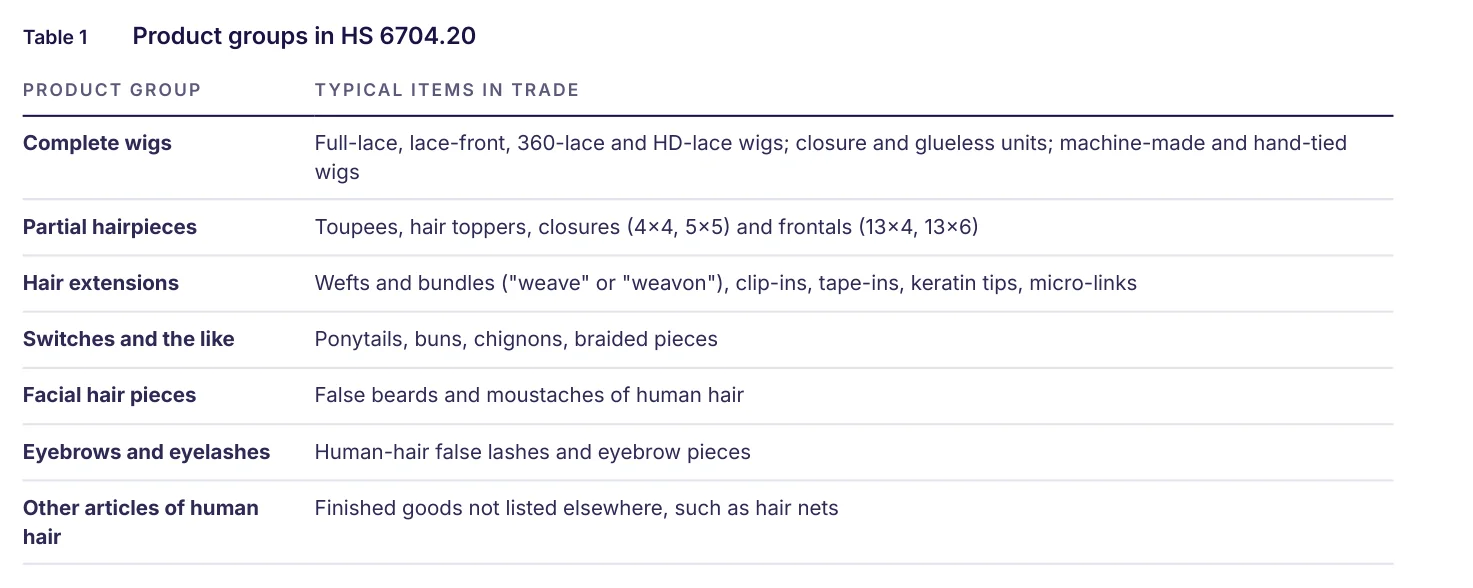
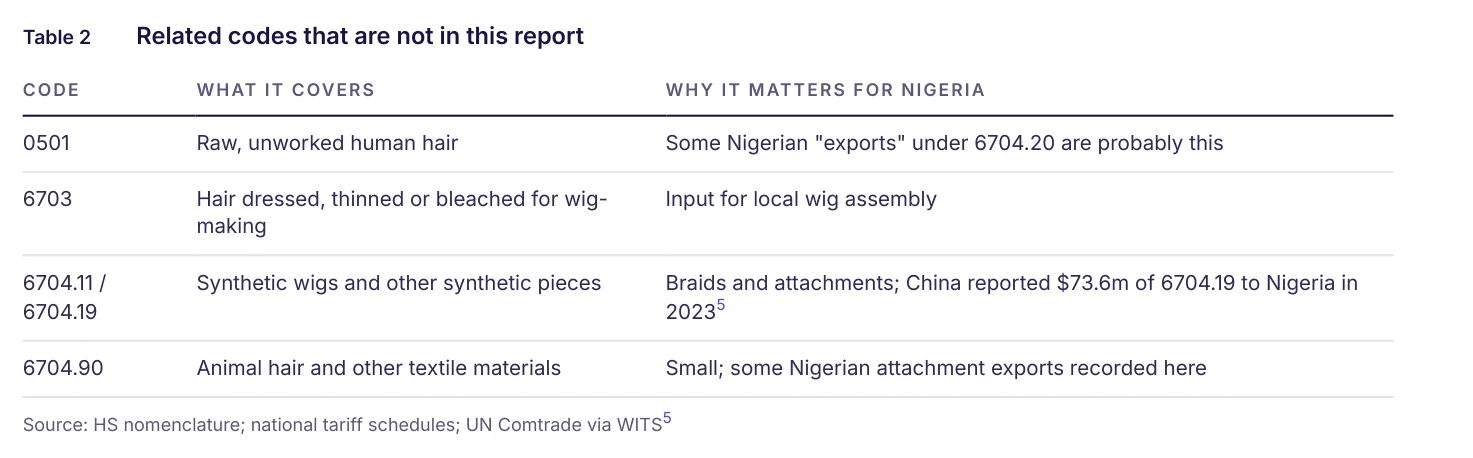
HS 6704.20 covers finished goods made of human hair. Raw hair, semi-processed hair and synthetic wigs sit under other codes.
Complete wigs Full-lace, lace-front, 360-lace and HD-lace wigs; closure and glueless units; machine-made and hand-tied wigs Partial hairpieces Toupees, hair toppers, closures (4x4, 5x5) and frontals (13x4, 13x6)
Hair extensions Wefts and bundles ("weave" or "weavon"), clip-ins, tape-ins, keratin tips, micro-links Switches and the like Ponytails, buns, chignons, braided pieces Facial hair pieces False beards and moustaches of human hair Eyebrows and eyelashes Human-hair false lashes and eyebrow pieces Other articles of human hair Finished goods not listed elsewhere, such as hair nets
"Brazilian", "Peruvian", "Malaysian" and "Cambodian" hair are mostly marketing names for textures. Most such hair is Indian or Southeast Asian hair processed in China. Remy hair keeps its cuticles aligned; non-remy hair is acid-stripped and siliconecoated. Virgin hair is chemically untreated, and raw or donor hair comes from a single donor. Vietnamese "super double drawn" (SDD) hair, where most strands run full length, sells at a premium in West Africa.
Trade value versus retail value
World trade in human-hair wigs is about $1.8bn a year. Consumers spend four to eight times that once duties, freight and margins are added.
China dominates supply, and the United States dominates demand. Nigeria is the clear second market, and the only African country near the top. China is also the third-largest importer, because it buys semi-processed hair and wigs knotted in North Korea, then re-exports finished goods1,15.
The gap between trade and retail has four causes: customs values are factory prices; duties, freight and two- to three-fold retail margins are added downstream; retail estimates include synthetics and services; and under-invoicing, as in Nigeria, depresses recorded trade. Human hair is about 55–70% of global retail value, with synthetics growing faster from a lower base7,9,11.
Global consumers and the supply chain
Black consumers in the US, the UK and Africa are the core of demand. Supply runs from Indian and Southeast Asian donors through Chinese and North Korean workshops.
Black and African-descent consumers. Black consumer beauty spending in the US reached about $16bn in the latest NIQ data, and nearly half of it is now online36. Wig spending comes on top of hair-care product figures and is poorly measured.
Protective styling and convenience. Glueless, preplucked units let wearers change styles without heat or chemical damage. Hair products filled most of TikTok's top US fashion-accessory sales in August 202613.
Medical hair loss and ageing. Alopecia, chemotherapy and older populations in Japan, Europe and the US support premium demand7,12.
Social media and celebrities. Style cycles move fast: bone straight, then glueless, then coloured units. Luxury custom pieces can cost up to $12,00012.
A well-kept human-hair wig lasts one to three years. Synthetic and blended units last months. That durability is the core of how vendors sell human hair as an "investment".
1. Collection. India is the main source of raw hair, with about $500m of hair exports in FY2024. Temple offerings are only a small share; most hair is collected from households and combings. India has restricted raw-hair exports below $65/kg since February 2025 because of smuggling16.
2. Processing. Xuchang in Henan province is China's wig capital, with about 300,000 people in the industry.
3. Hand-knotting. Chinese firms outsource lace knotting to North Korea. Wigs and hair products are North Korea's largest export to China, about $190m in 2025, and are re-labelled "made in China"15.
4. Distribution. Beauty supply stores and salons still lead global sales. Amazon, AliExpress, Shopify brands and TikTok Shop are gaining fast7.
US Customs has detained hair products from Xinjiang over forced labour since 202014, and reports link North Korean wig work to prison labour. No similar rule binds Nigerian importers, but any Nigerian brand selling to the US, UK or EU diaspora will need traceable sourcing.
A record import bill
Nigeria's imports of human-hair wigs and extensions reached a record $363.8m in 2024, almost all of it from China.
Nigeria imported $1.77bn of the product over 1995–2024, and 80% of it ($1.42bn) arrived in 2015–2024. Imports surged in 2014–15, fell back during the 2016 recession and devaluation, then rose about 75% a year from 2019. OEC's four-digit data suggests China's shipments to Nigeria rose again in 20252,35.
The mirror gap
China reported $352m of wig exports to Nigeria in 2023. Nigeria recorded $4.4m of imports, on a larger weight. ~80× Because the weight Nigeria records is higher than China's, the goods are arriving. They are being declared at a tiny fraction of their value, or recorded under other codes. Synthetic wigs show the same pattern at about 40
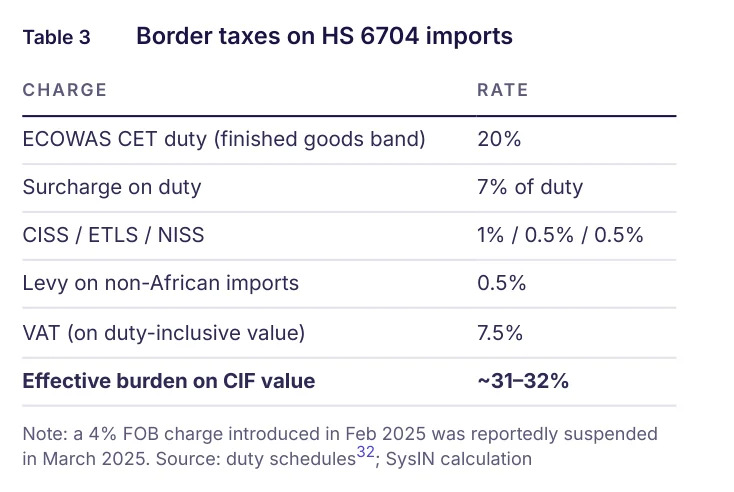
At full rates, a correctly declared $350m of imports would yield over $100m a year in duty and VAT. This is an upper bound: part of the gap reflects timing, CIF/FOB differences and goods re-exported from Benin and Togo. Hair was not on the CBN's 2015 list of items barred from official FX (lifted in October 2023), but importers largely bought dollars at parallel rates33.
Sizing Nigeria's consumer market
Nigerian consumers likely spend $0.8–1.2bn a year on human-hair wigs and extensions. With synthetics, the whole "dry hair" market is plausibly $1–1.5bn.
No representative survey of Nigerian wig ownership or spending exists. Every consumer figure in Part B rests on trade data, vendor price lists and journalism, and should be read as indicative.
The Nigerian customer
The core buyer is an urban woman aged about 18–45 who owns two to four units and spends from ₦45,000 to ₦220,000 on a mainstream human-hair wig.
Who buys. Working professionals, traders, students, corps members and brides, concentrated in Lagos and Abuja. Lagos's Lekki salons sell units from under ₦100,000 to ₦10m. Many city women own more than one human-hair wig, and some more than three; wig snatching has risen in Lagos because units hold resale value17.
How much of income. In 2019 one buyer on an ₦80,000 salary spent about ₦150,000 per wig, nearly two months' pay.
Zikoko's 2026 survey found monthly appearance budgets of ₦45,000–400,000, with hair often treated as non-negotiable22.
How Nigerians buy hair
Most hair is sold by small vendors on Instagram, WhatsApp and TikTok, often on instalments, and kept in use through revamping.
Wholesale markets. Balogun Market on Lagos Island and Trade Fair Complex are the national hubs, alongside Tejuosho and Idumota in Lagos, Wuse and Garki in Abuja, and Onitsha. Traders fold rent, port and clearing costs and naira swings into prices.
Social commerce. Most retail runs through Instagram, WhatsApp, TikTok and Instagram Live. Many vendors work from home. Balogun wholesalers run Instagram pages with tens of thousands of followers25.
Classifieds and e-commerce. Jiji is a major channel. Jumia and Konga list hair but trail social commerce23.
Direct import. Vietnamese, Indian and Chinese factories sell straight to Nigerian vendors, with naira payment agents and "tax-cleared" air cargo to Lagos, itself a sign of informal clearing.
"Pay small small". Lay-away and instalments are common, for example 50% deposit, 25% second payment and 25% final payment within three months.
Pre-orders and group buys. Vendors pool orders into bulk shipments from Asian factories, paid at parallel FX rates.
A common instalment plan: deposit, second payment and balance within three months How they behave Revamp, don't replace. Owners wash, re-colour, recurl and re-install units between purchases. Braids and attachment users restyle every three to eight weeks.
Low trust. Blends and "replica" hair are often sold as human hair, and origin labels are unreliable. X- Pression's maker launched an authentication app in 2022 to fight counterfeit braids29.
A local service economy. Wig making, installation, revamping and colouring are large and labourintensive. One Lagos wigmaker reports making 50– 300 wigs a week and training hundreds of students.
Owambe, aso ebi and weddings. A wedding guest can spend ₦500,000–2m on aso ebi, styling, hair and accessories18.
Work and church. Neat, low-maintenance wigs suit long commutes and conservative dress codes.
Influencers and Nollywood set trends. In 2026 vendors are shifting from bone straight to glueless closures, braided wigs and colour37.
The naira shock and the trade-down
The 2023–24 devaluation roughly tripled naira prices for imported hair. Demand did not collapse; it moved downmarket.
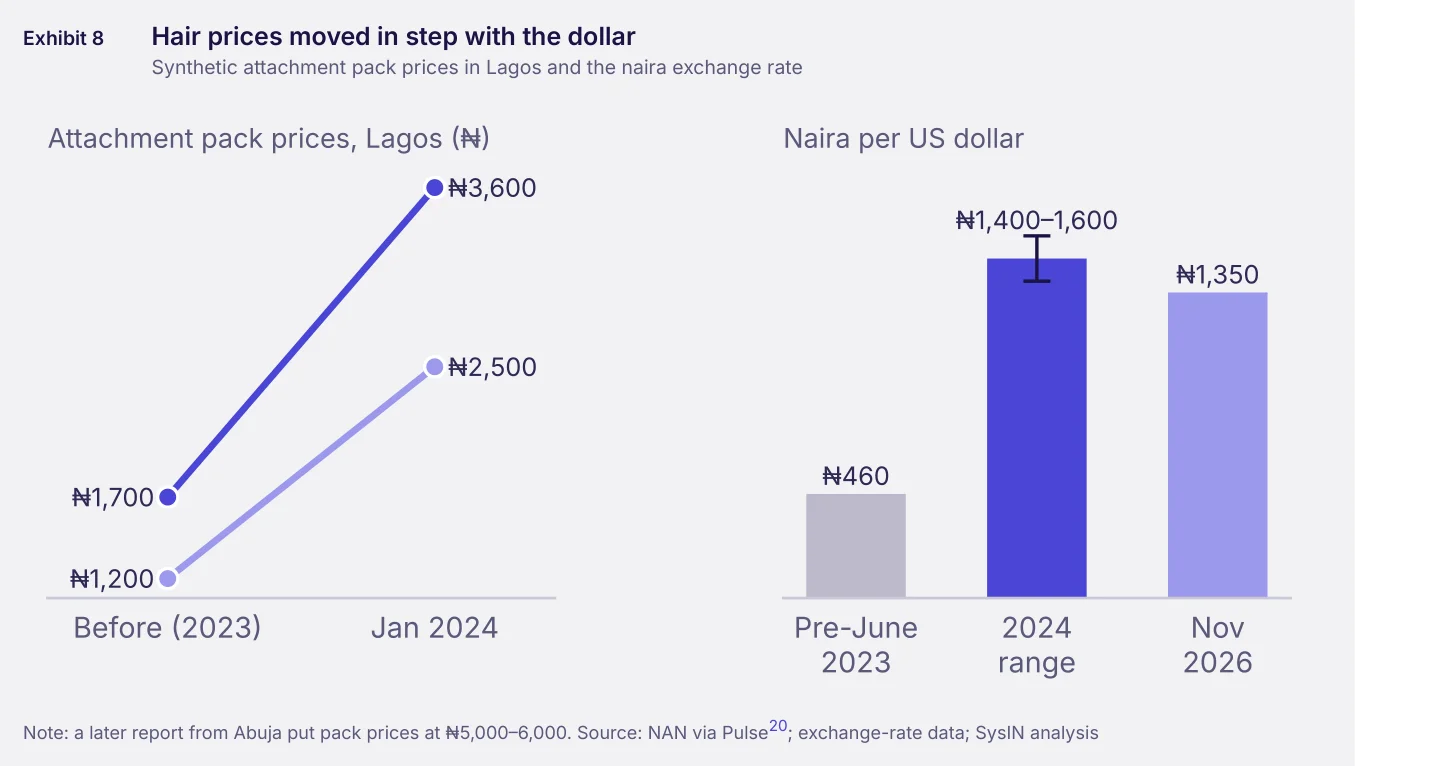
The naira fell from about ₦460/$ before the June 2023 unification to about ₦1,400–1,600/$ through 2024.
Because almost all hair is imported, naira prices followed. In Lagos, attachment packs that sold for ₦1,700 rose to ₦3,600 by January 2024, and ₦1,200 packs to ₦2,50020. In dollar terms, mid-market prices were stable or even lower. The squeeze fell on naira incomes.
Blends over pure human hair, and weavon converted into wigs instead of premium units22.
Longer use. One Lagos woman told ThisDayStyle she went from a new wig every few months to barely one a year18.
Exports and local industry
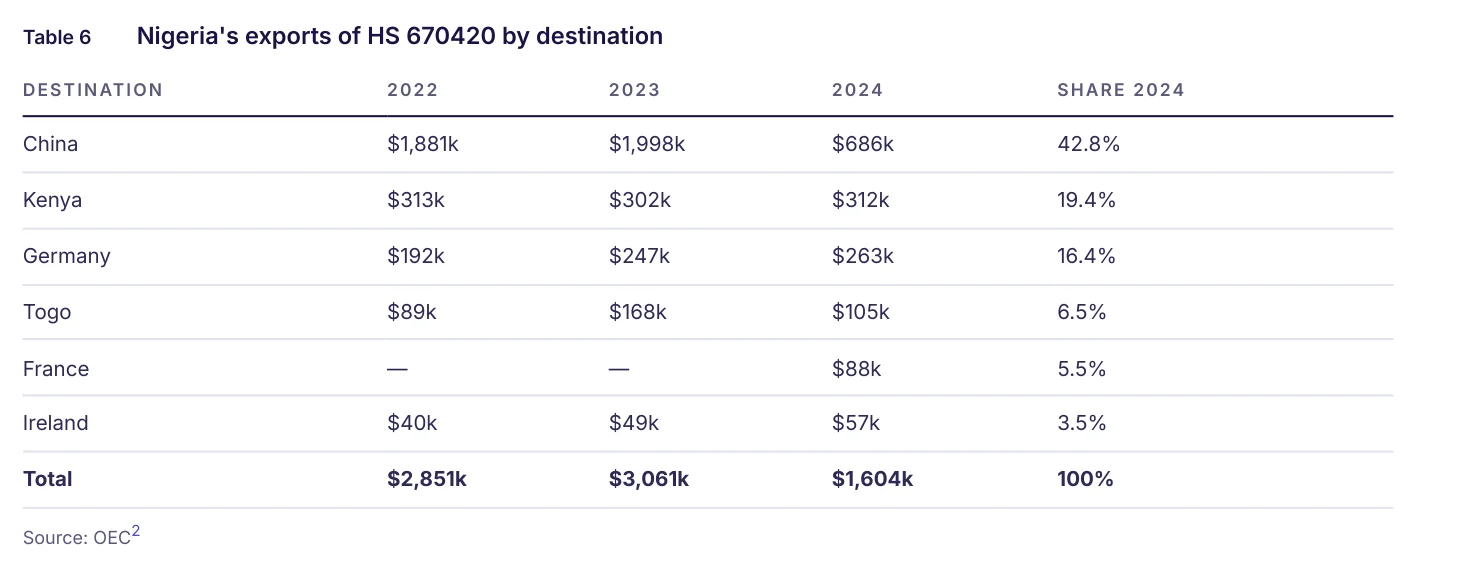
Nigeria makes synthetic braids at scale but processes no human hair. Its human-hair exports are small and falling. $1.6m What the exports are What Nigeria makes To China: probably raw or semi-processed hair recorded under the wrong code. Exports there fell 66% in 2024.
To Kenya and Germany: steady buyers, together 36% of 2024 exports. Germany has grown every year since 2021.
To neighbours and the diaspora: Togo, Côte d'Ivoire, Benin, France and Ireland. Ghanaian wholesalers also source from Nigeria.
Ghana imported $79.3m in 2022 and, like Nigeria, sells through markets and Instagram vendors with no local factories. South Africa ($107m, 2022) has a more formal chain and salon trade. DR Congo ($83.8m, 2023) shows similar demand in Central Africa. Benin and Togo import far more than they could use, consistent with re-export to Nigeria1,26.
Synthetic braids at scale. Godrej Nigeria makes Darling at Ikeja; X-Pression braids have been made in Agege since 199731.
Low wages in packing. A 2023 undercover report found casual packers at one Lagos plant earning about ₦1,155 a day30.
No human-hair processing. Neither Nigeria nor Ghana has a commercial plant. Local value comes from wig making, customisation and services.
Opportunities and implications by stakeholder
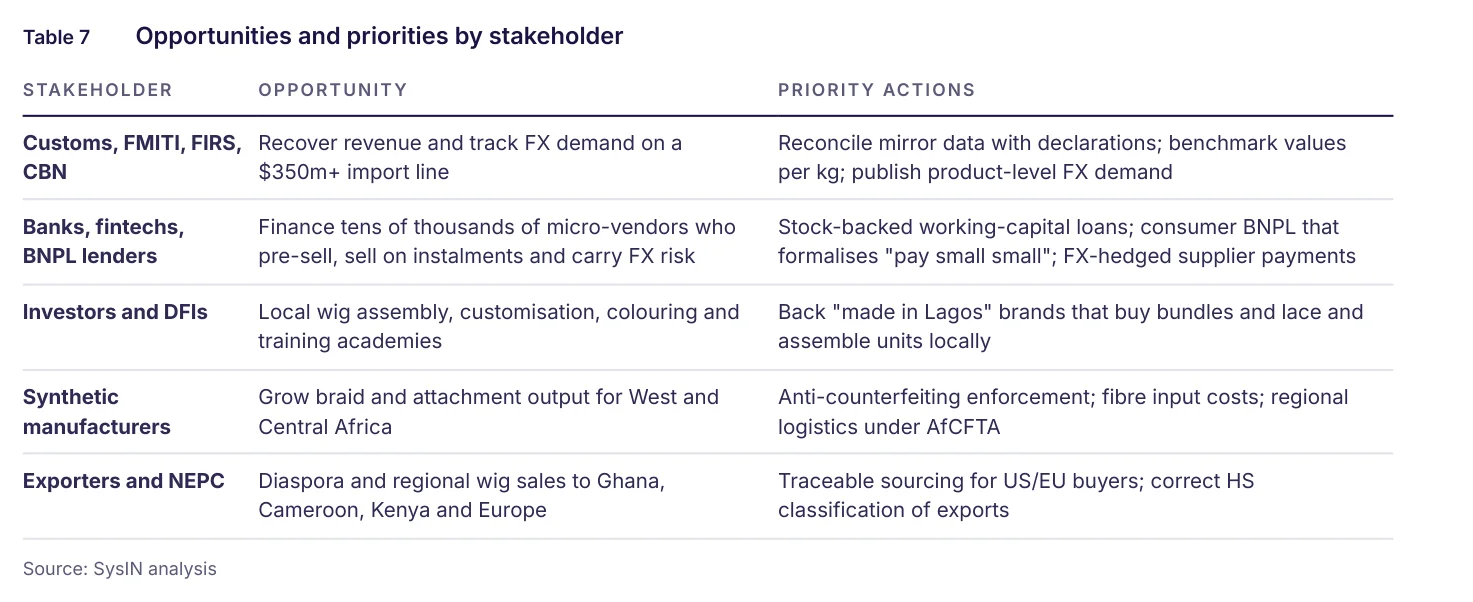
Nigeria's wig market creates openings for lenders, manufacturers and policymakers, but each depends on better data than exists today.
Nigeria has no raw-hair supply advantage. India, Vietnam, Myanmar and China control collection, and China and North Korea control knotting and processing at a scale that is hard to match. AfCFTA rules of origin will also limit preferences for imported hair that is only re-styled.
Most value is added in wefting, ventilating lace, colouring and styling, which are labour-intensive. Replacing just 5% of 2024 imports with locally assembled units would be about $18m a year, over ten times current exports.
Data gaps, what to watch and methodology
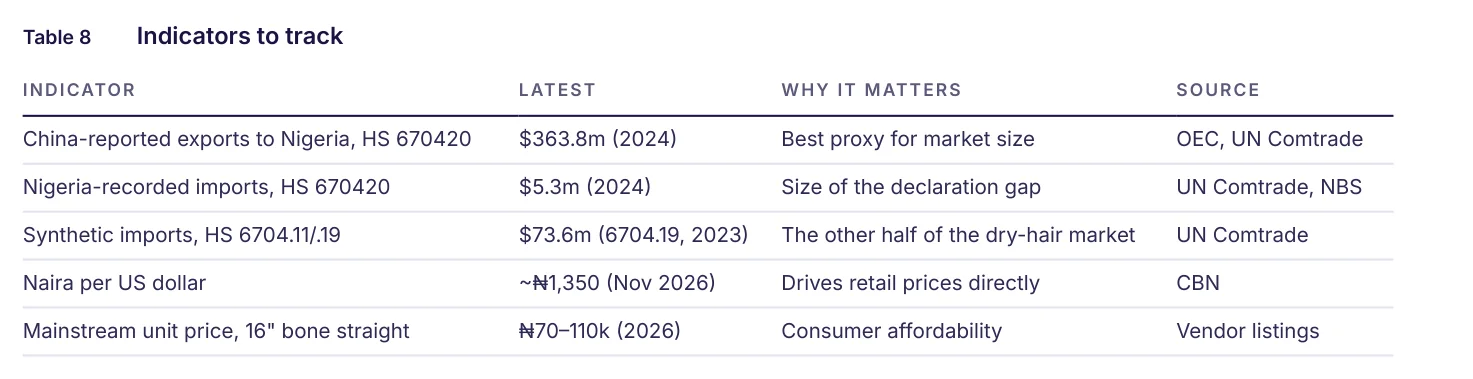
A reliable picture of Nigeria's wig market needs three things: honest customs declarations, a consumer survey and synthetic-hair data.
China-reported exports to Nigeria, HS 670420 $363.8m (2024) Best proxy for market size OEC, UN Comtrade Nigeria-recorded imports, HS 670420 $5.3m (2024) Size of the declaration gap UN Comtrade, NBS Synthetic imports, HS 6704.11/.19 $73.6m (6704.19, 2023) The other half of the dry-hair market UN Comtrade Naira per US dollar ~₦1,350 (Nov 2026) Drives retail prices directly CBN Mainstream unit price, 16" bone straight ₦70–110k (2026) Consumer affordability Vendor listings Methodology Trade data. Nigeria's imports and exports come from OEC's partner-reconciled data for HS 670420 (OEC product 12670420), 1995–2024. Nigerian-reported values come from UN Comtrade via WITS.
Market sizing. Retail value applies border taxes (30–36%), freight and vendor markups (1.5–2.5 times) to China-reported trade values. It is an order-of-magnitude estimate.
Consumer evidence. Prices come from 2024–26 vendor listings, classified ads and price guides. Behaviour comes from Nigerian lifestyle journalism and news reports. None of it is a representative survey.
Global retail estimates use opaque, incompatible scopes; read them as ranges. Mirror gaps can partly reflect timing, CIF/FOB valuation and transit through Benin or Togo. Sources differ on China's 2024 exports to Nigeria: OEC's four-digit data shows $277m, against $364m at six digits. Naira prices quoted in 2024 were set at different exchange rates from the ₦1,350/$ used here. The "60% of women" figure is unverified.
References
[1] OEC (2026), Wigs, false beards, eyebrows etc, of human hair: product profile. oec.world/profile/hs/wigs-false-beards-eyebrows-etc-of-human-hair
[2] OEC (2026), Nigeria trade in HS 12670420, 1995–2024 (trend and partner data export). oec.world
[3] UN Comtrade via WITS, China exports of HS 670420 by partner, 2023. wits.worldbank.org
[4] UN Comtrade via WITS, Nigeria imports of HS 670420 by partner, 2023. wits.worldbank.org
[5] UN Comtrade via WITS, China exports of HS 670419, 2023. wits.worldbank.org
[6] UN Comtrade via WITS, Nigeria imports of HS 670419, 2023. wits.worldbank.org
[7] Grand View Research, Hair Wigs and Extensions Market Report, and Horizon US outlook. grandviewresearch.com
[8] Fortune Business Insights, Human Hair Extension, Hair Extension and Hair Wig market reports. fortunebusinessinsights.com
[9] Market.us, Hair Wigs and Extension Market report. market.us
[10] Fact.MR, Hair Wig Market report. factmr.com
[11] Global Market Insights via GlobeNewswire (Apr 2025), The World Market for Hair Wig and Extensions 2025–2034. globenewswire.com
[12] Forbes (Dec 2024), Inside the luxury wig industry. forbes.com
[13] Reuters via Yahoo Finance (Sep 2026), Chinese beauty product exporters. finance.yahoo.com
[14] US Customs and Border Protection (2020), CBP detains Chinese shipment of products suspected to be made with forced labor. cbp.gov
[15] Korea Times (Feb 2025); Sino-NK (May 2026), North Korea–China wig and hair trade. koreatimes.co.kr; sinonk.com
[16] NewsBytes, India's human hair exports and smuggling. newsbytesapp.com
[17] Vanguard (Feb 2026), Why hair wig snatching is suddenly on the rise. vanguardngr.com
[18] ThisDayStyle (2026), Hair extension prices; The price of pretty. thisdaystyle.ng
[19] Nigerian Tribune (Oct 2024), Many ladies now embrace wigs to look beautiful. tribuneonlineng.com
[20] Pulse / NAN (2024), Lagos women and hairstylists cry over high cost of hair attachments. pulse.ng
[21] Prime Business Africa (May 2024), Demand for hair extensions dips as prices rise in Enugu. primebusiness.africa
[22] Zikoko (2019, 2025, 2026), Nigerian women's spending and beauty costs. zikoko.com
[23] Jiji Nigeria (2026), Wigs and human hair listings. jiji.ng
[24] Hair Vietnam (2025), Bone straight hair price in Nigeria. hairvietnam.com
[25] Sellevo (2026), How to sell wigs and hair online in Nigeria. sellevo.ng
[26] Friends of Nigeria, Nigeria's demand for fancy wigs fuels a global trade (citing The Economist, 2020). friendsofnigeria.org
[27] Brandspur (Feb 2025), Imported artificial hair consumes over $429m from Nigerian women annually. brandspurng.com
[28] Doing Business in Nigeria, Hair care in Nigeria: a billion-dollar market (citing Statista). doingbusinessinnigeria.org
[29] Vanguard (Jan 2022), Firm unveils app to stem proliferation of fake hair products. vanguardngr.com
[30] FIJ (2023), Lucky Fibres: inside a Lagos hair factory. fij.ng
[31] The Guardian Nigeria, Darling hair extension relaunches in Nigeria. guardian.ng
[32] Nigeria import duty guides; US Commercial Service, Nigeria trade barriers. trade.gov; deblingsglobal.com
[33] PRNigeria (Oct 2023), CBN lifts FX restriction on 43 items. prnigeria.com
[34] Volza, Human hair import data, Nigeria. volza.com
[35] Fabulive (2026), Nigeria hair extensions market report; OEC bilateral data on fake hair. fabulive.com; oec.world
[36] Defender Network / NIQ (2026), Black haircare spending statistics. defendernetwork.com
[37] TalkTalkNigeria (Aug 2026), Bone straight is out, glueless is in. talktalknigeria.com
[38] VICE, Nigeria's bone-straight hair trend and Indian wigs. vice.com