Nigeria & India Trade Brief 2026
India buys Nigerian crude; Nigeria buys Indian medicines, machines and motorcycles — one of Nigeria's two largest export markets in three of four years.
Executive summary
India buys Nigerian crude. Nigeria buys Indian medicines, machines and motorcycles. Almost everything else in this relationship follows from that exchange.
Key findings
India was one of Nigeria’s two largest export markets in three of four years.
It took 5.8% to 15.8% of Nigeria’s exports and supplied 5.6% to 8.6% of its imports.
Nigeria earned a surplus with India in 2021, 2022 and 2024.
The one deficit, −$416.1m in 2023, came when crude sales to India fell from $7.8bn to $3.2bn.
Crude made up 88.9% to 97.8% of Nigeria’s exports to India every year.
Farm exports led by cashew, oil seeds and ginger rose from $74.8m to $234.4m, still under 4% of crude.
India’s share of Nigeria’s medicine imports rose from 33.4% to 45.2%.
Pharmaceutical imports from India held at $384.9m to $500.9m while the total market shrank.
Refined fuel from India fell 89% from its 2022 peak, to $217.5m in 2024.
India’s share of Nigeria’s fuel imports dropped from 9.4% to 1.6%.
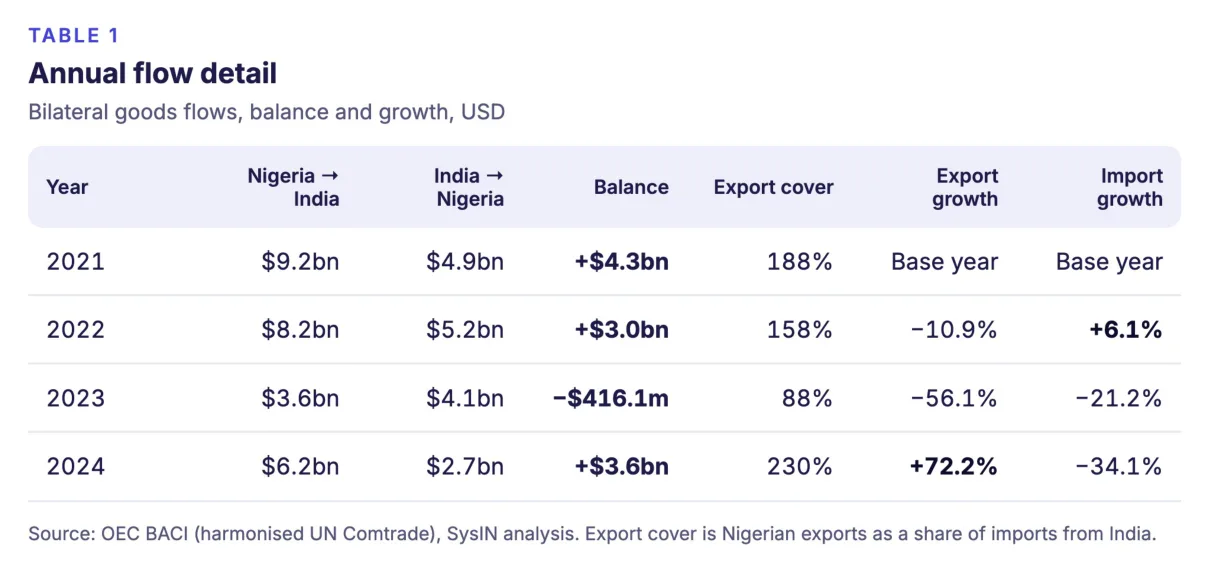
| Year | Nigeria → India | India → Nigeria | Balance | Export cover | Export growth | Import growth |
|---|---|---|---|---|---|---|
| 2021 | $9.2bn | $4.9bn | +$4.3bn | 188% | Base year | Base year |
| 2022 | $8.2bn | $5.2bn | +$3.0bn | 158% | −10.9% | +6.1% |
| 2023 | $3.6bn | $4.1bn | −$416.1m | 88% | −56.1% | −21.2% |
| 2024 | $6.2bn | $2.7bn | +$3.6bn | 230% | +72.2% | −34.1% |
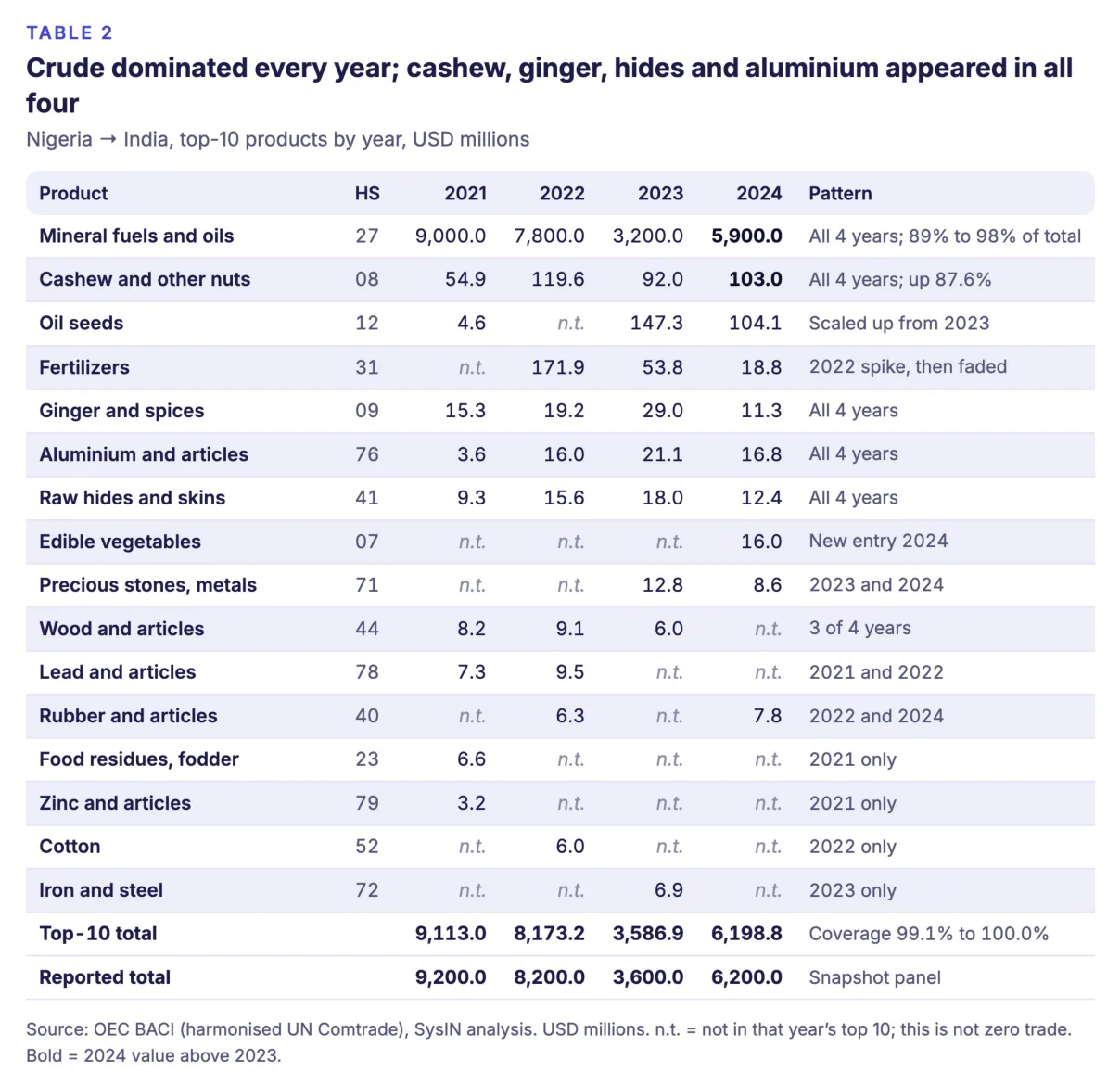
| Product | HS | 2021 | 2022 | 2023 | 2024 | Pattern |
|---|---|---|---|---|---|---|
| Mineral fuels and oils | 27 | 9,000.0 | 7,800.0 | 3,200.0 | 5,900.0 | All 4 years; 89% to 98% of total |
| Cashew and other nuts | 08 | 54.9 | 119.6 | 92.0 | 103.0 | All 4 years; up 87.6% |
| Oil seeds | 12 | 4.6 | n.t. | 147.3 | 104.1 | Scaled up from 2023 |
| Fertilizers | 31 | n.t. | 171.9 | 53.8 | 18.8 | 2022 spike, then faded |
| Ginger and spices | 09 | 15.3 | 19.2 | 29.0 | 11.3 | All 4 years |
| Aluminium and articles | 76 | 3.6 | 16.0 | 21.1 | 16.8 | All 4 years |
| Raw hides and skins | 41 | 9.3 | 15.6 | 18.0 | 12.4 | All 4 years |
| Edible vegetables | 07 | n.t. | n.t. | n.t. | 16.0 | New entry 2024 |
| Precious stones, metals | 71 | n.t. | n.t. | 12.8 | 8.6 | 2023 and 2024 |
| Wood and articles | 44 | 8.2 | 9.1 | 6.0 | n.t. | 3 of 4 years |
| Lead and articles | 78 | 7.3 | 9.5 | n.t. | n.t. | 2021 and 2022 |
| Rubber and articles | 40 | n.t. | 6.3 | n.t. | 7.8 | 2022 and 2024 |
| Food residues, fodder | 23 | 6.6 | n.t. | n.t. | n.t. | 2021 only |
| Zinc and articles | 79 | 3.2 | n.t. | n.t. | n.t. | 2021 only |
| Cotton | 52 | n.t. | 6.0 | n.t. | n.t. | 2022 only |
| Product | HS | 2021 | 2022 | 2023 | 2024 | Pattern |
|---|---|---|---|---|---|---|
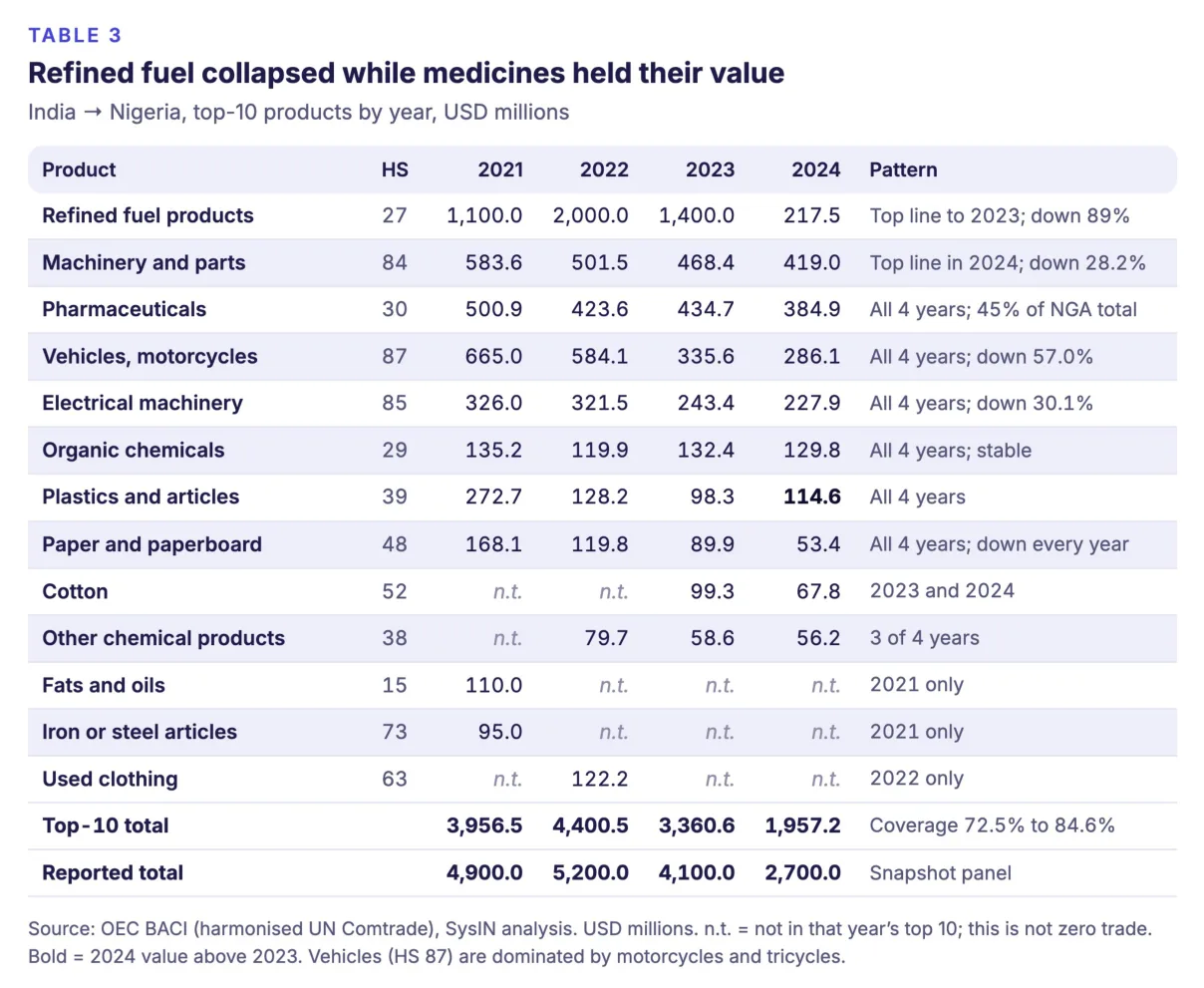
| Refined fuel products | 27 | 1,100.0 | 2,000.0 | 1,400.0 | 217.5 | Top line to 2023; down 89% |
| Machinery and parts | 84 | 583.6 | 501.5 | 468.4 | 419.0 | Top line in 2024; down 28.2% |
| Pharmaceuticals | 30 | 500.9 | 423.6 | 434.7 | 384.9 | All 4 years; 45% of NGA total |
| Vehicles, motorcycles | 87 | 665.0 | 584.1 | 335.6 | 286.1 | All 4 years; down 57.0% |
| Electrical machinery | 85 | 326.0 | 321.5 | 243.4 | 227.9 | All 4 years; down 30.1% |
| Organic chemicals | 29 | 135.2 | 119.9 | 132.4 | 129.8 | All 4 years; stable |
| Plastics and articles | 39 | 272.7 | 128.2 | 98.3 | 114.6 | All 4 years |
| Paper and paperboard | 48 | 168.1 | 119.8 | 89.9 | 53.4 | All 4 years; down every year |
| Cotton | 52 | n.t. | n.t. | 99.3 | 67.8 | 2023 and 2024 |
| Other chemical products | 38 | n.t. | 79.7 | 58.6 | 56.2 | 3 of 4 years |
| Fats and oils | 15 | 110.0 | n.t. | n.t. | n.t. | 2021 only |
| Iron or steel articles | 73 | 95.0 | n.t. | n.t. | n.t. | 2021 only |
| Used clothing | 63 | n.t. | 122.2 | n.t. | n.t. | 2022 only |
| Scenario | Exports | Imports | Balance | Conditions |
|---|---|---|---|---|
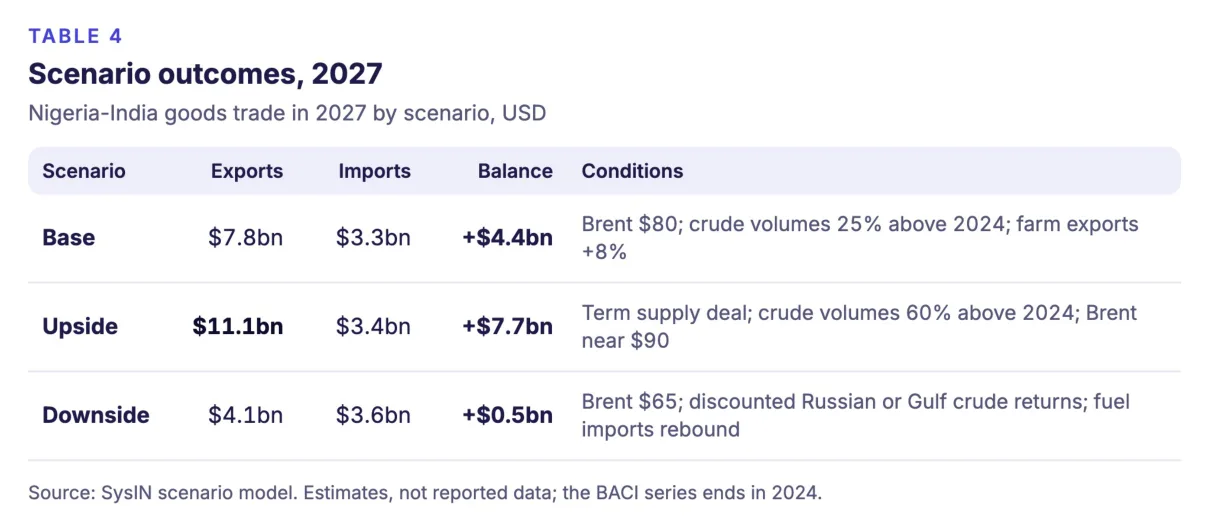
| Base | $7.8bn | $3.3bn | +$4.4bn | Brent $80; crude volumes 25% above 2024; farm exports +8% |
| Upside | $11.1bn | $3.4bn | +$7.7bn | Term supply deal; crude volumes 60% above 2024; Brent near $90 |
| Downside | $4.1bn | $3.6bn | +$0.5bn | Brent $65; discounted Russian or Gulf crude returns; fuel imports rebound |
| Factor | Status, September 2026 | Implication for the corridor |
|---|---|---|
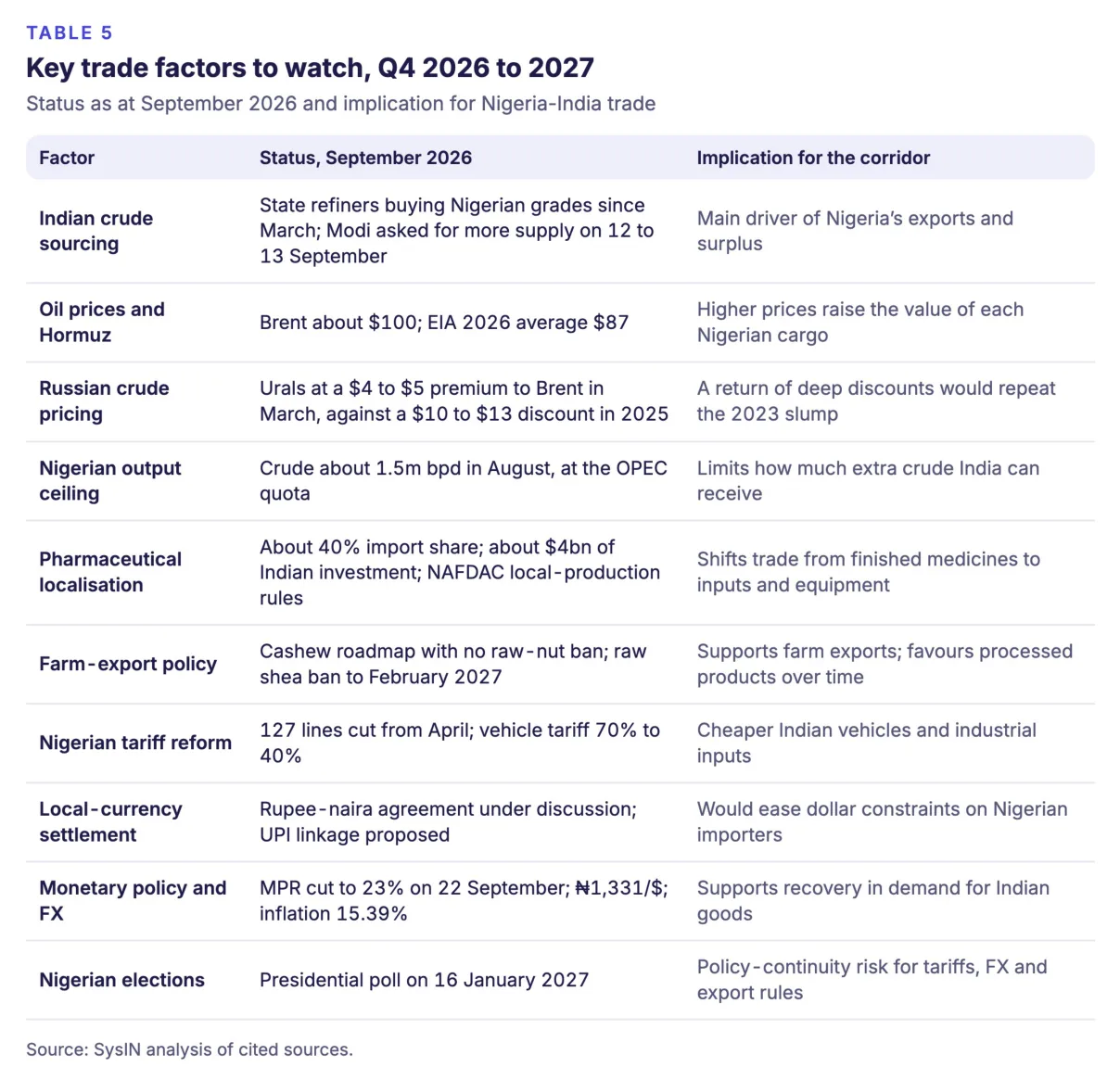
| Indian crude sourcing | State refiners buying Nigerian grades since March; Modi asked for more supply on 12 to 13 September | Main driver of Nigeria’s exports and surplus |
| Oil prices and Hormuz | Brent about $100; EIA 2026 average $87 | Higher prices raise the value of each Nigerian cargo |
| Russian crude pricing | Urals at a $4 to $5 premium to Brent in March, against a $10 to $13 discount in 2025 | A return of deep discounts would repeat the 2023 slump |
| Nigerian output ceiling | Crude about 1.5m bpd in August, at the OPEC quota | Limits how much extra crude India can receive |
| Pharmaceutical localisation | About 40% import share; about $4bn of Indian investment; NAFDAC local-production rules | Shifts trade from finished medicines to inputs and equipment |
| Farm-export policy | Cashew roadmap with no raw-nut ban; raw shea ban to February 2027 | Supports farm exports; favours processed products over time |
| Nigerian tariff reform | 127 lines cut from April; vehicle tariff 70% to 40% | Cheaper Indian vehicles and industrial inputs |
| Local-currency settlement | Rupee-naira agreement under discussion; UPI linkage proposed | Would ease dollar constraints on Nigerian importers |
| Monetary policy and FX | MPR cut to 23% on 22 September; ₦1,331/$; inflation 15.39% | Supports recovery in demand for Indian goods |
| Nigerian elections | Presidential poll on 16 January 2027 | Policy-continuity risk for tariffs, FX and export rules |
Bilateral trade snapshot
Headline flows, balances and India’s weight in Nigeria’s trade, 2021 to 2024.
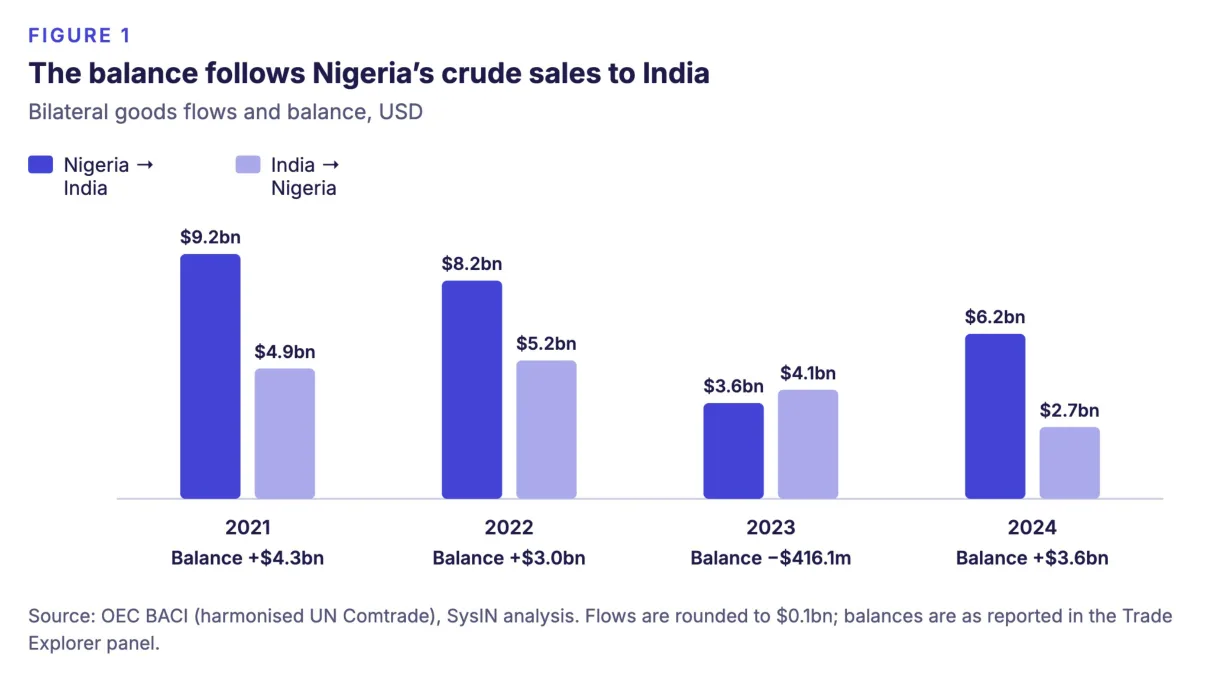
The balance follows Nigeria’s crude sales to India Bilateral goods flows and balance, USD
Two regimes Read the four years as two regimes. In 2021 and 2022, trade ran at $13bn to $14bn a year. In 2023 and 2024 it roughly halved: exports fell 56.1% to $3.6bn in 2023 and recovered 72.2% to $6.2bn in 2024, while imports fell 21.2% and then a further 34.1% to $2.7bn. The Nigerian side is a crude story that swings with Indian refiners’ buying; the Indian side is a steadier decline driven by Nigeria’s shrinking ability to pay.
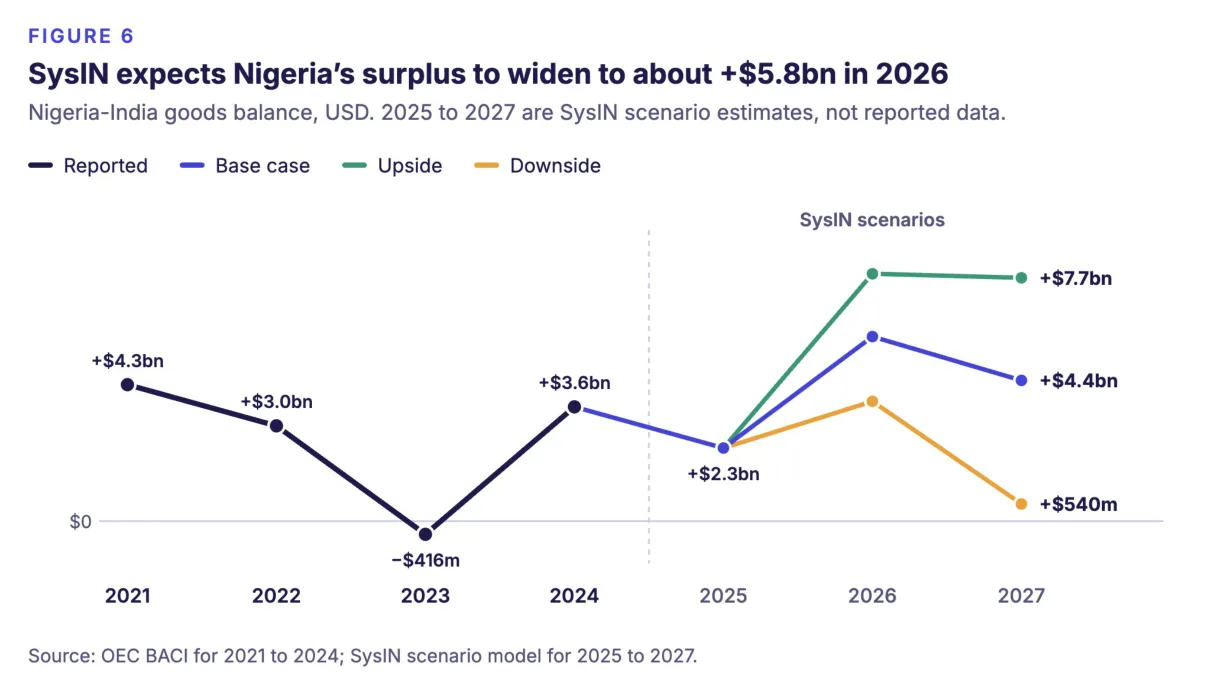
The balance mirrors the crude cycle Nigeria ran surpluses of +$4.3bn in 2021 and +$3.0bn in 2022, slipped to a −$416.1m deficit in 2023 when crude sales collapsed, and returned to +$3.6bn in 2024. Over the four years, its cumulative surplus with India was about $10.5bn, earned almost entirely from one product.
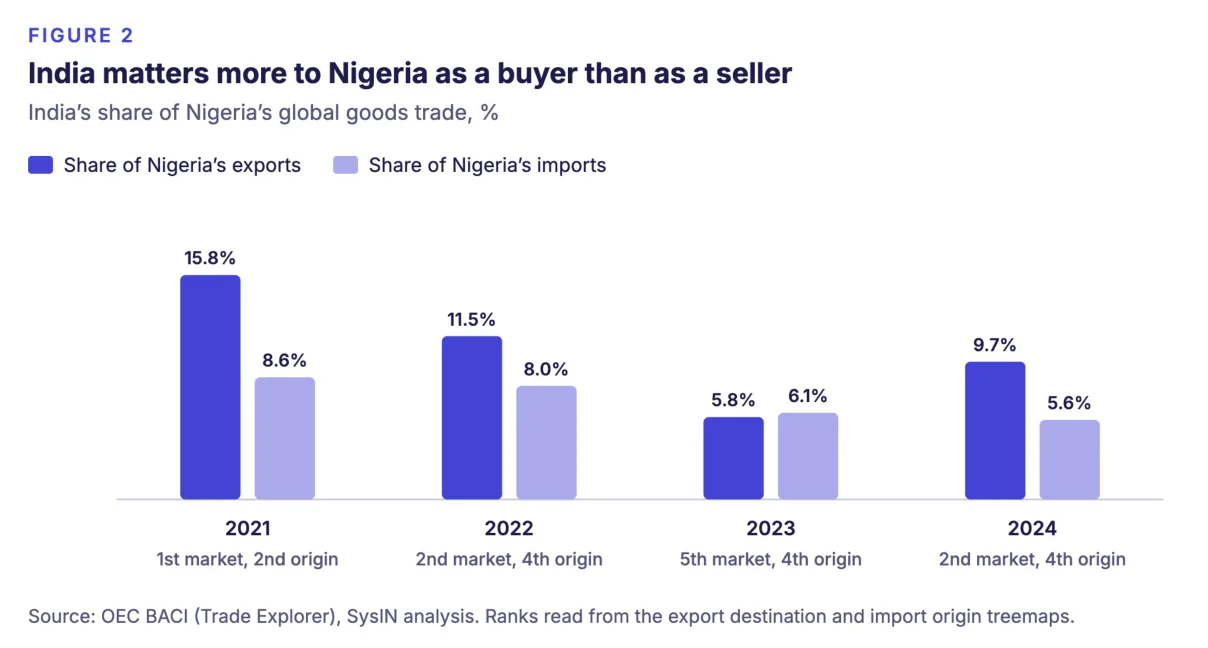
India matters more to Nigeria as a buyer than as a seller India’s share of Nigeria’s global goods trade, %
India is one of the two or three buyers whose refinery decisions can move Nigeria’s export receipts in a given year, and one of a handful of suppliers whose goods are part of everyday Nigerian consumption.
Export profile
Nigeria → India: the structure of outbound trade.
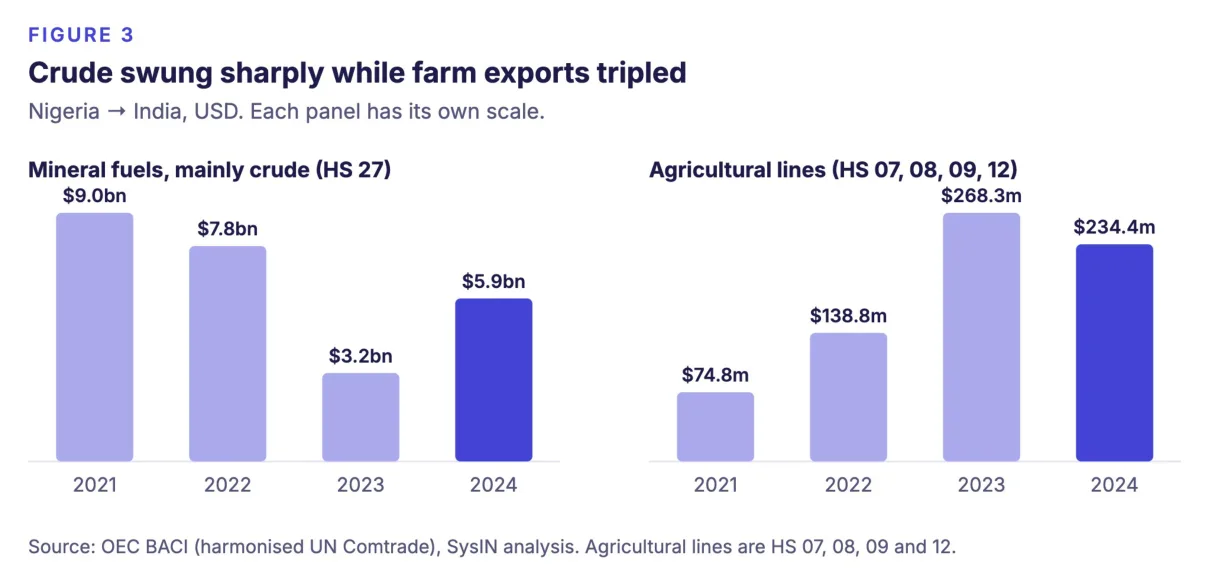
Crude: nearly the only export Mineral fuels (HS 27), mainly Nigerian light sweet crude, accounted for $9.0bn in 2021 (97.8% of the total), $7.8bn in 2022 (95.1%), $3.2bn in 2023 (88.9%) and $5.9bn in 2024 (95.2%). The $4.6bn fall in 2023 is the largest single movement in this relationship. It came as Russia’s share of India’s crude imports rose from about 2% to more than a third, with sanctioned Urals crude trading $10 to $13 a barrel below Brent. Nigerian grades, priced near Brent, lost out.
India absorbed 17.5% of Nigeria’s global fuel exports in 2021, 6.0% in 2023 and 10.8% in 2024.
Crude swung sharply while farm exports tripled Nigeria → India, USD. Each panel has its own scale.
A small but shifting non-oil basket The non-oil basket is small but has moved toward agriculture. Cashew and other nuts (HS 08), almost entirely raw cashew for Indian processors, rose from $54.9m in 2021 to $103.0m in 2024. Oil seeds (HS 12) reached $147.3m in 2023 and $104.1m in 2024, and ginger and spices (HS 09) ranged from $11.3m to $29.0m. Together, agricultural lines rose from $74.8m to $234.4m. Fertilizers spiked to $171.9m in 2022 as world urea prices peaked, then faded to $18.8m.
Import profile
India → Nigeria: the structure of inbound trade.
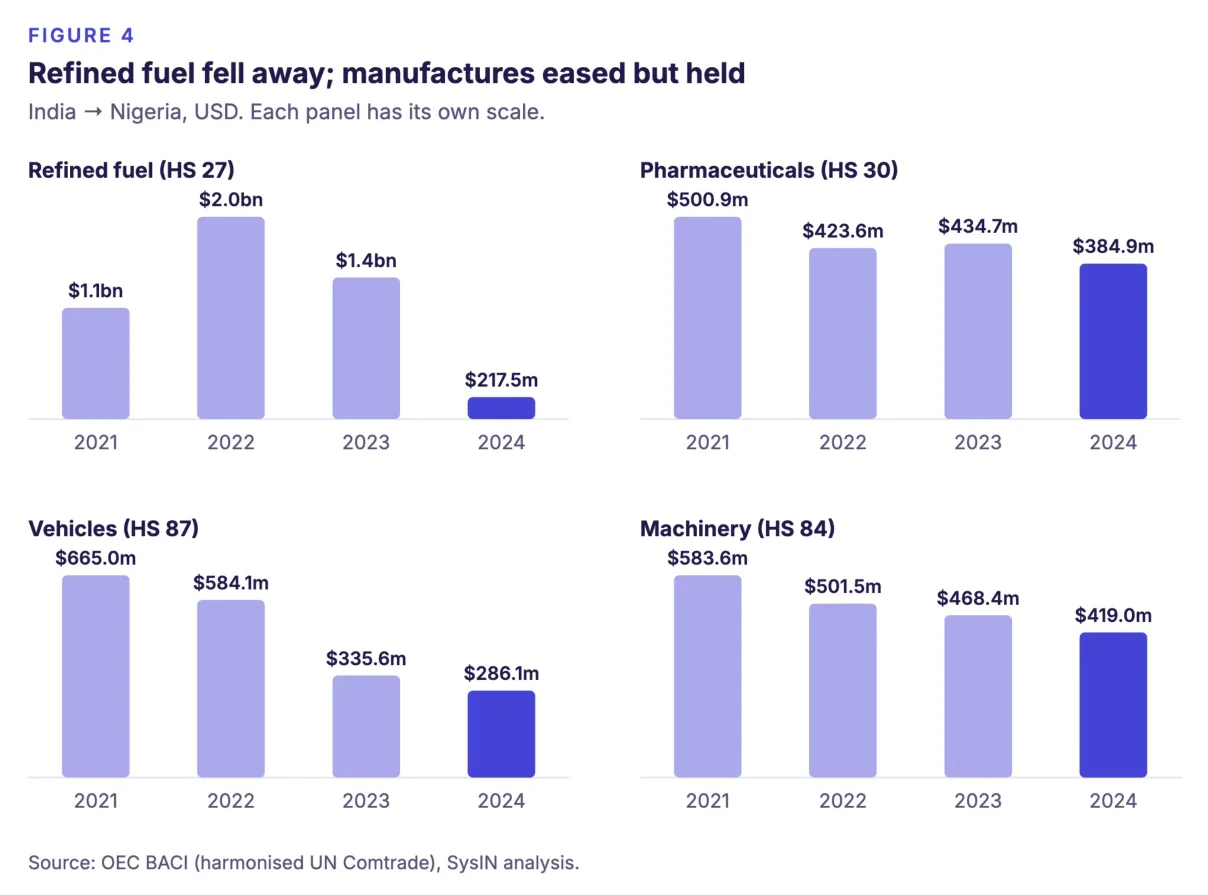
Refined fuel: the unwinding leg Refined fuel from India rose from $1.1bn in 2021 (22.4% of the total) to $2.0bn in 2022 (38.5%), when Nigeria’s subsidised petrol and diesel demand peaked, then fell to $1.4bn in 2023 and $217.5m in 2024, just 8.1% of the total. That is an 89% decline in two years, driven by petrol subsidy removal, a weaker naira and the arrival of large-scale domestic refining. Indian diesel still reached West Africa in volume into early 2026, but direct Nigeria-bound refined-fuel trade has largely unwound.
Refined fuel fell away; manufactures eased but held India → Nigeria, USD. Each panel has its own scale.
Manufactures: sturdier ground Pharmaceutical products (HS 30) held at $384.9m to $500.9m while Nigeria’s total medicine imports fell from $1.5bn to $852m, lifting India’s share of that market from 33.4% to 45.2%. Machinery (HS 84) eased from $583.6m to $419.0m and electrical equipment (HS 85) from $326.0m to $227.9m. Vehicles (HS 87) fell furthest, from $665.0m to $286.1m (−57.0%); the line is dominated by Indian motorcycles and tricycles, a market hit by city-level restrictions and the post-2023 fall in household purchasing power. Organic chemicals, a key input for local drug manufacturing, held at $119.9m to $135.2m. Indian supply is broad: the top 10 covers only 72.5% to 84.6% of imports.
Bilateral relationship assessment
Nature, depth and asymmetries of the relationship.
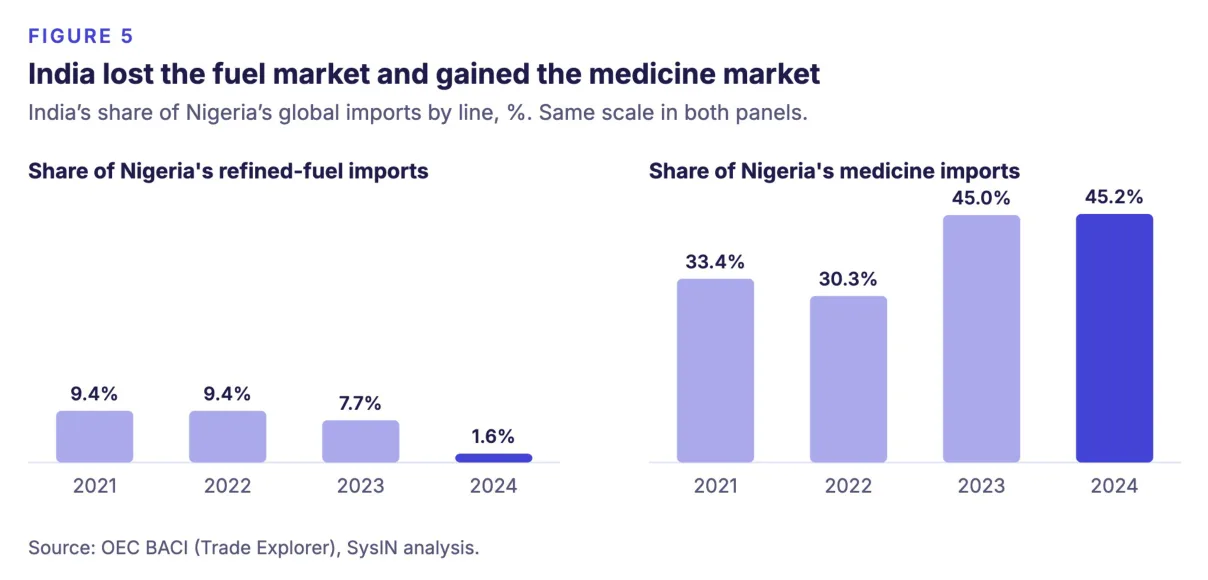
Asymmetry analysis The two sides face different kinds of risk. Nigeria’s exports depend on one decision in Indian refinery procurement offices: whether Nigerian crude is the cheapest acceptable barrel on the day. India’s exports depend on Nigerian household income and hospital budgets. India’s share of Nigeria’s refined-fuel imports shrank from 9.4% to 1.6% as Nigeria’s fuel economics changed, while its share of medicine imports rose from 33.4% to 45.2% because Indian generics are what Nigerian buyers turn to when budgets tighten.
India lost the fuel market and gained the medicine market India’s share of Nigeria’s global imports by line, %. Same scale in both panels.
On Nigeria’s side, the non-oil story is modest but real. Ranked non-fuel exports to India were $113.0m in 2021, $373.2m in 2022, $386.9m in 2023 and $298.8m in 2024. The 2022 figure was inflated by fertilizer; the 2023 and 2024 figures rest on agriculture, which made up about 70% to 80% of non-oil sales in those years.
Trade potential gap Three gaps stand out. The first is contractual: India has asked Nigeria for more crude at head-of-government level, yet Nigerian sales to India remain largely spot-traded through intermediaries. Even a modest government-to-government term arrangement would reduce the volatility that produced the 2023 deficit.
The second is agro-processing. India processes Nigerian cashew and imports oil seeds and ginger raw; Nigeria’s cashew roadmap and extended ban on raw shea exports signal a preference for local processing, and Indian processors and machinery suppliers are natural partners. The third is pharmaceutical localisation. With about $4bn of Indian investment already in Nigerian drug manufacturing and NAFDAC pushing foreign brand owners toward local production, the medicines line could shift from finished products to active ingredients, equipment and co-production.
Trade framework and institutional channels Nigeria and India have no free-trade or preferential agreement and share no regional bloc, so trade runs on WTO most-favoured-nation terms, with Nigeria applying the ECOWAS Common External Tariff as amended by its 2026 Fiscal Policy Measures. The institutional scaffolding is broader than the trade figures suggest: a 1983 Economic Cooperation Agreement being updated alongside a double taxation agreement, a Strategic Partnership from 2007, and a Joint Trade Committee whose April 2024 session called for early conclusion of a local-currency settlement agreement. That agreement is still pending; a rupee-naira channel would matter most for Nigerian importers of medicines and machinery, who now pay in scarce dollars.
India’s High Commissioner, Abhishek Singh, put bilateral trade at about $9bn in India’s 2025-26 fiscal year, up from $7.13bn a year earlier. At the September 2026 BRICS summit, the two sides cited $15bn as the ambition. On this brief’s data, reaching that level would require Nigerian crude sales to India to return to their 2021 to 2022 range, which India’s current energy predicament makes possible.
Structural context
The external and domestic forces shaping the corridor in 2026.
The crude question: India comes back to the Niger Delta India imports most of its crude, and for decades most of it came through the Strait of Hormuz. The US-Israeli war with Iran from late February 2026 broke that model. Russia’s price advantage has also gone: Urals crude, which traded $10 to $13 below Brent through 2025, sold to Indian buyers at a $4 to $5 premium by March 2026. Indian refiners still bought record Russian volumes in July, but they have also sought barrels that avoid Gulf chokepoints, and Nigeria’s light sweet grades suit Indian refineries.
The purchases are real. SEEPCO, a Nigerian independent, shipped about six million barrels to Indian Oil, Bharat Petroleum and Hindustan Petroleum between March and May. Nigeria’s first Cawthorne cargo, 950,000 barrels, reached India’s Sikka port in April, and in August HPCL bought Okwuibome and Utapate cargoes through Glencore, plus further Forcados and Bonga barrels. With Brent around $100 in September, each cargo is worth more than a year ago. The constraint is Nigerian: crude output of about 1.5m bpd in August already matched the OPEC quota, so extra sales to India largely mean diverting barrels from other buyers.
Medicines, motorcycles and machines Indian officials estimate that India supplies around 40% of Nigeria’s pharmaceutical imports, more than 90% in some categories, and that Indian firms have invested roughly $4bn in drug manufacturing inside Nigeria. NAFDAC rules requiring foreign brand owners to plan local production before renewing licences are accelerating that shift. Indian brands also dominate Nigeria’s commercial two- and three-wheeler market, where local assembly is gradually replacing fully built imports. Nigeria’s April 2026 tariff reforms, which cut duties on 127 lines and reduced the total effective tariff on fully built passenger vehicles from 70% to 40%, lower the cost of Indian-sourced vehicles and inputs alike.
The processing push on farm exports Nigeria extended its ban on raw shea nut exports to February 2027. For cashew, its most important farm export to India, it chose a national roadmap, validated in July 2026 and presented in Accra in September, that rules out a raw-nut export ban for now in favour of processing incentives, finance and infrastructure. Cashew export value rose from $219.8m in the first half of 2024 to $398.1m in the first half of 2025. For Indian buyers, the roadmap removes the immediate risk of a supply cut-off but signals that Nigeria will increasingly want to sell kernels rather than raw nuts.
Nigeria: easing cycle, tariff reform and the election clock Real GDP grew 4.43% in the second quarter of 2026, inflation eased to 15.39% in August, the naira has held near ₦1,331/$ with reserves around $55bn, and on 22 September the CBN cut its policy rate by 350 basis points to 23%. These conditions support demand for exactly what India sells Nigeria. The main risk is political: the 16 January 2027 presidential election brings pressure on fiscal policy, FX management and trade regulation, and any reversal of the 2026 tariff reforms or processing-focused export policy would feed directly into this relationship.
Analyst’s assessment
Strategic verdict, outlook and implications for the reader.
Outlook, 2025 to 2027 SysIN’s base case, built from the 2024 product composition and explicit price, volume and growth assumptions, sees Nigerian exports to India dipping to about $5.2bn in 2025, when Brent averaged roughly $69, then rising to about $9.0bn in 2026 as Indian refiners buy more Nigerian crude at higher prices, before easing to about $7.8bn in 2027. Farm exports grow 8% to 15% a year. Indian goods recover gradually, to about $2.9bn, $3.2bn and $3.3bn, led by medicines and machinery, with a temporary rise in refined-fuel imports in 2026. Nigeria’s surplus widens from $3.6bn in 2024 to about $5.8bn in 2026 and $4.4bn in 2027, broadly consistent with the roughly $9bn in two-way trade India reports for its 2025-26 fiscal year.
Upside and downside The upside assumes a term supply arrangement that lifts crude volumes to India 60% above 2024 with Brent near $90, plus strong farm growth under the processing roadmap. Exports would reach about $11.1bn in 2027, total trade would pass $14bn and the surplus would reach about $7.7bn, making the $15bn ambition plausible. The downside combines a Gulf settlement that takes Brent toward $65, a return of discounted Russian or Gulf crude to Indian refineries, stagnant farm exports and a rebound in refined-fuel imports from India. Exports would fall to about $4.1bn and the surplus to about $0.5bn, close to the 2023 break-even.
For the reader’s action
Trade ministries and policy bodies Convert a head-of-government request into a contract. A term crude supply framework with Indian state refiners, ideally paired with Indian participation in Nigerian upstream or midstream investment, would stabilise Nigeria’s largest export line and give India the non-Gulf security it wants. Alongside it, conclude the local-currency settlement agreement, use the cashew roadmap to attract Indian processing investment rather than exporting raw nuts, and structure pharmaceutical engagement around co-production and active-ingredient supply. The 1983 agreement update and pending double taxation treaty are natural vehicles for all three.
Commercial institutions and investors The clearest near-term flow is crude trade finance and logistics for India-bound cargoes while Gulf supply stays disrupted, noting that Nigerian output is capped and Russian pricing can turn quickly. Over a longer horizon, the more durable opportunities sit where India already dominates: local pharmaceutical manufacturing and distribution, two- and three-wheeler assembly, and machinery and spare parts for manufacturing and power, all helped by the 2026 tariff cuts and easing cycle. Cashew processing is the most promising farm play. Price election-season FX and trade-policy risk into any commitment made before February 2027.
References
[1] Nigeria bilateral trade with India, 2021 to 2024 OEC BACI Trade Explorer, dataset
[2] India turns to Nigerian crude as Hormuz closure disrupts Gulf oil supplies Ecofin Agency https://www.ecofinagency.com/news-industry/1509-58914-india-turns-to-nigerian-crude-as-hormuz-closure-disrupts-gulf-oil-supplies
[3] SEEPCO ships six million barrels of Nigerian crude to Indian state refiners Yahoo Finance, ACCESS Newswire https://finance.yahoo.com/energy/articles/seepco-ships-six-million-barrels-154500837.html
[4] India’s HPCL snaps up Nigerian crude to dodge the Hormuz bottleneck OilPrice.com https://oilprice.com/Latest-Energy-News/World-News/Indias-HPCL-Snaps-Up-Nigerian-Crude-To-Dodge-The-Hormuz-Bottleneck.amp.html
[5] Hormuz bottleneck pushes Indian refiners toward West African grades OilPrice.com https://oilprice.com/Latest-Energy-News/World-News/Hormuz-Bottleneck-Pushes-Indian-Refiners-Toward-West-African-Grades.amp.html
[6] HPCL, IOC, MRPL secure West African and Omani crude as Middle East term supplies fail IndexBox https://www.indexbox.io/blog/indian-refiners-turn-to-west-african-crude-amid-middle-east-supply-disruptions/
[7] India pivots to African and Latin American oil after Hormuz disruption Discovery Alert https://discoveryalert.com/india-african-latin-american-oil-hormuz-disruption-2026/
[8] Local refineries’ low diesel production reinforces huge import receipts AllAfrica, January 2026 https://allafrica.com/stories/202601260497.html
[9] Nigeria-India trade hits $9bn as strategic partnership expands across key sectors BusinessDay https://businessday.ng/news/article/nigeria-india-trade-hits-9bn-as-strategic-partnership-axpands-across-key-sectors/
[10] India-Nigeria trade hits $9bn as firms deepen local production Vanguard, August 2026 https://www.vanguardngr.com/2026/08/india-nigeria-trade-hits-9bn-as-firms-deepen-local-production/
[11] India-Nigeria trade hits $9bn as investment, local production expand Africa Interviews https://www.africainterviews.com/india-nigeria-trade-hits-9bn-as-investment-local-production-expand/
[12] Nigeria and India to partner on $15bn bilateral trade Megastar Magazine https://www.megastarmagazine.com/news/nigeria-and-india-to-partner-on-15bn-bilateral-trade/
[13] India-Nigeria bilateral economic and commercial relations High Commission of India, Abuja https://www.hciabuja.gov.in/pages/ODg
[14] Commercial brief High Commission of India, Abuja, March 2025 https://hciabuja.gov.in/public_files/assets/pdf/Commercial_Brief_March_2025.pdf Nigeria & India Trade Brief 2026
[15] 2nd session of India-Nigeria Joint Trade Committee held in Abuja Press Information Bureau, India https://www.pib.gov.in/PressReleaseIframePage.aspx?PRID=2019519
[16] Top 21 pharmaceutical companies in Nigeria (2026) BioNixus https://www.bionixus.com/pharmaceutical-companies-nigeria
[17] Nigeria unveils cashew roadmap, rules out raw nut export ban Tribune Online https://tribuneonlineng.com/nigeria-unveils-cashew-roadmap-rules-out-raw-nut-export-ban/
[18] FG replaces planned cashew export ban with road map as growers eye N635bn market Leadership https://leadership.ng/fg-replaces-planned-cashew-export-ban-with-road-map-as-growers-eye-n635bn-market/
[19] Nigeria extends raw shea nut export ban to strengthen local processing Global Cosmetics News https://www.globalcosmeticsnews.com/nigeria-extends-raw-shea-nut-export-ban-to-strengthen-local-processing/
[20] FG cuts tariffs on cars, palm oil, sugar in new 2026 fiscal policy measures TheCable https://www.thecable.ng/exclusive-fg-cuts-tariffs-on-cars-palm-oil-sugar-in-new-2026-fiscal-policy-measures/
[21] Brent crude oil Trading Economics https://tradingeconomics.com/commodity/brent-crude-oil
[22] Oil prices rise as attacks dent hopes for Strait of Hormuz reopening Al Jazeera, 12 August 2026 https://www.aljazeera.com/economy/2026/8/12/oil-prices-rise-as-attacks-dent-hopes-for-strait-of-hormuz-reopening
[23] 2026 Iran war fuel crisis Wikipedia https://en.wikipedia.org/wiki/2026_Iran_war_fuel_crisis
[24] Nigeria’s crude oil output rises 0.4% in August, NUPRC Vanguard, September 2026 https://www.vanguardngr.com/2026/09/nigerias-crude-oil-output-rises-0-4-in-august-nuprc/
[25] Nigeria’s economy grows 4.43% in Q2 2026, NBS Premium Times https://www.premiumtimesng.com/business/business-news/906587-nigerias-economy-grows-4-43-in-q2-2026-nbs.html
[26] Nigeria inflation rate Trading Economics https://tradingeconomics.com/nigeria/inflation-cpi
[27] CBN cuts interest rate to 23% Blueprint https://blueprint.ng/cbn-cuts-interest-rate-to-23/
[28] Dollar to naira exchange rate today, September 21, 2026 Opinion Nigeria https://www.opinionnigeria.com/dollar-to-naira-exchange-rate-today-september-21-2026/
[29] INEC issues revised timetable for 2027 general election Voice of Nigeria https://von.gov.ng/inec-issues-revised-timetable-for-2027-general-election/
Frequently asked questions
What is the primary driver of trade between Nigeria and India?
The primary driver of trade between Nigeria and India is complementary dependence, with India needing crude that avoids Gulf chokepoints and Nigeria needing affordable medicines, equipment, and transport. Specifically, Nigeria exports crude oil, while India exports medicines, machines, and motorcycles to Nigeria.
How has India's import of refined fuel to Nigeria changed recently?
India's refined fuel exports to Nigeria saw an 89% decline in two years, falling from a peak of $2.0bn in 2022 to $217.5m in 2024. This change was primarily driven by petrol subsidy removal in Nigeria, a weaker naira, and the emergence of large-scale domestic refining in Nigeria.
What is the status of India's share in Nigeria's pharmaceutical imports?
India's share of Nigeria's pharmaceutical imports rose from 33.4% to 45.2% during the 2021-2024 period. Pharmaceutical imports from India held at $384.9m to $500.9m while Nigeria's total medicine market shrank, indicating that Indian generics are a preferred choice as budgets tighten.
What non-oil products does Nigeria export to India?
While crude oil dominates Nigeria's exports to India, a small but growing non-oil basket includes cashew and other nuts (mainly raw cashew), oil seeds, and ginger and spices. Agricultural lines collectively rose from $74.8m to $234.4m.
What factors are currently influencing Indian refiners' interest in Nigerian crude?
Indian refiners are showing increased interest in Nigerian crude since March 2026 due to the US-Israeli war with Iran disrupting Gulf supply routes via the Strait of Hormuz. Additionally, Russia's Urals crude, which previously offered a discount, now trades at a premium, making Nigerian light sweet grades more attractive.